A quarter of Germany's territory is still searching for a site for a nuclear waste repository
Germany's BGE has presented a report identifying possible locations for a final repository for high-level radioactive waste.
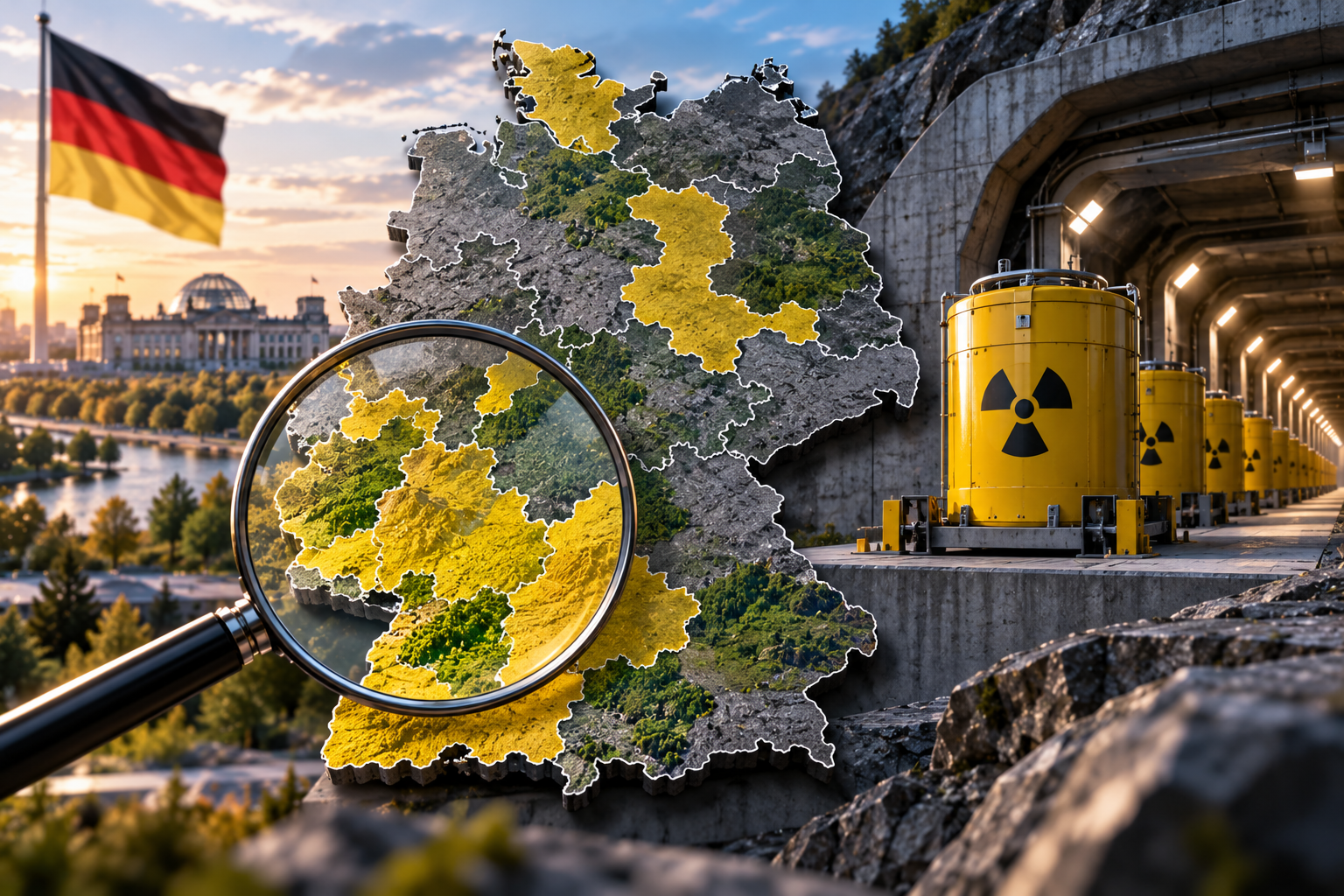
The search has been narrowed to roughly a quarter of the country's territory, but no final decision has been made yet, Euronews reports. Some areas with the best rating may be moved into the "good suitability" category and will drop out of the further search.
The gist in brief
- BGE has been searching for a site since 2017; currently about 25% of Germany's territory is under consideration.
- According to SWR, several districts in the state of Baden-Württemberg are considered especially promising.
- Some areas in category A ("best suitability") may be moved to category B ("good suitability").
- BGE must present its proposal on areas for surface exploration by the end of 2027.
What was presented
The report shows where in Germany highly radioactive waste can be reliably stored deep underground. The site must ensure safety for up to a million years. Currently such waste is held in 16 surface interim storage facilities across the country. Over more than 60 years of nuclear power, about 27,000 m³ of waste has accumulated; the last German nuclear power plants were shut down in 2023.
BGE has narrowed the search to roughly 25% of the territory. For comparison: in 2020, about 54% was still under consideration. According to SWR, several districts in Baden-Württemberg are considered especially promising. Which territories are unsuitable can be shown on BGE's interactive map, but it does not yet cover the whole country.
What was decided and what was not
No final site was selected on Tuesday. BGE representative Sven Petersen said that some areas rated "best suitability" (category A) may be moved to category B, "good suitability." Category B areas are no longer considered; only category A will be selected for the final disposal of highly radioactive waste.
What happens next
BGE plans to present a proposal on areas for surface exploration by the end of 2027. It will then be reviewed by the Federal Office for the Safety of Nuclear Waste Management, public consultations will be held, and the areas will be approved by parliament.
Back in 2025, Environment Minister Carsten Schneider said the search needed to be accelerated:
"We owe it to the people who live in regions with interim storage facilities."
Separately, in Lower Saxony, near Salzgitter, the Konrad repository is being built, but only for low- and intermediate-level waste; its launch is expected in the 2030s. And Switzerland has already approved a deep geological repository near the border with Germany, in the canton of Zurich.
What about waste outside Germany
While Germany is choosing a site, Finland has already received the world's first permit to operate a spent fuel repository. The UK, meanwhile, has returned to Germany the last batch of vitrified high-level waste: seven containers of 100 tonnes each.
The issue is also relevant in Central Asia. Uzbekistan, as we wrote, has radioactive waste storage facilities that will last only about 4-5 years. And Kazakhstan initiated the creation of a CIS Regional Competence Council on radioactive waste management based at the National Nuclear Center in Kurchatov. It plans to bury waste from a future nuclear power plant, about 50 m³ from two reactors, at the former Semipalatinsk test site.
Author's conclusion
The search has been underway for nine years, and the area has been reduced from 54% to 25% of the territory. Yet the site will only be selected after 2027, and the timelines in the plan run until 2050.
Comments ()