Ocean as a uranium reservoir: license issued in the US for commercial uranium extraction from seawater
Austin startup SuperCritical Materials got exclusive US DOE license to commercialize seawater uranium extraction tech from Pacific Northwest National Lab.
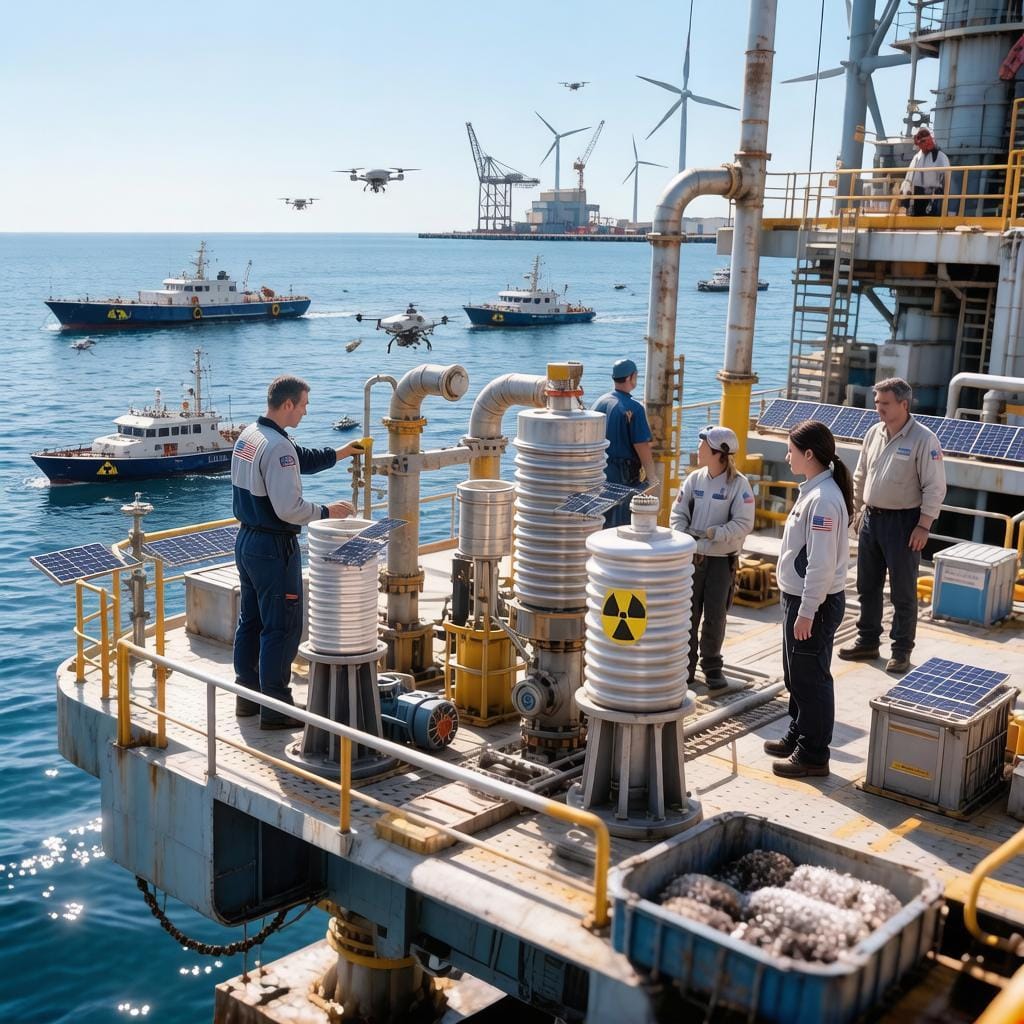
The world's oceans contain about 4.5 billion tons of dissolved uranium — several times more than all proven land-based reserves. As ITC.ua reports, the technology has not yet left the commercialization stage, but the license is the first step towards uranium ceasing to be an exclusively land-based resource. For Kazakhstan, which produces nearly half of the world's uranium, this is a long-term challenge worth monitoring.
The Gist
- The company SuperCritical Materials (Austin, USA) has received an exclusive license from the U.S. Department of Energy to commercialize the technology for extracting uranium from seawater, developed by the Pacific Northwest National Laboratory (PNNL).
- The technology is based on advanced adsorption materials — special absorbers that extract dissolved uranium from water. Uranium extraction from seawater has been demonstrated in scientific experiments but has not been scaled to an industrial level.
- The world's oceans contain about 4.5 billion tons of dissolved uranium — significantly more than all known land-based reserves, which are estimated at approximately 8 million tons.
- The license grants rights for production and industrial implementation in the USA. In the future, the company plans to expand its application to allied countries.
- The main barrier is economic: the cost of extracting uranium from seawater is currently many times higher than the cost of land-based extraction. Commercial viability depends on scaling the technology.
Why Extract Uranium from Water if it Exists on Land
The answer lies in geopolitics, not geology. The USA does not have significant domestic uranium mines and depends on imports — primarily from Kazakhstan, Canada, Australia, and Russia. Amid the rejection of Russian nuclear fuel and the overall drive for energy independence, any alternative source of uranium acquires strategic importance.
The founder of SuperCritical Materials, Alexander Canon Bryan, articulates the company's logic directly: "If the knowledge economy is going to need a lot of reliable nuclear energy, then it's also going to need a lot of reliable nuclear fuel."
Artificial intelligence, data centers, advanced manufacturing — all of this creates rapidly growing demand for electricity, and nuclear power plants are seen as one of the main answers to this demand.
How the Technology Works
Uranium in seawater exists in the form of uranyl carbonate ions at a concentration of about 3.3 parts per billion — vanishingly small compared to ore deposits. The PNNL technology uses special adsorbent materials — polymer fibers or fabrics — that are lowered into the water, accumulate uranium ions, and are then retrieved for processing.
In scientific experiments, the technology has demonstrated fundamental feasibility. The SuperCritical team includes Dr. Gary Hill — a co-founder of the company who studied this process at PNNL for more than two decades. Besides uranium, the technology is potentially applicable for extracting other strategic materials from seawater — lithium, vanadium, and other critically important elements.
The Barrier: Price vs. Price
The fundamental problem is economics. Land-based uranium mining, including the Kazakh method of in-situ leaching, costs on average $30–80 per pound depending on the deposit. According to most researchers, extracting uranium from seawater at the current level of technology costs several hundred dollars per pound — a fundamental gap.
Industry experts acknowledge: the licensing agreement is an important milestone, but the commercial viability of the process will depend on achieving a competitive cost and successfully scaling the technology for industrial application. For now, this is an open question.
The Kazakhstan Context
Kazakhstan produces about 43% of the world's uranium — and it is precisely this position that comes under long-term question if seawater extraction is successfully commercialized. A competitor without geographical limitations, accessible to any coastal country, represents a fundamentally different type of threat for a landlocked monopolist of the uranium market.
An important caveat: real competition is decades away, if it ever materializes. But this is precisely why Kazakhstan should accelerate its movement up the value chain right now: not just selling natural uranium, but participating in enrichment, fuel pellet production, and technological processing — as provided for within the framework of Pax Silica and the NPP negotiations. If seawater extraction ever becomes competitive, Kazakhstan should by then be earning not from ore, but from technology.
Author's Conclusion
The license for extracting uranium from seawater is not tomorrow's market, but the day after tomorrow's. However, it is precisely such developments that change long-term dynamics in strategic resources. Kazakhstan, holding nearly half of the world's uranium production, can afford to watch this technology calmly — as long as it doesn't forget to accelerate the transition from raw material exports to technological ones. Then, seawater uranium will no longer be a threat, but simply one of many sources of raw materials for technologies that the country should own by then.
Comments ()