Oil consumption per capita is record high in Singapore and Curacao
In 2025, Singapore consumed nearly 94 barrels of oil per capita, while Curaçao exceeded 84, according to a per-capita oil consumption ranking by Italian energy company Eni.
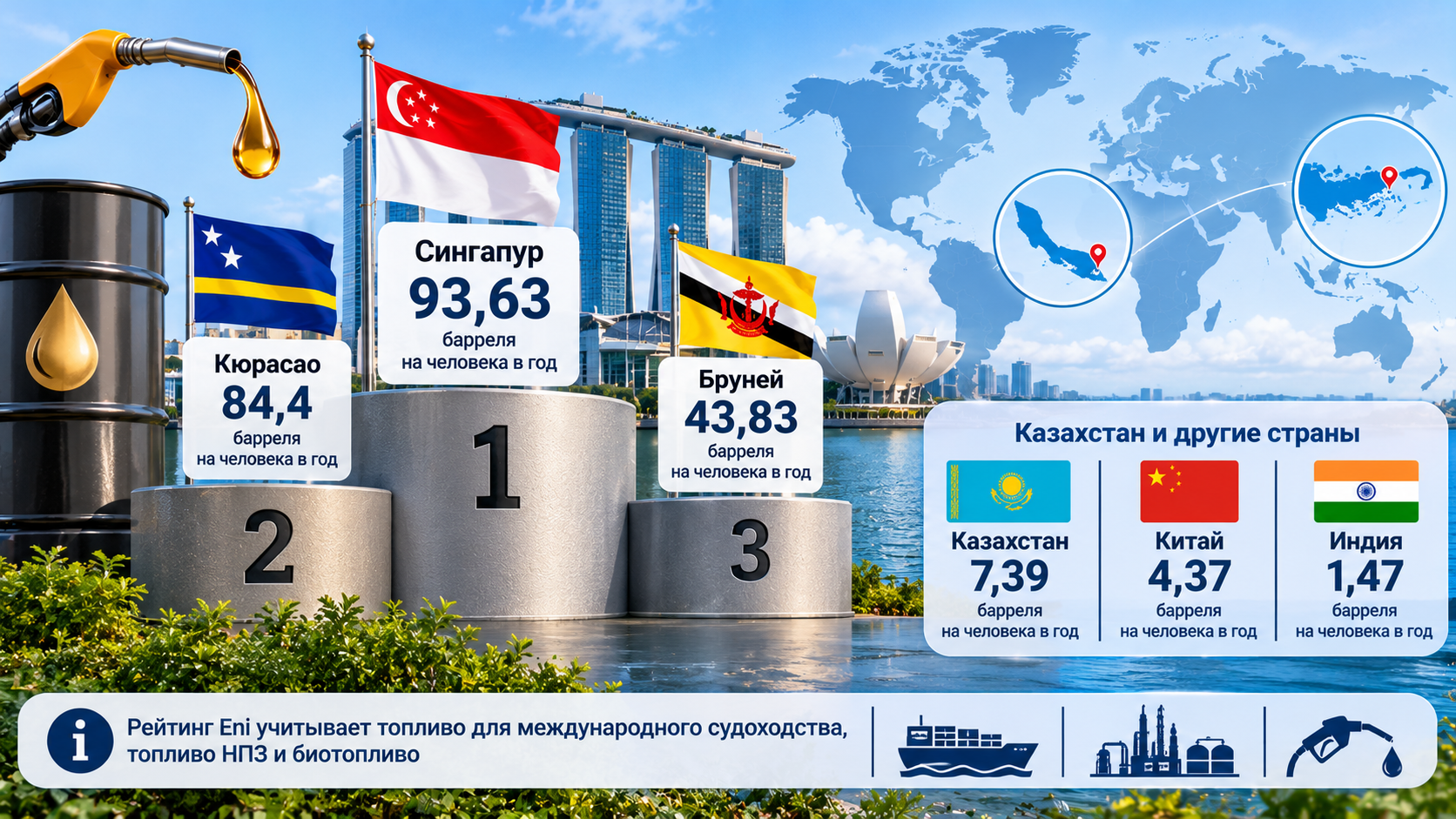
Kazakhstan did not make the top twenty; its figure is around 7 barrels, according to the Eni World Energy Review 2026 report.
The essence in brief
- Singapore leads (93.63 barrels per capita per year), followed by Curaçao (84.4) and Brunei (43.83).
- Six Middle Eastern countries made the top twenty: Qatar, Kuwait, the UAE, Saudi Arabia, Bahrain and Oman.
- The figure includes fuel for international shipping, refinery fuel and biofuels, so it does not equal household consumption.
- Kazakhstan had 7.39 barrels per capita in 2025, China had 4.37, and India had 1.47.
Who is in the top ten
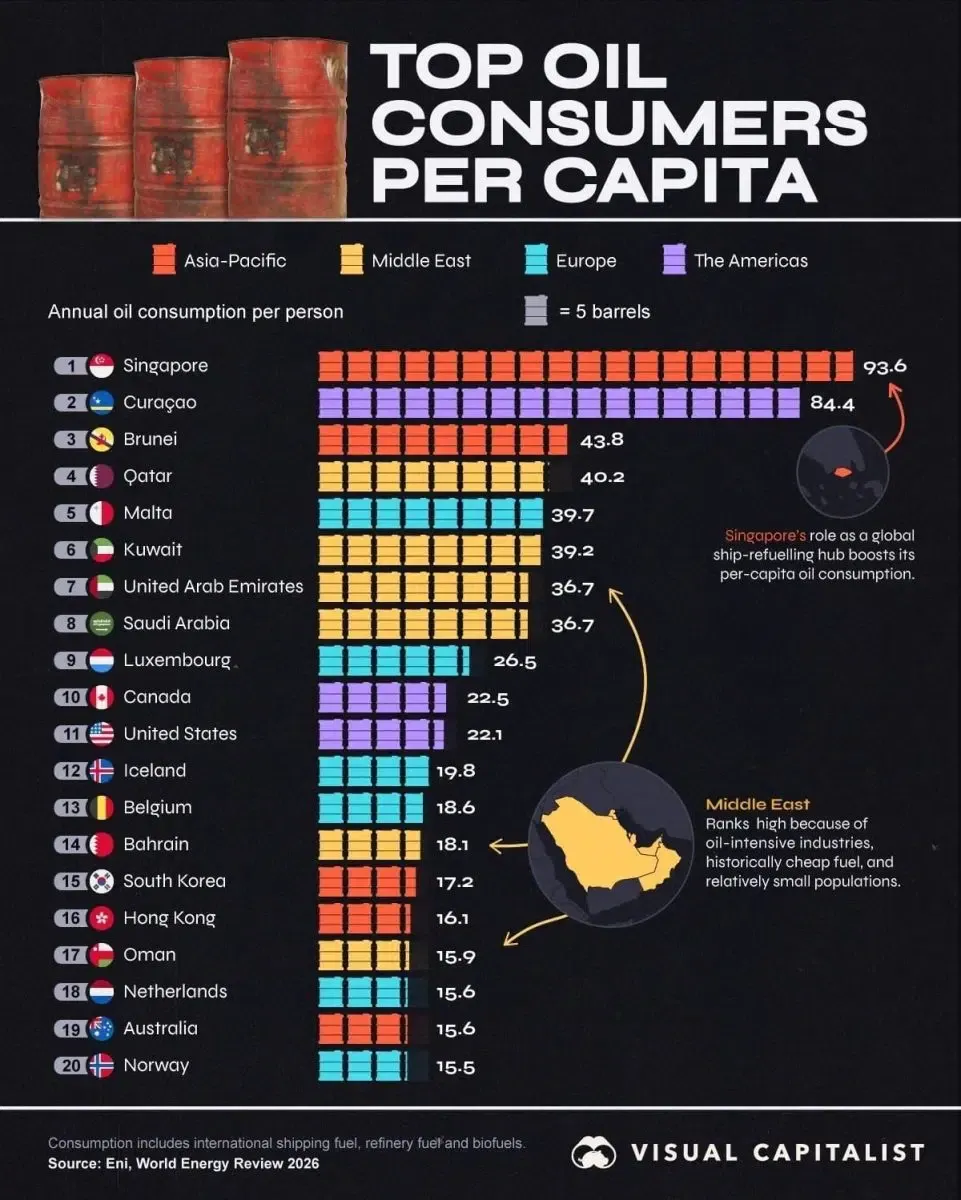
First place goes to Singapore with 93.63 barrels per capita per year. It is followed by Curaçao (84.4) and Brunei (43.83). Next come Qatar (40.19), Malta (39.7), Kuwait (39.23), the UAE (36.74) and Saudi Arabia (36.68). Ninth place is Luxembourg (26.5), and tenth is Canada (22.5).
The US, with 22.1 barrels per capita, is in 11th place. Bahrain, with 18.1, is in 14th place, and Oman, with 15.9, is in 17th. China and India, major oil consumers overall, did not make the per capita ranking.
Why Singapore is ahead
Consumption in Eni's tables includes fuel for international shipping, refinery fuel and biofuels. Therefore the figure is strongly influenced not only by the number of residents and their lifestyle, but also by how much fuel a country sells to ships. The Visual Capitalist infographic, which relies on Eni data, specifically notes that Singapore's role as a global bunkering hub boosts its figure. For Middle Eastern countries, it also cites oil-intensive industries, historically cheap fuel and a small population.
Where Kazakhstan and its neighbors stand in this ranking
Eni's full table also includes countries that did not make the top twenty. Kazakhstan's figure in 2025 was 7.39 barrels per capita; in 2015 it was 6.43. Russia has 8.92, Turkmenistan 6.83, Azerbaijan 4.69, and Uzbekistan 1.45.
For comparison, China had 4.37 barrels per capita in 2025, and India had 1.47.
What is happening with oil in the world and in Kazakhstan
Oil demand is shifting to Asia: countries in the Asia-Pacific region imported 38.2 million barrels per day in 2025, or 50.1% of the global volume. The largest importers are China, India and South Korea.
For Kazakhstan, oil remains the main export item: according to 2025 data, it accounts for 50.5% of export revenue. Domestically, there are plans to increase refining: the Ministry of Energy cited a target of 39 million tons per year versus the current 18 million tons at existing plants.
Author's conclusion
The ranking shows not only how much oil residents consume, but also how much fuel passes through a country, for example for ships. Therefore, Singapore's 93.63 barrels and Kazakhstan's 7.39 cannot be read as a difference in household consumption. For Kazakhstan, this is a reference point: the figure is higher than China's (4.37) and India's (1.47), and much lower than Qatar's (40.19) and Kuwait's (39.23).


Comments ()