Pesticides poison up to 433 million farmers worldwide every year
New research reveals the scale of acute pesticide poisoning among those who grow food for the world—a crisis overshadowed by more visible farming issues.
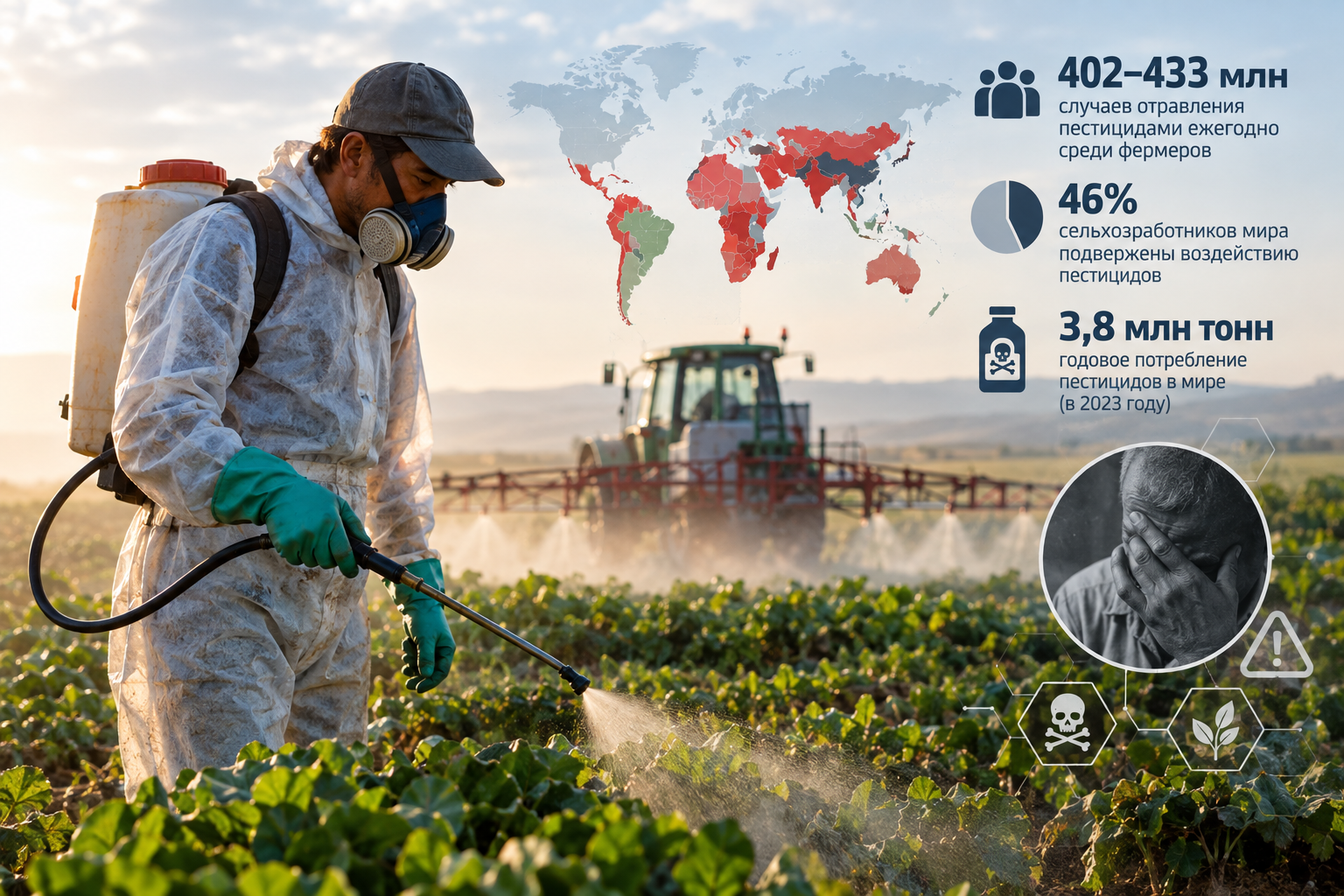
The figures turned out to be so large that they affect nearly half of all agricultural workers on the planet.
The gist in brief
- According to a new study published in the journal Frontiers in Public Health, between 402 and 433 million cases of acute pesticide poisoning are recorded annually among farmers and agricultural workers worldwide.
- With the total number of agricultural workers worldwide at about 934 million, researchers estimate that approximately 46% of farmers are exposed annually.
- Despite two decades of international efforts to reduce harm, global annual pesticide consumption has doubled since 1990 and reached 3.8 million tonnes in 2023.
- Countries in South Asia, Southeast Asia and East Africa suffer the most — Burkina Faso records the highest national rate, with nearly 84% of farmers affected annually.
Europe as an exception to the rule
The director of Pesticide Action Network (PAN) Germany, Susan Haffmans, which commissioned the report, outlined the core of the problem: the people who grow our food are "exposed to hazardous pesticides and fall ill" — and this can no longer be tolerated. Europe is the only major region in the world where pesticide consumption has been declining since 1990 — the authors attribute this to strict regulation. Thanks to these measures, the number of fatalities remains extremely low — from two in Western Europe to 60 in Eastern Europe. However, the burden of non-fatal poisonings remains significant: in Southern Europe the rate reaches 32%, more than 1.5 million cases per year, while in Western and Eastern Europe it is around 6%.
Data gaps hinder understanding of the true scale
A separate issue highlighted by the authors is the quality of the data itself. Statistics for Eastern Europe are particularly limited: the region is represented in the study by practically only Hungary's indicators, suggesting that the true scale of the problem in this part of the continent is not fully tracked. PAN UK's head Sheila Willis explained one of the reasons: underreporting of cases is driven by "limited access to healthcare" and a lack of systems for recording such poisonings. The authors call for more effective monitoring systems and remind of the UN goal to phase out highly hazardous pesticides by 2035. Technological alternatives already exist — we have previously reported that California-based startup TRIC Robotics has deployed autonomous robots on strawberry fields that destroy pests with ultraviolet radiation, reducing chemical pesticide use by 70% without loss of yield — practical proof that reducing the chemical burden on farmers does not necessarily require abandoning effective crop protection.
Regulation is not only a scientific but also a political issue
How acute the question of approving specific pesticides can become is illustrated by a recent French case: France's Minister for Ecological Transition Monique Barbu resigned in protest against a law temporarily authorizing two pesticides harmful to bees — but President Macron did not accept the resignation. The conflict between the agricultural lobby seeking access to effective plant protection products and the environmental and medical arguments against them is not a one-off episode but a systemic contradiction that manifests itself almost everywhere agriculture tries to balance between yield and safety.
Kazakhstani context
Kazakhstan is not mentioned in this study at all — not because the problem does not exist, but, apparently, for the same reason the gap was recorded in Eastern Europe: the absence of systematic data. According to the Union of Organic Agriculture, about 38% of pesticides registered in Kazakhstan contain highly hazardous substances, and the country still does not conduct nationwide epidemiological studies that would allow tracking the link between pesticide exposure and public health, including biomonitoring. As far back as 2023, FAO found that healthcare workers in Kazakhstan, Kyrgyzstan and Tajikistan do not always have the necessary training to respond effectively to pesticide poisonings, and organized a special training session for the Kazakh side involving 60 instructors. Separately, disposal efforts continue in the country — just one stage of the programme covered more than 6,000 tonnes of obsolete, unusable pesticides, which in itself indicates the scale of the legacy accumulated over decades.
Author's conclusion
The gap between 400+ million poisoning cases worldwide and the almost complete absence of Kazakhstani data in such international studies is not a reason for comfort, but rather a signal that the real picture inside the country is simply not being measured at a systemic level. Until a national monitoring system similar to what is already used in Europe exists, Kazakhstan can neither assess the scale of its own problem nor track the effect of measures being taken — whether it is the disposal of obsolete stockpiles or the training of medical workers. Given that 38% of pesticides registered in the country fall into the category of highly hazardous substances, the question is not whether the problem exists, but when Kazakhstan will have its own figures comparable to those that underpinned the international study.



Comments ()