Physicists learned to monitor shut-down reactors via antineutrinos
An international physics team used the Chooz antineutrino detector for the first time not for fundamental research, but to remotely monitor shut-down reactors and spent fuel.
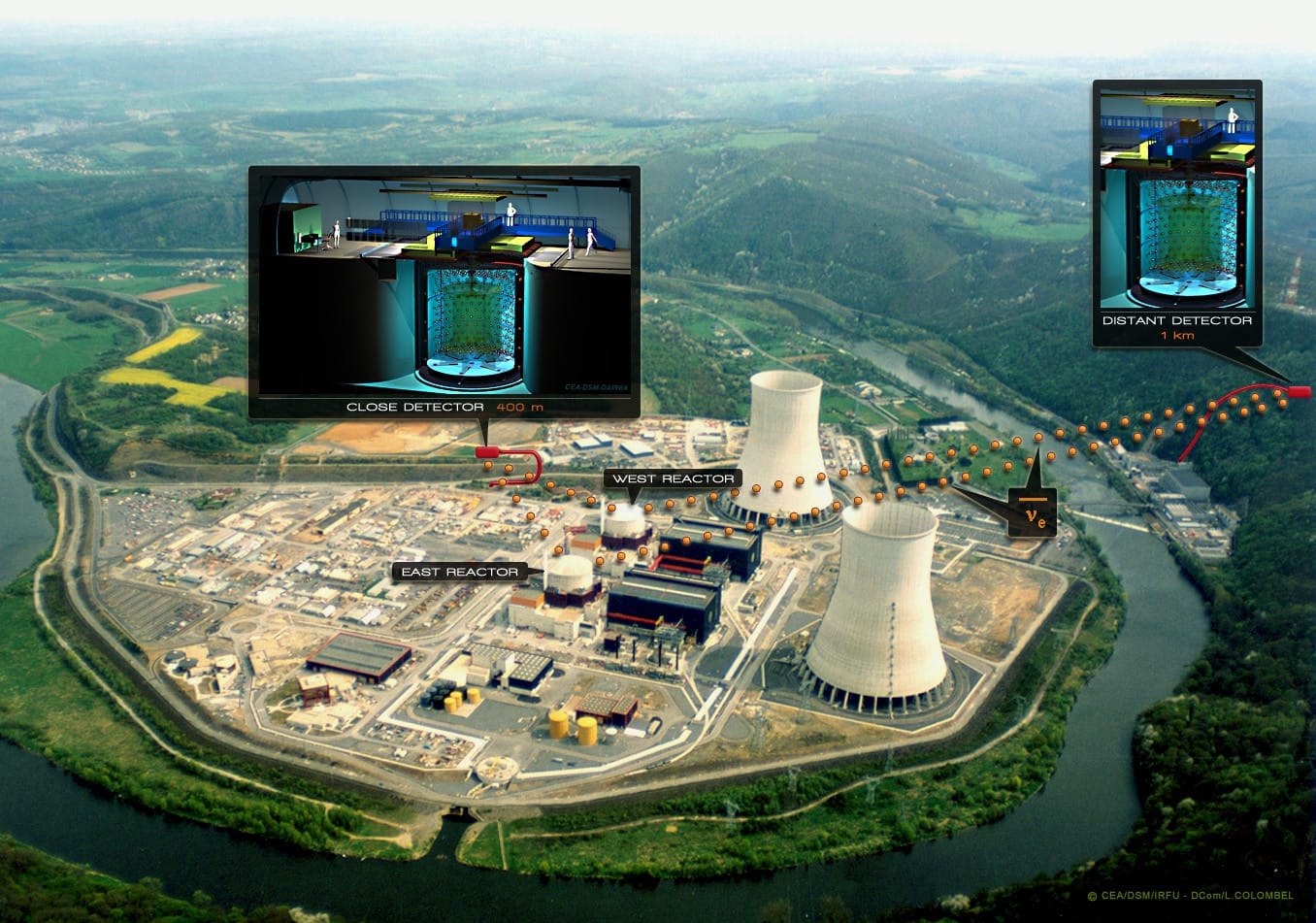
The result is interesting not only for science: it demonstrates a fundamentally new way to check what is happening inside a shut-down reactor without physically opening it.
The gist in brief
- An international team of physicists has for the first time used the Chooz antineutrino detector to observe shut-down nuclear reactors and spent fuel, the press service of the German Institute for Nuclear Physics reported, writes Atomic Energy 2.0.
- Within a week after the reactors were shut down, the detectors picked up about 100 antineutrinos produced by the decay of particles in the spent fuel — data that matched theoretical calculations.
- The method opens up the possibility of remotely verifying whether plutonium or other heavy isotopes have been removed from a shut-down reactor without physical access to the fuel itself.
- The experiment is being conducted at the Double Chooz facility near the Chooz nuclear power plant in France, where physicists, including Russian scientists, have been conducting observations since 2011.
What are antineutrinos and why are they detected underground
Antineutrinos are the antiparticles of neutrinos, among the most elusive particles in the universe: they have almost no mass, carry no electric charge, and can pass through entire planets while almost never interacting with matter. It is precisely this property that makes antineutrinos both an incredibly difficult object to detect and an exceptionally reliable indicator: since the particle almost never interacts with anything, it cannot be shielded, nor can the signal about its source be faked. The Double Chooz detectors were placed deep underground near the French Chooz nuclear power plant back in 2011 — not for safety monitoring, but to study neutrino oscillations, that is, the transformation of one type of neutrino into another, which ultimately helped physicists prove that these particles have non-zero mass. The underground location protects the sensitive equipment from cosmic rays, which would otherwise create background noise drowning out the rare and weak signal from the reactor.
How antineutrinos reveal the composition of nuclear fuel
During reactor operation, nuclear fuel gradually changes its isotopic composition: uranium is consumed, while the share of long-lived decay products grows in a predictable manner. Each of these unstable atoms emits an antineutrino upon decay, and as the fuel burns up, the character of this flux changes — and it changes so regularly that it can be calculated in advance and compared with actual observations. This is the principle behind the physicists' idea: if the actual antineutrino flux from a shut-down reactor diverges from the calculated one, it may mean that part of the fuel — in particular, plutonium suitable for nuclear weapons — has been removed without authorization.
Why this matters for nuclear safety
Before this experiment, all such measurements had been carried out only on operating reactors, where the antineutrino flux is significantly more intense and easier to detect. Research scientist at the Institute for Nuclear Physics Anthony Onion noted that it was precisely the analysis methods developed under Double Chooz and the extremely low background level that made it possible for the first time to identify the barely perceptible signal from an already shut-down reactor and spent fuel. The practical significance of the discovery lies in the prospect of creating a new tool for nuclear safeguards: today, control over spent fuel and shut-down reactors requires physical access by inspectors to the facility, while antineutrino detectors in theory allow part of such control to be carried out remotely and continuously, without the need to obtain inspection permission each time.
Why this matters for Kazakhstan
For a country preparing to build its own first nuclear power plant, such developments are relevant for the long term, even if applying them to a Kazakhstani reactor will not be possible anytime soon. Any nuclear plant sooner or later faces the issue of spent fuel management and obligations on nuclear safeguards to the IAEA — this is precisely what the current standards point to, which the future VVER-1200 reactor at Balkhash must meet. Technologies like antineutrino monitoring do not replace traditional inspections, but they show the direction in which the system of control over nuclear facilities may develop by the time Kazakhstan faces its own practical issues of managing irradiated fuel.
Author's conclusion
The Chooz experiment is a good example of how fundamental physics unexpectedly finds applied use: detectors built to study the properties of elementary particles turn out to be useful a decade and a half later for a completely different task — nuclear safety. So far, the result has been confirmed only for one specific facility and requires further verification at other reactors, but the principle itself — judging the contents of a closed reactor by the nearly elusive particles it emits — could over time change how international inspectors monitor nuclear facilities around the world.



Comments ()