Professional standards and staffing level regulations are being prepared for Kazakhstan's energy sector
Kazakhstan is tackling two energy staffing issues at once: developing its first professional standards for renewables and updating staffing norms for power plants and grids.
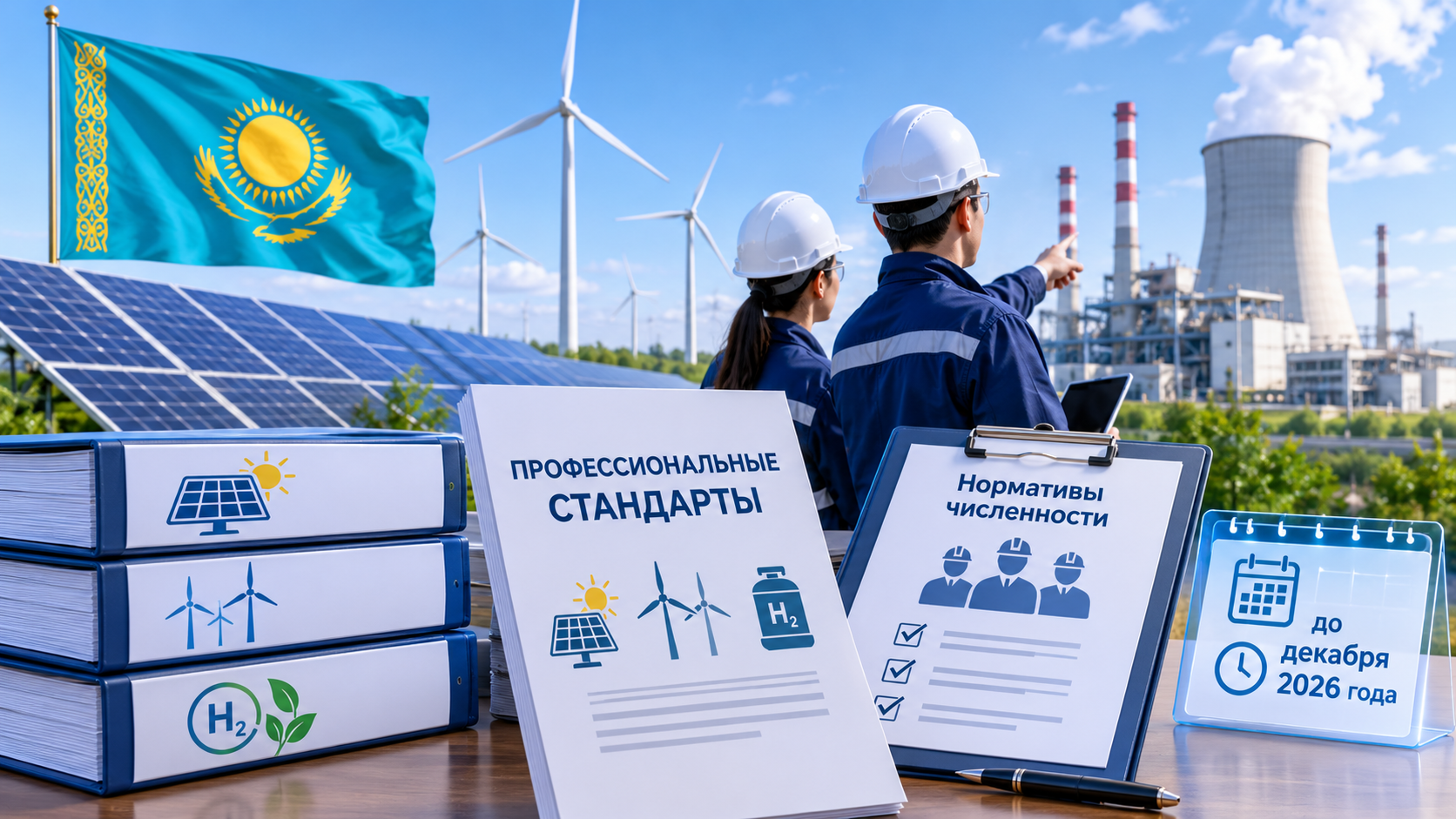
Five draft standards for solar, wind energy and green hydrogen production have been prepared, and a field study on staffing norms will continue until early December 2026, the Ministry of Energy reported.
The gist in brief
- On October 29, 2026, the Industry Council on Qualifications in the Renewable Energy Sector reviewed five draft professional standards.
- Staffing norms for energy enterprises are being updated based on a study at pilot facilities in Astana, Akmola and Karaganda regions and in Ekibastuz.
- The field phase of the study will last until early December 2026, with the update of the norms planned to be completed in February 2027.
- The draft standards will soon be posted for public discussion on the Open Portal of Regulatory Legal Acts.
What was decided on renewable energy standards
A professional standard is a document that describes what a worker in a particular profession must know and be able to do. At the meeting of the Industry Council, the names of professions were determined and five draft standards were prepared. They set requirements for specialists in the design, construction, commissioning, operation and maintenance of solar and wind power plants, as well as for specialists in green hydrogen production.
The work is being carried out on the instructions of Prime Minister Olzhas Bektenov: 100 professional standards with artificial intelligence components and digital competencies need to be developed and approved. The renewable energy drafts reflect requirements for digital monitoring systems, automated control and analysis of production data. Meeting participants also reviewed the plan for developing the qualifications and skills system in the renewable energy sector for 2027-2029.
How staffing levels will be recalculated
In parallel, the Kazakhstan Electricity Association (KEA), together with the ministries of energy, national economy, and labor and social protection of the population, is updating staffing norms in the energy sector. The study is being conducted by the Republican Scientific Research Institute for Labor Protection, and it should show how many specialists are needed to service equipment, carry out repairs and ensure reliable operation of infrastructure.
Since October 20, institute specialists have been conducting time-and-motion observations at CHPP-2 (combined heat and power plant) of Astana-Energia JSC: they record the duration of production operations, study workers' functions, conduct workday photography and survey employees. The analysis covers work at control panels and directly at equipment.
What will be taken into account and where checks are being carried out
When developing the norms, the scale of the enterprise, equipment composition, fuel type, level of automation, and the length and density of electrical and heating networks are taken into account. This, as noted in the statement, will help avoid a formal approach. The pilot facilities are: CHPP-1, CHPP-2 and district boiler houses of Astana-Energia, Karaganda CHPP-1 and CHPP-3, Stepnogorsk CHPP and Ekibastuz GRES-1 (state district power plant). Astana-REC, Akmola Distribution Electric Grid Company and Karagandy Zharyk are also participating in the study.
KEA Chairman Talgat Temirkhanov linked the study to the president's instructions: in the Address, 2027 was declared the Year of Construction, so the need for personnel, according to him, will grow.
"It is important to ensure not only the commissioning of facilities, but also their subsequent reliable maintenance," he emphasized.
What is happening with renewable energy in Kazakhstan
The sector itself is developing. In 2026, the country commissioned 7 of the 10 planned renewable energy facilities with a total capacity of 212 MW, 24 investment agreements for 3.8 GW are being implemented, and by 2035 renewable capacity is to be brought to more than 8 GW. The Development Bank of Kazakhstan approved about KZT 54.5 billion for the first phase of a 1 GW project: two solar plants of 60 MW and 185 MW. In Kyzylorda, construction has begun on the region's first solar plant with an energy storage system. At the same time, fossil fuels account for about 85% of the country's electricity, while wind and solar together account for about 6%, according to 2025 data from the Ember analytical center.
How personnel are being prepared for the first NPP
A separate staffing issue is the first nuclear power plant. In July, in response to a Kazinform request, the Atomic Energy Agency reported that construction would require 10-15 thousand people, commissioning 2-4 thousand, and after launch the plant would provide 1,800 permanent jobs. Over 25 years, universities have trained about 4,500 nuclear specialists, and another 1,332 people are studying. Practical training of personnel, according to the agency, is included in the EPC contract (engineering, procurement and construction agreement) and is paid for by the contractor. A comprehensive personnel training plan for 2027-2031 was being developed at that time.
Author's conclusion
Two decisions look at the same problem from different sides: standards for professions are being created for new areas of energy, while for existing plants it is being clarified how many people they need. Together they show that the personnel issue in energy is moving from talk to measurement: observations at CHPPs, interviews with employees, deadlines until February 2027. But the main thing is still missing: neither the ministry nor the KEA has said how many specialists are lacking today and how many will be needed when renewable capacity grows to 8 GW. As long as this figure is absent, the norms and standards will address the issue of training quality, but not the issue of quantity.
Comments ()