World's largest liquid air energy storage facility connected to grid in China
A 60 MW liquid air energy storage facility has been connected to the grid in the Chinese city of Golmud.
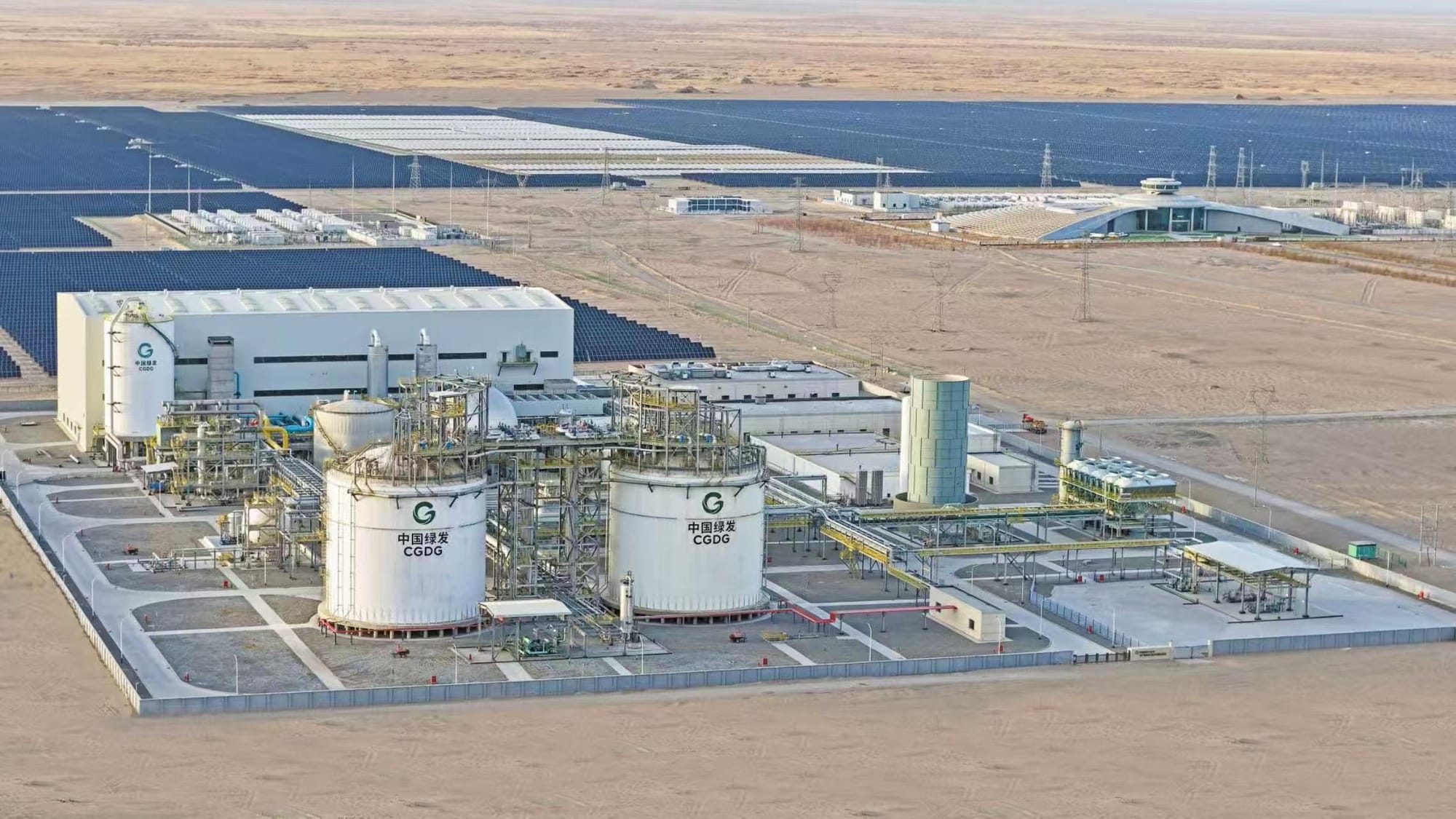
The installation is being called the largest in the world among such systems. The connection was reported by the Chinese newspaper Science and Technology Daily .
The gist in brief
- The national demonstration project in Golmud (Qinghai Province) has been connected to the grid; the unit's rated capacity is 63 MW, maximum 66 MW.
- The installation stores energy in the form of air cooled to minus 194 °C and generates about 180 million kWh per year.
- The equipment is entirely Chinese, with a localization level of 100%.
- The efficiency of the full storage cycle is not stated in the reports: the figure of 91.3% refers only to the generator units.
How the storage facility works
During low-load hours, surplus electricity is used to compress and cool air to minus 194 °C, until it turns into liquid. The liquid air is stored in tanks. At peak consumption it is heated, evaporates, expands more than 750 times and spins the turbines.
Proponents of the technology note that it does not require special terrain, unlike pumped-storage power stations, and compared with batteries they cite its scalability, storage duration and equipment service life.
What is known about the project
The project is called Super Air Power Bank. It was built by China Green Development Investment Group (CGDI) together with the Technical Institute of Physics and Chemistry of the Chinese Academy of Sciences. Construction began on July 1, 2023.
According to ESS News, the design capacity is 600 MWh, and the installation can operate continuously for about 10 hours. Annual generation is estimated at 180 million kWh, enough for approximately 30 thousand households. A 250 MW solar power plant is planned nearby to power the charging.
The Science and Technology Daily newspaper also cites other parameters: the unit's rated capacity is 63 MW, maximum 66 MW. All key data come from the developer and Chinese state media; there are no independent assessments yet.
Why the launch was already reported at the end of 2025
Headlines about the launch of the installation appeared as early as December 2025, but at that time it was about the completion of installation and commissioning. Thus, ESS News wrote on December 30, 2025 that the equipment had been installed and testing was underway, while the South China Morning Post, citing Science and Technology Daily of December 23, called the facility "almost ready." Grid connection was not confirmed in the reports of those months.
Chinese media announced that the project had been successfully connected to the grid only on October 30, 2026, and in the following days repeated this news, in particular Global Times and the regional portal of People's Daily in Qinghai.
What is not yet known
The reports do not include full-cycle efficiency: how much energy is returned from the storage compared with how much was spent on it. The figure of 91.3% in the newspaper's material is described as the design efficiency of the four-stage expansion generator units, that is, it describes only the generation stage, not the system as a whole. The cost of the project is also not stated.
What other long-duration storage technologies are being developed
Liquid air is not the only way to store energy for more than a few hours. In the Netherlands, the energy company Budget Thuis and the startup Ore Energy are building a system based on iron-air batteries with a total capacity of 1 GWh: the first phase of 400 MWh is due to come online in 2028. Such batteries are designed to deliver energy for up to 100 hours, whereas most lithium-ion systems operate for 2-4 hours.
What is happening with energy storage in Central Asia
In Kyzylorda, on October 21, construction began on the region's first solar station with storage. The investor is Orda Power LLP; in the future the station's capacity is planned to be increased to 50 MW. The storage will allow part of the daytime generation to be saved and fed into the grid when the panels are not working, but its capacity, cost and launch date are not stated in the reports.
Kazakhstan is preparing a separate law on energy storage systems: this was announced at a business summit in September by the director of the RES department of the Ministry of Energy, Turar Alimzhan. A large-scale storage facility is already part of the 1 GW wind park with Masdar being built in Zhambyl Region: the storage system's capacity is 300 MW, with an energy capacity of 600 MWh.
Uzbekistan plans to place energy storage systems in all regions. According to Minister of Energy Sherzod Khodjayev, storage facilities already cover 13% of the evening consumption peak, and a 175 MW system in Zangiata District has been connected to the grid.
Author's conclusion
The news is important for its scale: a 60 MW installation with a stated 10 hours of operation shows that this storage method is being brought to industrial size. This is an answer to the question of how to smooth out fluctuations in solar and wind generation where there are no rivers for pumped-storage stations. But it is too early to compare it with batteries or pumped storage. Without full-cycle efficiency and cost, it remains unclear whether such a system would pay off outside a demonstration project with state support.
Comments ()