Radioactive contamination at the Semipalatinsk test site remained local, scientists believe
Modern radioactive contamination at the Semipalatinsk Test Site is mostly localized, according to scientists at Kazakhstan's National Nuclear Center.
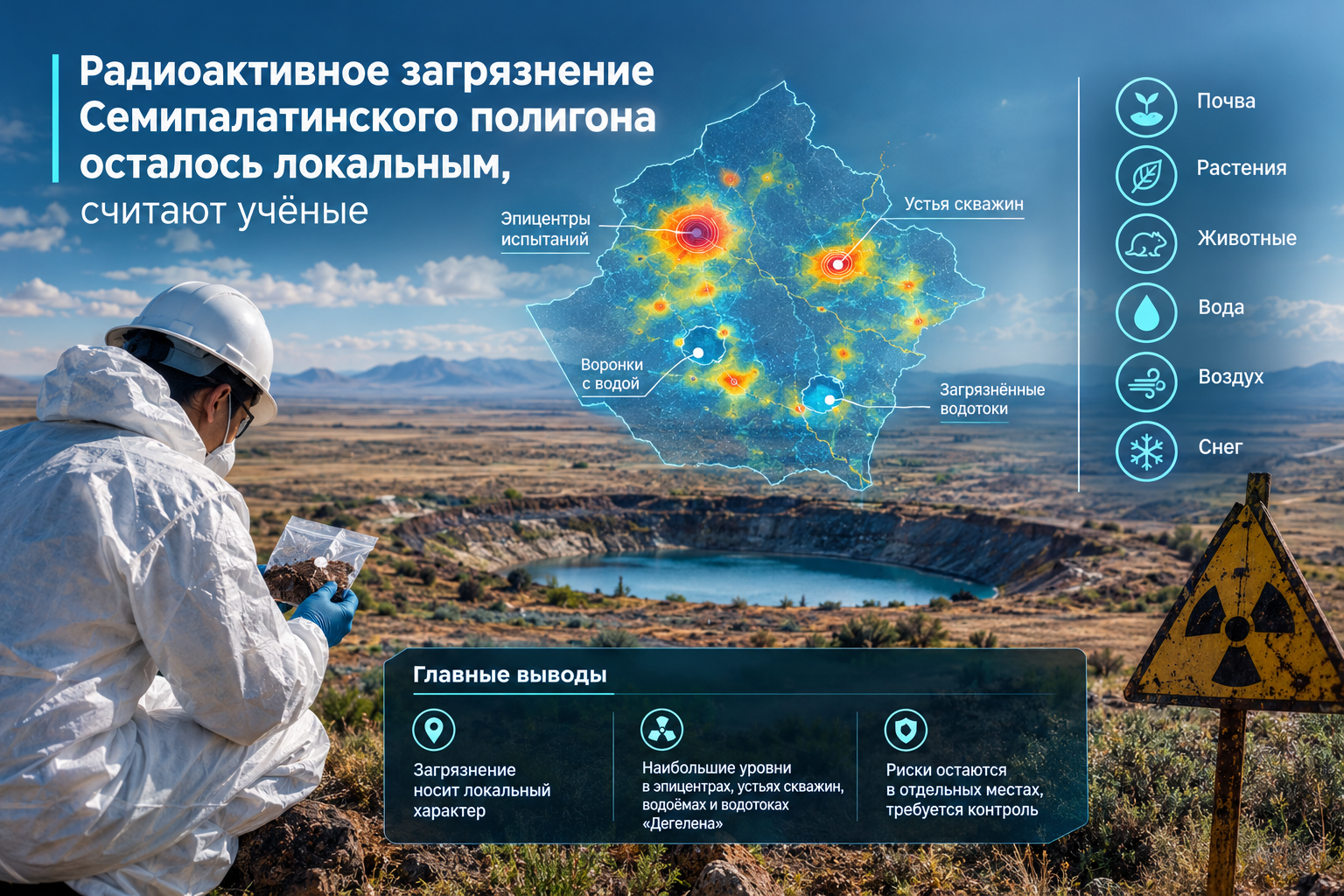
The review was published in the "Bulletin of the NNC RK"; it compiles data on soil, plants, animals, water, air and snow. The main hotspots are the epicenters of surface tests, radioactive traces, wellheads, water-filled craters and contaminated watercourses.
The essence in brief
- Contamination is uneven: the highest levels are confined to the epicenters of surface tests, wellheads, water-filled craters and watercourses of the "Degelen" site.
- In the upper 5 cm of soil on the traces of the 1951 and 1953 tests and on "background" plots, between 83% and 93% of cesium-137 and plutonium is retained. Strontium-90 is more mobile: in this layer, from 38% to 73%.
- Tritium in the Shagan River ranges from values below the detection limit to 320,000 Bq/kg, with the maximum at 5 km from "Atomic" Lake, and about 90 Bq/kg at the mouth.
- Plants accumulate strontium-90 most intensively.
What was studied
The work is titled "35 Years after the Closure of the Semipalatinsk Test Site: Radioactive Contamination and Patterns of Radionuclide Behavior in the Main Components of the Environment." It was written by NNC scientists, with E. G. Batyrbekov and A. O. Aidarkhanov listed first among the authors. It is a review of previously published data. Radionuclides are radioactive isotopes left over after the tests. The authors examined five of them: tritium (radioactive hydrogen), strontium-90, cesium-137, americium-241 and plutonium-239+240. Activity is measured in becquerels per kilogram (Bq/kg): one becquerel is one decay per second.
Soil
The soil data are based on 169 sampling points: depth up to 30 cm, step of 5 cm, 1,014 samples in total. Cesium-137, americium-241 and plutonium are mainly retained in the upper horizons and are bound to the solid part of the soil. Strontium-90 penetrates to depth better than all the others: in terms of mobility along the profile, it is ahead of cesium-137, plutonium and americium.
Tritium in the soil is concentrated near the explosion epicenters. At technical site P-1 of the "Experimental Field," its activity in the surface layer reached 185,000 Bq/kg.
Plants and animals
The accumulation of radionuclides by plants depends heavily on the territory: minimal at the "Experimental Field," maximal in the zones of radioactive watercourses and test locations. Strontium-90 leads: its accumulation coefficient is on average 8 times higher than that of cesium-137. For example, in the "Telkem" craters, wormwood accumulates the most radionuclides. Tritium in the water of plants near the Shagan River reaches about 200,000 Bq/kg.
In rodents and lizards, the average levels of cesium-137 and strontium-90 are low, but in individual specimens at local sites, strontium-90 reached high values. The expected concentrations of cesium-137 and strontium-90 in livestock meat under conservative scenarios do not exceed sanitary norms. Fish with the highest content of technogenic radionuclides were found in the crater of well No. 101 ("Sary-Uzen"); in "Atomic" Lake, the river and Lake Shagan, no significant values were found. The review contains no data on birds.
Water, air and snow
The most radionuclides are found in technogenic water bodies, bottom sediments and watercourses of "Degelen." Strontium-90 in the water of technogenic water bodies reaches 400 Bq/kg, with maxima in the craters of the "Experimental Field," "Telkem-2" and well No. 101. Tritium in the watercourses of "Degelen" at the outlet of the adits exceeds the intervention level (7,600 Bq/kg) by about an order of magnitude. Natural lakes are generally cleaner, with the exception of Lake Kishkensor, where strontium-90 is about 17 Bq/kg: the authors attribute this to the inflow of groundwater from the "Balapan" site.
Tritium enters the air from contaminated waters and soil moisture, as well as with dust. At "Degelen," its concentration at the outlet of the adits reaches 1,400 Bq/m³. Plutonium aerosols are maximal at the "Experimental Field" and near the well at "Sary-Uzen": about 1.6·10⁻² Bq/m³, which is approximately 6 times higher than the permissible volumetric activity for the population. At a distance of 400 m from the source, its levels no longer exceed it.
In snow at "Degelen," tritium reaches 40,000 Bq/kg, with a background at the test site of 4.6-12 Bq/kg.
Background on the test site
The last nuclear explosion at the test site took place on October 19, 1989, and it was closed on August 29, 1991. Tests were conducted starting in 1949: according to official data, there were 456 of them, and in total at least 616 nuclear and thermonuclear devices were detonated, Kazinform recalls.
What this means for Kazakhstan
The conclusion about the focal nature of contamination is consistent with how the territory of the test site is divided. At the end of August, Kazakhstan completed the marking of the boundaries of the Semipalatinsk Nuclear Safety Zone: more than 18,000 km² were surveyed, of which about 8,300 km² retain radiation risks and require a special regime, while about 10,000 km² were recognized as safe and can gradually return to economic use. Deputy Chairman of the Atomic Energy Agency Gumar Sergazin noted that dangerous areas "must remain under reliable state control."
Author's conclusion
The review shows that 35 years after the closure of the test site, radiation risks are concentrated in individual locations, but in these locations they remain high: in water, air and snow there are values that exceed the standards. Therefore, the conclusion about the local nature of contamination does not remove the need for monitoring. Which areas and when will be returned to economic use depends on further research and decisions by the state.

Comments ()