Reclamation of uranium tailings in Kyrgyzstan completed six months ahead of schedule
Rosatom and Kyrgyzstan's Emergencies Ministry completed ahead of schedule the rehabilitation of mountain dumps at former uranium mines in Too-Moyun and Kyzyl-Zhar.
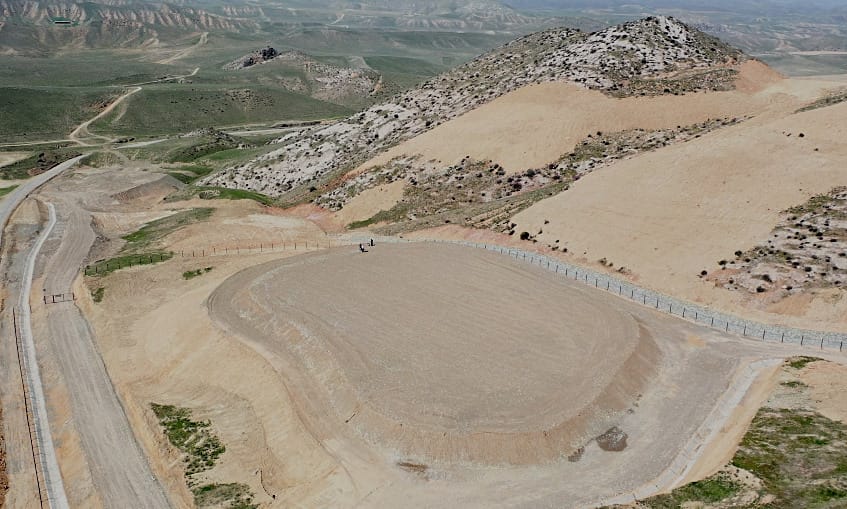
The work took 11 months instead of the planned 18. This is part of the Russian-Kyrgyz agreement running through 2030, writes Atomic Energy 2.0.
The gist in brief
- The rehabilitation of tailings dumps in Too-Moyun (Osh region) and Kyzyl-Zhar (Jalal-Abad region) was completed in 11 months against a plan of 18.
- More than 100,000 cubic meters of rock were moved, mines and adits were sealed, and hydraulic engineering structures were built.
- For the entire current phase, the Russian side has allocated more than 2 billion rubles.
- Kazakhstan has completed the marking of the boundaries of the Semipalatinsk Nuclear Safety Zone, and Uzbekistan's radioactive waste storage capacity will last approximately 5 years.
What was done
The Rosatom State Corporation and the Ministry of Emergency Situations of Kyrgyzstan received state acts on commissioning the facilities. For the mining tailings, containment sites were created with an impermeable liner, that is, a layer that prevents radioactive substances from seeping into the soil. The territories were brought to a radiation-safe condition. The work was carried out by JSC "Experimental and Demonstration Center for Decommissioning of Uranium-Graphite Nuclear Reactors," part of Rosatom's "Environmental Solutions" division.
The Too-Moyun mine was developed from 1922 to 1954, and the facility in Kyzyl-Zhar, previously known as Maili-Suu-12, from 1946 to 1967. After closure, radioactive tailings and unsealed workings remained there.
What's next
The current phase is proceeding under the cooperation agreement signed by the governments of Russia and Kyrgyzstan on March 26, 2024. It provides for the rehabilitation of three mining tailings dumps in the south of the republic and facilities on mine territories, with a deadline through 2030. Rosatom Deputy Director General Andrey Nikipelov stated that "environmental problems know no borders, so they must be solved together." Minister of Emergency Situations Kanatbek Chynybayev promised to continue joint work.
Before this, Russia had been helping Kyrgyzstan for more than ten years under an interstate program for the reclamation of territories affected by uranium mining. It operated from 2012, and over nine years, five facilities in Min-Kush and Kadji-Sai were brought to a safe condition: more than 27 hectares were reclaimed, and more than 1.4 million cubic meters of tailings material were transported. The results of the program were summarized in Bishkek in May 2026.
What this means for Kazakhstan
The radiation legacy remains a common problem for the region, and Kazakhstan is participating in addressing it. In July, it headed the CIS Regional Council of Competencies on radioactive waste management, created on the basis of the National Nuclear Center in Kurchatov: its participants include, in particular, Kyrgyzstan and Uzbekistan, and its goal is to harmonize common approaches and assist with the rehabilitation of uranium legacy sites.
In neighboring Uzbekistan, as hunn.kz wrote, radioactive waste storage capacity will last approximately 5 years: of 10 storage facilities, 4 are already full, and the first comprehensive law on handling such waste has only passed its first reading.
At the end of August, Kazakhstan completed the marking of the boundaries of the Semipalatinsk Nuclear Safety Zone. Of the more than 18,000 sq. km of surveyed territory, about 8,300 sq. km retain radiation risks, while around 10,000 sq. km have been recognized as safe. Uranium sites in the country were reclaimed earlier: according to Zakon.kz data for 2019, three tailings dumps and 13 mines were brought into order by 2010, costing approximately 4 billion tenge. According to a Ministry of Energy employee, inspections of such territories after reclamation are not always carried out due to a lack of funds.
Author's conclusion
The early completion of the work shows that uranium legacy projects in Kyrgyzstan are proceeding faster than planned. But the main question is who will monitor the territories after the contractor leaves. For Kazakhstan, this is a reminder that after reclamation, regular monitoring of former uranium sites is needed.
Comments ()