Romania blasts rocks on the Danube riverbed to save a nuclear power plant
Romania's Defense Ministry launched a military operation on the Danube's bed: over 100 troops and 16 units conduct blasting to alter the river's course.
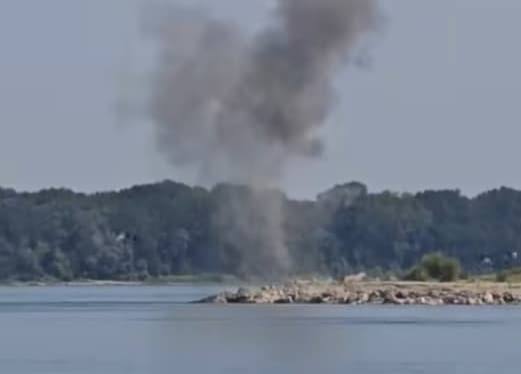
The goal is to redirect the water flow to the Cernavodă Nuclear Power Plant, which was shut down on July 28 due to historically low water levels, European Pravda reports. The rock turned out to be harder than expected: the first explosions yielded no results. Romania's National Agency for Water Resources warned that the operation is extremely complex and may not succeed. For Kazakhstan, which has just signed an agreement to build a nuclear power plant near Lake Balkhash, what is happening in Romania is a clear lesson in what underestimating the water factor can lead to.
The gist in brief
- Romania's Ministry of Defense has begun blasting operations to alter the course of the Danube to ensure the operation of the Cernavodă NPP. The operation involves more than 100 military personnel and 16 pieces of equipment.
- The task is to divert part of the flow from the Bala branch to the Old Danube branch to ensure the necessary water supply for cooling the reactor.
- The first explosions yielded no results: the bedrock turned out to be harder than expected. Navy divers analyzed the situation — on Monday, the operation was resumed with higher-yield charges.
- Romania's National Agency for Water Resources warned that the operation is extremely complex and there is a risk it may not produce results.
- Romania's Foreign Minister discussed with her Ukrainian counterpart the possibility of emergency electricity supplies from Ukraine — in case the NPP cannot be restored to operation.
From reactor shutdown to military blasting operations
We previously reported that on July 28, 2026, Romania was forced to shut down the first power unit of the Cernavodă NPP: the Danube's level dropped to a 30-year low, and there was no longer enough water to cool the reactor. At the time, it seemed to be a temporary pause — one just needed to wait for the water to return.
But the water did not return. And Romania took the next step, which just a few weeks ago would have seemed incredible: the Ministry of Defense sent combat divers and sappers to the Danube with the task of literally blasting the rocks on the riverbed to change the direction of the current.
An operation that may not work
Deputy Commander of the Romanian Naval Forces, Rear Admiral Marcel Neculae, admitted that the first two explosions did not produce the expected effect. The bedrock turned out to be significantly harder than preliminary calculations had indicated. Divers surveyed the riverbed after the explosions — and a decision was made to continue with charges of increasing power.
Romania's National Agency for Water Resources does not hide the risks: the operation is described as "extremely complex," with an acknowledgment that it may not yield results. This is an honest but alarming statement: a country with an operating nuclear power plant has found itself in a situation where the only option to restore its operation is military blasting operations in the river.
Parallel plan: electricity from Ukraine
In parallel, Romania has begun negotiations on a fallback option. Foreign Minister Oana Țoiu discussed with her Ukrainian counterpart Andrii Sybiha the possibility of electricity supplies from Ukraine — taking into account production capacities and maintenance schedules. This means: Romania is seriously considering a scenario in which the Cernavodă NPP cannot be restarted in the near future and is already looking for a replacement for the lost capacity.
The Kazakh context
Just last week, Kazakhstan signed intergovernmental agreements with Russia to build two VVER-1200 reactors near Lake Balkhash. Construction is planned to begin in 2027, with the first unit expected to come online in 2034.
Balkhash is an endorheic lake with an already recorded decline in water levels. Experts have repeatedly pointed to this problem. The Romanian scenario turns abstract warnings into a concrete precedent: a nuclear power plant built without accounting for the long-term water dynamics of the water body may face a choice — shut down the reactor or blast rocks in the river.
The difference between Balkhash and the Danube is that the Danube is a flowing river that could theoretically recover its level if precipitation returns. Balkhash is an endorheic body of water whose level depends on the balance between inflow and evaporation. With increasing heat and shrinking glacial feeding of the rivers that flow into the lake, this balance could shift irreversibly.
Author's conclusion
Romania is blasting the bottom of the Danube to save a nuclear power plant from thirst — and this is not a metaphor but an operational summary from August 2, 2026. What seemed like a climate scenario for the distant future has become an engineering emergency right now. For Kazakhstan, this is not someone else's story: building a nuclear power plant near Lake Balkhash requires answers to water-related questions before the foundation is laid — not at the moment when one has to choose between shutting down the reactor and military blasting operations.

Comments ()