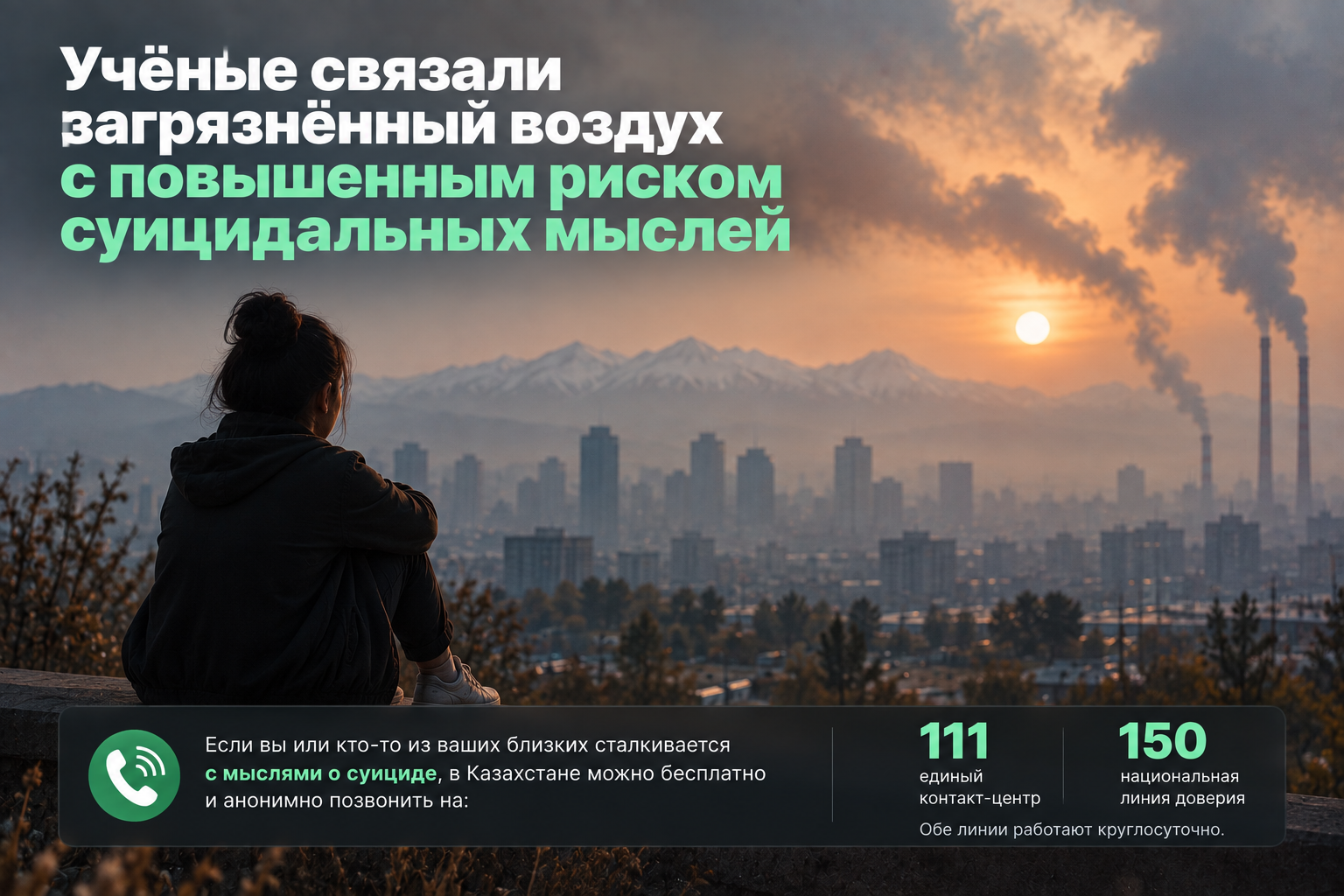
Scientists have linked air pollution to an increased risk of suicidal thoughts
A new scientific analysis adds a less obvious consequence of dirty air to asthma and heart disease: its impact on mental health, up to suicide risk.
The authors insist, however, that this is not about a direct cause, but about one of the factors in a more complex picture, Euronews writes.
The gist in brief
- A new analysis published in the Journal of Epidemiology & Community Health showed that short-term exposure to fine particulate matter (PM2.5 and PM10), as well as long-term exposure to nitrogen dioxide and PM2.5, are associated with an increased risk of death by suicide, suicide attempts, and suicidal thoughts.
- The scientists analyzed more than 40 studies devoted to various types of pollution — air, noise, light, and water — and their connection to suicidal behavior.
- Every year, more than 720,000 people die worldwide as a result of suicide; in the European Union in 2023, more than 48,000 people died as a result of intentional self-harm, according to Eurostat.
- The authors explicitly emphasize that there is no single cause of suicide — motives are always multifactorial and include individual, biological, cultural, and social factors.
Possible mechanisms of the connection
The researchers point to several likely pathways of influence. Air and water pollution are linked to neurological effects, including chronic inflammation and neurotoxicity, which can disrupt brain function and affect mood and stress resilience. Noise and light pollution — for example, from heavy traffic — is also associated with increased stress levels due to disruption of the body's circadian rhythms.
Pollution as context, not diagnosis
Professor of Psychology at the University of Oviedo (Spain) Susana Al-Halabi, who was not involved in the study, articulated the main meaning of the work most precisely: the main contribution of this study is not in proving direct causality, but in reminding us that psychological suffering always arises in a certain context. According to her, pollutants can shape a more vulnerable social environment as a whole — areas with worse living conditions, lower environmental quality, and increased levels of everyday stress and inequality. The authors of the study agree with this caveat and call for further study of the combined effect of such factors, rather than considering air pollution in isolation from other circumstances of a person's life.
Practical conclusion for public health policy
The key formulation of the authors concerns precisely the practical implications of the work: the results emphasize the importance of recognizing environmental factors as modifiable risk factors within suicide prevention efforts. This shifts the focus from exclusively individual, clinical care to broader urban and environmental policy — air quality, noise levels, access to green spaces — as elements that states can realistically improve and thereby potentially reduce one of the factors of suicide risk at the level of the population as a whole.
Author's conclusion
The value of such studies is not in sensational headlines claiming that "dirty air kills," but in a far more modest and practical conclusion: environmental policy is not only a matter of the lungs and the cardiovascular system, but also, probably, of the mental health of the population in the broad sense. For countries where air quality remains a systemic problem, this is another argument in favor of the idea that investments in clean air pay off not only through reduced morbidity, but also through less obvious yet no less significant social effects.
This topic is sensitive in nature. If you or someone close to you has experienced thoughts of suicide, in Kazakhstan you can contact the unified contact center "111" or the national helpline "150" free of charge and anonymously — both operate around the clock.


Comments ()