Sheep's wool tested as a substitute for synthetics in glacier protection.
This summer, Swiss glacier tests used plain sheep wool—not synthetic material—as a cover to slow ice melt.
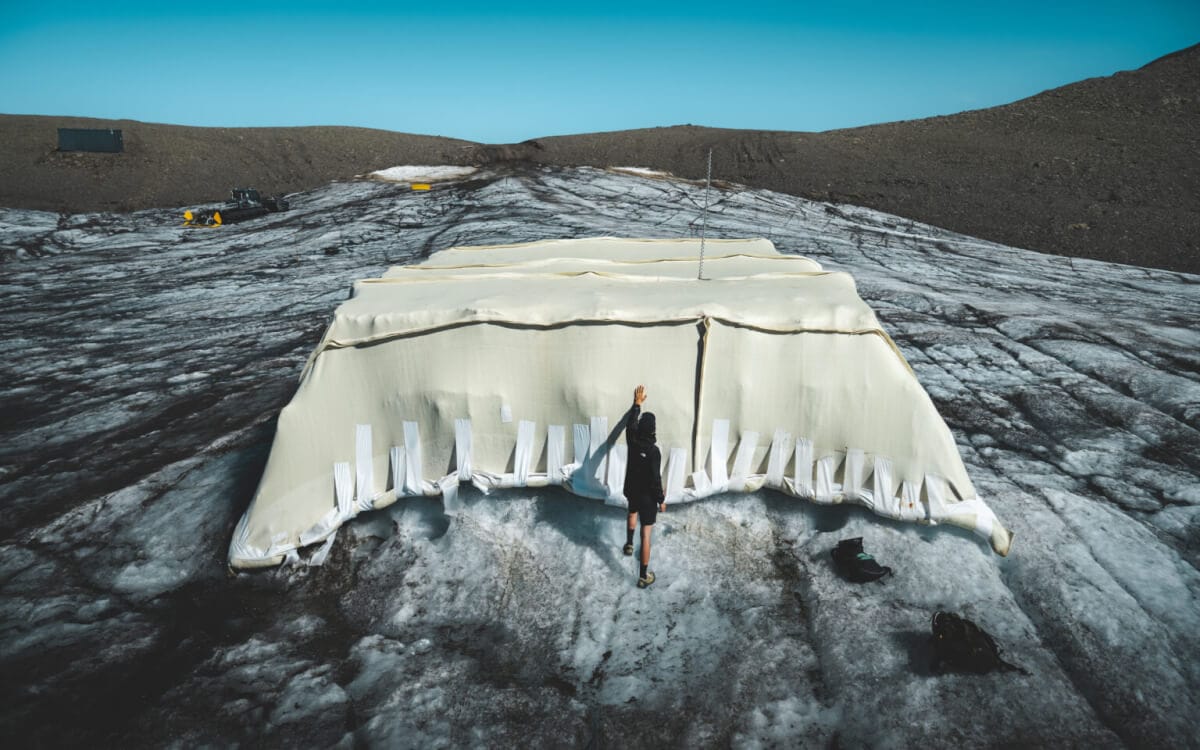
The experiment is still preliminary, but is already showing results comparable to traditional geotextiles.
In brief
- On the Tsanfleuron glacier in the Swiss canton of Vaud, sheep wool coverings were tested as an alternative to synthetic geotextiles used to locally slow glacier melting.
- The Keep It Wool project is being implemented by the environmental organization Summit Foundation together with the University of Lausanne; in June 2026, two wool sheets measuring 10 by 10 meters each and a synthetic covering of the same area were laid on the ice for comparison.
- Preliminary observations showed that the wool coverings protect snow and ice from melting at roughly the same level as synthetics, while proving more resistant to the external impacts of the high mountains than expected.
- The experiment covered only two plots with a total area of 200 m² and lasted one season, so it is too early to judge the material's durability or the scalability of the solution; according to the organizers' estimates, up to 70% of Swiss wool currently finds no application and is disposed of.
Why do glaciers need geotextiles at all
Coverings of any type — synthetic or, now potentially, wool — are used only on small, most vulnerable sections of glaciers: according to Summit Foundation, geotextiles currently cover about 0.02% of the total area of all Swiss glaciers. Even such a modest coverage allows preserving roughly 300,000 m³ of snow annually — even though annual ice losses across the country approach 1 billion m³. In other words, such coverings cannot stop glacier melting as a phenomenon, but they do extend the life of specific sections most valuable for tourism or hydrology.
Why wool is a logical alternative to synthetics
Traditional synthetic coverings made of polyester or polypropylene carry a hidden environmental cost: as they wear out, plastic microfibers detach from them and enter the environment right on the glacier. Wool, in this sense, is a renewable and biodegradable material, and its large-scale use also solves another problem: a significant portion of Swiss wool today simply finds no application in the textile industry and is disposed of as waste. The Keep It Wool project turns the surplus of one resource into a solution for another, seemingly unrelated challenge.
Kazakhstani context
The topic of glacier melting is not abstract for hunn.kz readers — we have already written about how experts this summer called the retreat of Alpine glaciers a climate signal directly comparable to what is happening with the Tien Shan and Dzungarian Alatau glaciers that feed the rivers of southern Kazakhstan. Kazakhstan here finds itself in a dual position: on the one hand, the country depends on its own mountain glaciers as a source of water for irrigation and drinking water supply in the southern regions; on the other, it has one of the world's largest sheep farming and wool production industries, which faces a similar problem of raw material surplus that does not always find a use. The Swiss experiment shows that these two seemingly different challenges may find a common technological solution.
Author's conclusion
The wool experiment on the Tsanfleuron glacier is one of those stories where the scale is still far outweighed by the symbolic value: two plots of 100 m² each will not solve the problem of glacier melting either in Switzerland or anywhere else, for that matter. But the very idea — using the surplus of one natural resource to mitigate the consequences of climate change — deserves attention regardless of the ultimate scale of application, especially for countries like Kazakhstan, where mountain glaciers and wool surplus exist simultaneously but are not yet connected by any such solution.


Comments ()