Solar farms have unexpectedly become a lifeline for bees.
A five-year study of two solar farms in Minnesota found that well-designed solar farms don't destroy wildlife—they restore it.
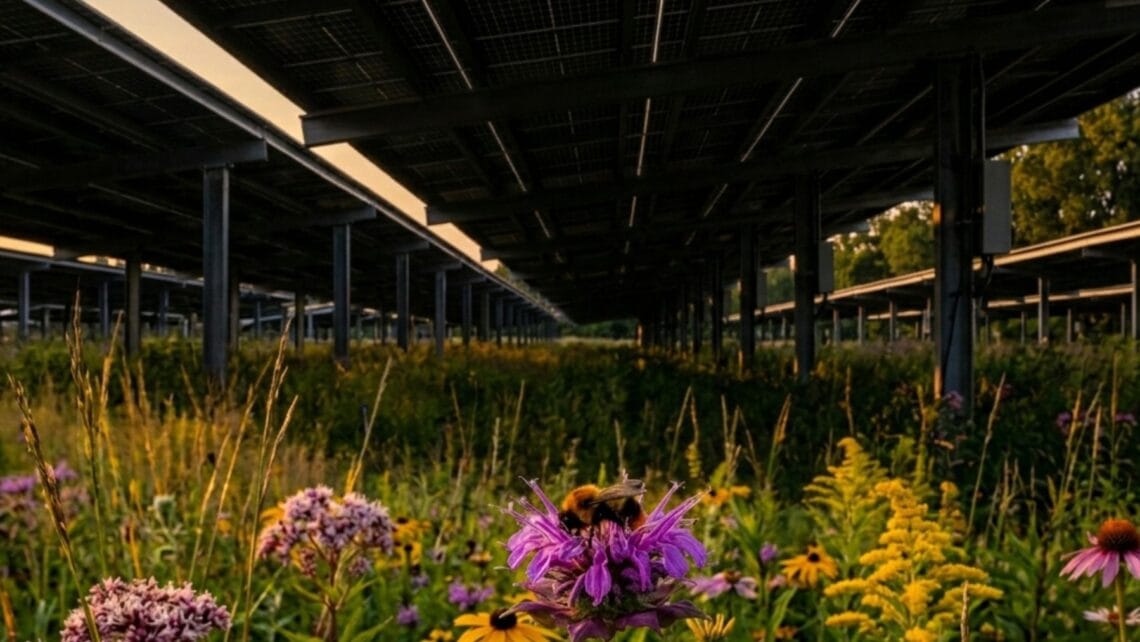
Solar power plants are commonly considered dead zones for wildlife. A five-year observation of two farms in Minnesota showed the opposite: the land beneath the panels turned into a veritable haven for insects.
In a Nutshell
- Researchers observed two solar farms in Minnesota for five years: native grasses and wildflowers were planted under the panels instead of bare gravel.
- During the study, insect numbers tripled at both sites, and populations of wild bees — the main pollinators of agricultural crops — grew steadily.
- Sowing undemanding native plants requires less mowing and maintenance, which offsets the additional costs of raising the panels higher off the ground.
- Kazakhstan is actively building solar stations in the steppes — areas with degrading biodiversity. Combining energy generation with ecosystem restoration has hardly been considered here.
A Fear That Was Not Entirely Justified
The main argument of solar energy critics sounds convincing: large-scale installations occupy vast areas, thus displacing wildlife. A field covered with panels does indeed resemble a concrete wasteland on the surface.
It was under the influence of this logic that a persistent belief formed: every new solar farm is a piece of nature lost forever. For a long time, no one really checked if this was actually true.
What Was Discovered in Minnesota
As reported by THE PULSE, researchers selected two sites that differed from standard solutions. The panels on them were raised higher off the ground — so that enough space remained underneath for vegetation. Then, instead of the usual gravel or mowed lawn, native grasses and wildflowers characteristic of the area were planted.
The monitoring results were unexpected even for the study's authors. By the end of the five-year period, insect numbers at both sites had tripled. Particularly significant was the growth in populations of wild bees — pollinators that are losing their habitats worldwide due to the disappearance of meadows and wild corners of nature.
The structure designed to collect sunlight turned into a refuge for insects, which an urbanizing and warming world is steadily pushing to the margins.
An Argument for Investors and Developers
Beyond the environmental dimension, the study contains a practical financial argument. Undemanding native plants require significantly less mowing and maintenance compared to a lawn. The savings on maintenance can offset the additional costs of higher support structures — meaning the eco-friendly option is not necessarily more expensive.
According to Johanna Neumann from the Environment America Research & Policy Center, in a context where bees are under serious pressure and the world is rapidly transitioning to clean energy, designing solar farms with the needs of local pollinators in mind is almost an obvious solution.
The Kazakh Context: Steppes Under Threat
Kazakhstan has one of the world's largest steppe biomes, a significant part of which is in a state of degradation. According to the Ministry of Ecology and Natural Resources of the Republic of Kazakhstan, more than 70 million hectares of pastureland are subject to varying degrees of degradation. It is in these zones that the construction of large solar facilities is concentrated — in the Zhambyl, Turkestan, Kyzylorda, and Karaganda regions.
The Minnesota experience shows: solar stations in the steppe can not only occupy space but also become a tool for its partial restoration — through the sowing of native plants under the panels. The cost of such a solution is comparable to the standard approach, while the environmental and reputational effect is significantly higher. Regulators and developers in the Kazakh renewable energy market should include this parameter in design requirements.
Author's Conclusion
Every new solar station is a choice: to leave the land dead or to turn it into a living meadow that simultaneously produces electricity. Minnesota has already made this choice and obtained a measurable result. For Kazakhstan, where solar energy and the degree of degradation are developing in parallel, combining these two processes is not romanticism, but elementary agronomic logic.

Comments ()