Solar panel owners in Uzbekistan were paid 642 billion soums
In the first nine months of 2026, 70,700 residents of Uzbekistan received 642.1 billion soums from the state budget for electricity their solar panels fed into the grid.
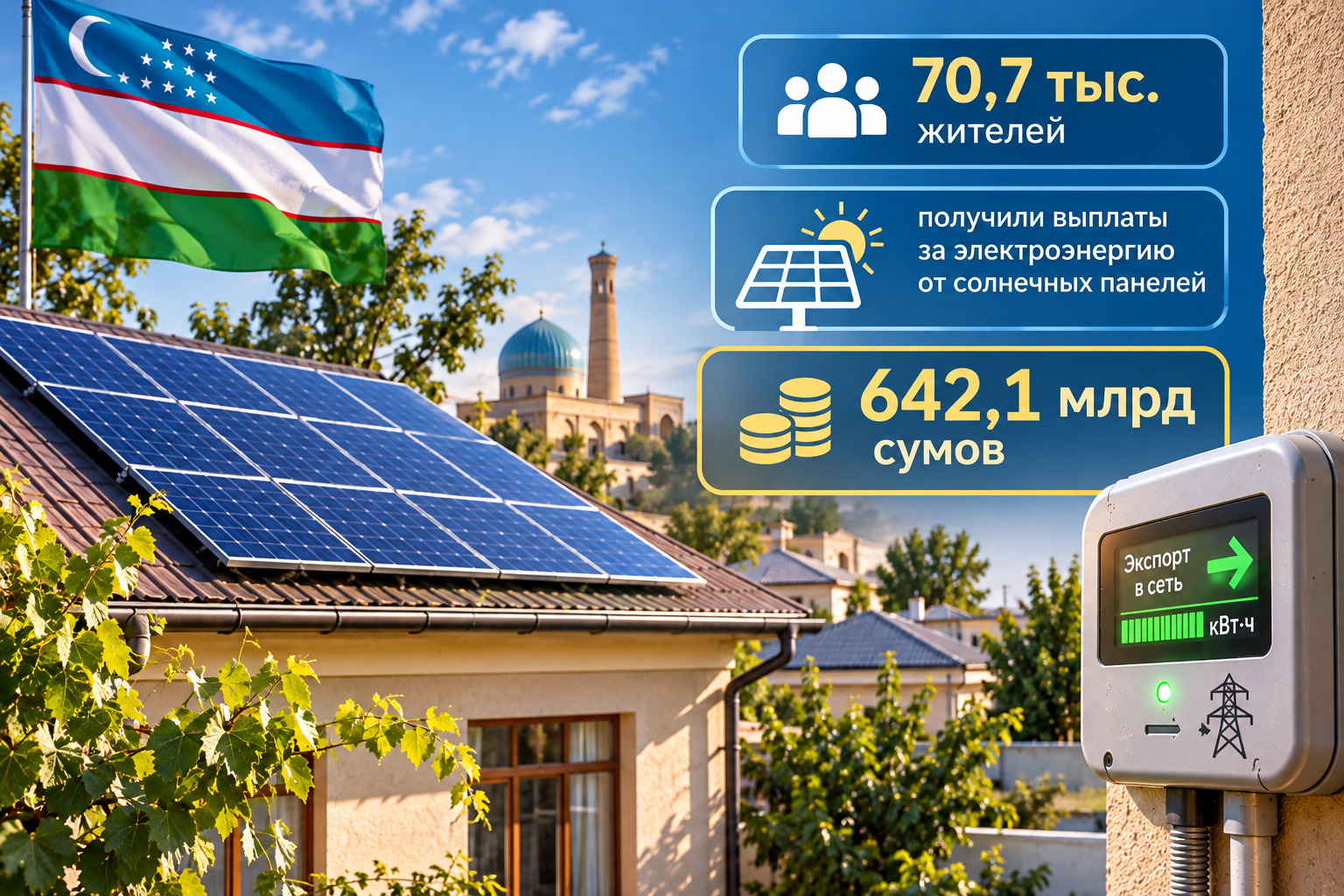
This is stated in the data of the Telegram channel "Fiscal Analysis," which is cited by UzDaily.
The gist in brief
- Payments for January-September 2026 amounted to 642.1 billion sums, received by 70.7 thousand residents.
- The largest amount was received by Bukhara region - 116.7 billion sums, followed by Khorezm - 115.3 billion and Karakalpakstan - 77.2 billion.
- In the first half of 2026, payments amounted to 330.82 billion sums and grew 9-fold over the year.
- The money is transferred to a card via the Soliq mobile application.
Who received how much
Payments come from the state budget to owners of solar panels who generate more electricity than they consume and transfer the surplus to the grid. The three regions that received the most are Bukhara region (116.7 billion sums), Khorezm (115.3 billion) and the Republic of Karakalpakstan (77.2 billion). Data for the remaining regions is not provided in the material.
How to receive the money
In the Soliq mobile application, you need to open the "Cashback and Benefits" section, select "Solar Home" and use the "Transfer to card" function. The "Solar Home" program has been in effect since April 1, 2023: owners of stations with a capacity of up to 50 kW receive 1,000 sums for each kilowatt-hour transferred to the grid beyond their own consumption.
How fast payments are growing
In the first half of 2026, 68.6 thousand people received payments, and their total amounted to 330.82 billion sums, which is 9 times more than a year earlier. The number of recipients grew 3.5-fold over the year. In June, 100.7 billion sums were paid to 61.1 thousand people. The growth is attributed to the declining cost of panels, clear payback at a fixed purchase price, and the digital payment mechanism.
What is happening with solar energy in Kazakhstan and Central Asia
In Kazakhstan, owners of their own solar stations (they are called net consumers) can also sell surplus to the grid. The rules in effect since October 5, 2024, are designed for stations with a total capacity of up to 200 kW; the surplus is bought by the energy supply organization serving the consumer at its own maximum price. There are still very few such owners: according to the latest open data from the Ministry of Energy for November 2025, which is cited by National Business, in the south of the country, in Turkestan region and Shymkent, there were 78 of them.
Large projects are proceeding separately: in 2026, 7 of the 10 planned renewable energy facilities with a total capacity of 212 MW came online in the country, of which three solar stations provided about 62.6 MW. The Development Bank of Kazakhstan approved about 54.5 billion tenge for the first phase of a 1 GW project: two solar stations of 60 MW for Kazatomprom and 185 MW for KEGOC. In Kyzylorda, construction has begun on the region's first solar station with an energy storage system, which is planned to be expanded to 50 MW. At the same time, fossil fuels provide about 85% of the country's electricity, while wind and solar together account for about 6%, according to 2025 data from the analytical center Ember.
In neighboring Tajikistan, Dushanbe authorities instructed that solar panels be installed at all enterprises in the city, but no deadlines, capacity or budget were named.
What is happening with power grids in Uzbekistan
The growth of solar generation requires grids capable of accepting it. The World Bank and the Asian Development Bank will finance the modernization of 60 key substations: the total program budget is $371 million; after its completion, the grid will be able to accept at least 3.3 GW of renewable energy capacity. In addition, energy storage systems will be placed in all regions of the country: battery systems already cover more than 13% of evening peak electricity demand.
Author's conclusion
The "Solar Home" program has proven successful, and that is its main problem: each new panel owner increases the bill paid by the budget. Payments grew from 330.82 billion sums in the first half of the year to 642.1 billion over nine months. At the same time, the second expense item is also growing - the grids: in order to accept solar energy, the country is investing $371 million in substations alone. A simple fixed purchase price attracted residents, but going forward Uzbekistan will have to decide how much it is willing to pay for each kilowatt-hour and for how long.

Comments ()