Startup wants to extract uranium from the ocean — enough to last tens of thousands of years
Seawater holds more dissolved uranium than all known land deposits on Earth combined.
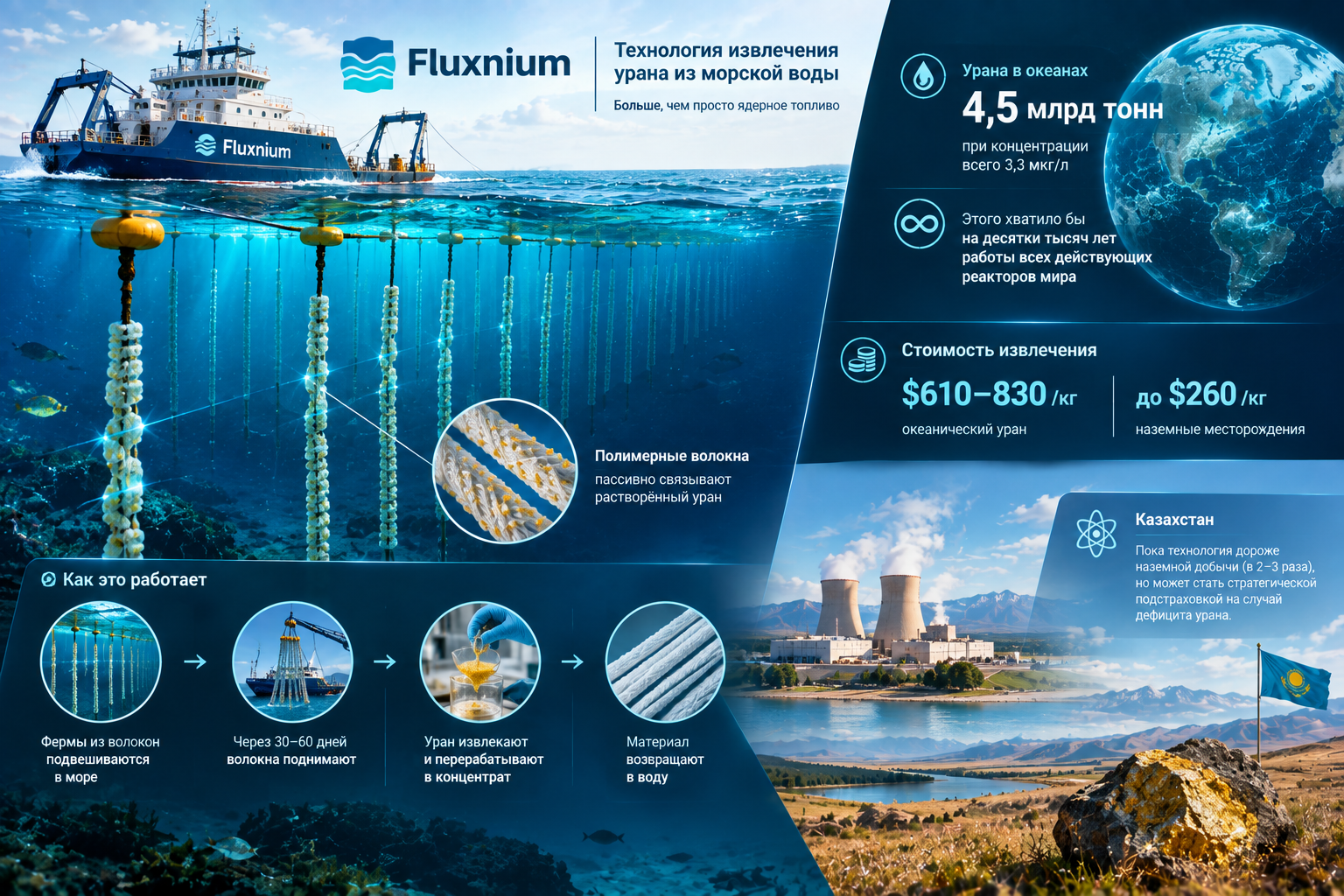
An American startup has publicly disclosed for the first time a technology that could turn this vast but extremely dispersed resource into a real source of nuclear fuel, reports Techno.nv.
The gist in brief
- The startup Fluxnium, after raising about $7 million in seed funding, has publicly presented for the first time a technology for extracting uranium from seawater using polymer fibers that passively bind the dissolved metal.
- The fibers are woven into long lines and suspended in the sea following the principle of existing infrastructure for seaweed and shellfish farms — after roughly 30–60 days they are raised, the uranium is extracted and processed into concentrate, and the material is returned to the water.
- According to IAEA estimates, about 4.5 billion tons of uranium are dissolved in the oceans at a concentration of just 3.3 micrograms per liter — this reserve would theoretically be enough for tens of thousands of years of operation of all reactors currently operating in the world.
- The cost of extraction is estimated at $610–830 per kilogram — 2–3 times more expensive than onshore deposits included in the current registry of proven resources at a price of up to $260 per kilogram.
Why Americans need this technology at all
The founder and CEO of Fluxnium, Jeff Green, explained the logic of the project to TechCrunch: "If demand grows as projected, we will face a structural uranium deficit."
The American startup's motivation is largely geopolitical — according to the Nuclear Energy Agency, last year only 7% of the uranium supplied to American reactor operators was mined directly in the United States, while the rest came from imports. The company licensed the technology for producing the sorbent itself from U.S. Department of Energy national laboratories, where this idea was tested even before Fluxnium appeared: one of the experimental materials accumulated 5.2 grams of uranium per kilogram of sorbent in natural seawater over 49 days, and in 2018 researchers for the first time obtained five grams of finished concentrate extracted specifically from the ocean.
The technology is still far from commercial maturity
A researcher at the Pacific Northwest National Laboratory (PNNL), Gary Gill, commenting on his team's earlier experiments, noted: "This approach could ultimately provide a commercially attractive nuclear fuel from the ocean."
But the path to that goal is still long — the material loses efficiency when reused: after the fourth cycle, one of the sorbents retained only 28% of its original capacity, and biofouling by algae and microorganisms can reduce uranium uptake by up to 30% in just 42 days of operation. Fluxnium has not yet disclosed either the actual performance of its fibers in the open sea or the final cost per kilogram of the finished product, limiting itself to a general demonstration of the principle.
Connection to the already familiar topic of uranium in water
Fluxnium is solving the opposite task to the one we have already examined — extracting valuable uranium from water rather than removing a contaminant. We wrote that a German-Spanish group of scientists for the first time revealed the mechanism by which natural bacteria are able to convert uranium dissolved in mine waters into a chemically stable compound that is not leached back even upon contact with oxygen. The two stories share the same basic fact: uranium in dissolved form is a far more widespread and difficult state of the metal to work with than compact solid ore, and scientists around the world are simultaneously looking for ways either to extract it from there usefully or to neutralize it where it has become a pollutant.
Why this matters for Kazakhstan
The difference in cost is the most practical detail of this story for Kazakhstan, which remains the world leader in onshore uranium mining by in-situ leaching. As long as ocean extraction technology costs 2–3 times more than already proven onshore resources, countries with a rich mineral resource base like Kazakhstan retain a significant price advantage over any alternative sources that can so far be discussed only in theory. This is not a reason to ignore such developments — if onshore mining becomes more expensive or the most accessible deposits are depleted, the economics could change — but on the foreseeable horizon, oceanic uranium remains more of a strategic fallback in case of deficit than a real competitor to traditional mining.
Author's conclusion
The story of Fluxnium is a good example of how a real physical surplus of a resource (4.5 billion tons of uranium in the ocean versus several million tons of proven onshore reserves) does not always mean that this resource is economically accessible. As long as the cost of oceanic uranium is several times higher than onshore, and the technology itself has not passed testing at industrial scale, discussion of it remains more of a long-term insurance for energy security than a practical alternative to existing uranium provinces — including Kazakhstan's.


Comments ()