The Alps are crumbling before our eyes: the closure of Mont Blanc and the Matterhorn is a climate signal, not a tourism problem
In mid-July 2026, several iconic Alpine routes were closed or effectively removed from use: the Italian route on Mont Blanc, the Hörnli Ridge on the Matterhorn, and the route on the Dent d'Hérens.
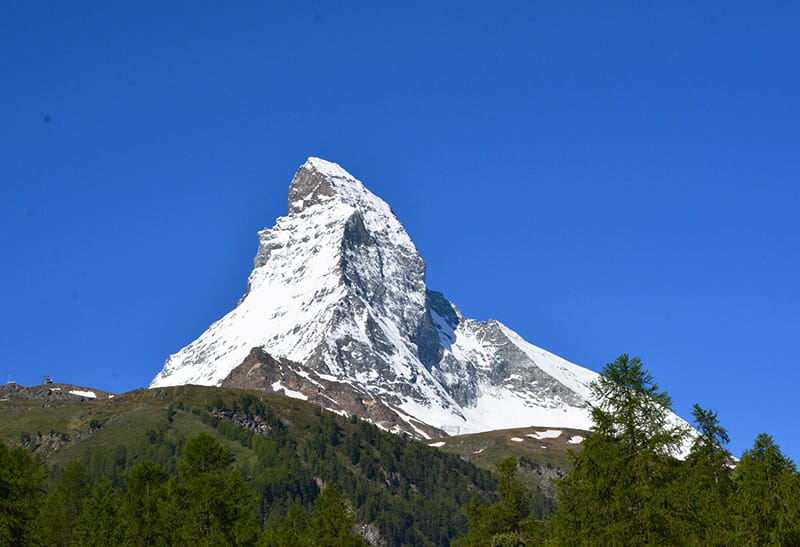
The reason is not bureaucracy or a fashion for safety. Glaciers are crumbling, rocks are shifting, and rockfalls are killing even experienced guides. Behind these news stories from the world of mountain tourism lies a fundamentally different message: the Alps — one of the planet's most visible climate indicators — are recording irreversible changes in real time. For Kazakhstan, whose glaciers are melting no less dramatically, this is a mirror of the near future.
The gist
- The classic Italian route up Mont Blanc via the Miage glacier is officially closed to commercial groups: the depth of the crevasses has reached critical levels, and snow bridges that were reliable just a year ago have become deadly.
- On the French Goûter route, guides have banned crossing the "Couloir de la Mort" after 6:00 AM: on July 15, 2026, a rockfall killed an experienced Czech guide and his client. After noon, the thawed rock falls like an avalanche.
- The Hörnli ridge on the Matterhorn has been temporarily closed by guides: "Rocks that were held together for centuries by ice frozen into their seams have started moving right before our eyes."
- The reason for what is happening is not an anomalous season, but a structural process: routes considered "classics," traversed by thousands of people for centuries, are becoming deadly within a single season.
- The heatwave and El Niño are accelerating melting: over the last 60 years, the area of glaciers in the Alps has shrunk by more than a third. Europe is warming twice as fast as the global average.
What is happening to the Alpine ice — and why it cannot be stopped
The mechanism of destruction is physically simple and practically catastrophic. Alpine routes were safe for centuries not because climbers were more agile, but because the rocks were held together by permafrost and ice that firmly bound the cracks and seams between rock formations. This ice served as natural cement.
Now it is melting. Rocks that were held together for centuries by ice frozen into their seams have started moving. When the ice disappears, the rock loses its cohesion — and begins to crumble. The daytime heat accelerates this process: at night, the rock freezes together with the remaining frost; in the morning, it thaws again and moves. This is why guides have issued a strict directive to cross the "Couloir de la Mort" exclusively before 6:00 AM, while the rocks are still bound by the night's cold.
El Niño as an accelerator of the disaster
The summer of 2026 is particularly harsh — and this is no coincidence. We have already written about the record-breaking heatwave in Europe: at the end of June, temperatures in France reached 45°C, making it the hottest day since meteorological observations began in 1947, with over 10,000 people killed. France shut down nuclear reactors due to anomalously high water temperatures in rivers.
Behind this anomalous summer is El Niño — a global climate phenomenon that, in 2026, is叠加 on an already warmed planet.
The synergy effect: the baseline climate has warmed by 1.2°C relative to pre-industrial levels — meaning every heatwave now starts from a higher baseline and reaches more extreme values. The Alpine glaciers, already shrinking for decades, are melting at double the speed during such a summer. According to the World Glacier Monitoring Service, the area of Alpine glaciers has shrunk by more than a third over the past 60 years. If current rates continue, by 2100, less than 10% of their 1900 levels will remain.
The Alps as a climate indicator
We are not observing a temporary phenomenon, but a tectonic shift in mountain tourism. The closure of routes is the visible part of the iceberg. The invisible part is much larger: mountain villages are losing water sources as glaciers melt, hydroelectric power plants are reducing output due to decreased glacial runoff, and avalanche danger is changing a configuration that was stable for centuries.
The Alps are one of the most studied mountain ranges in the world, and that is why what is happening there becomes a benchmark for understanding what awaits other mountain systems. Europe is warming roughly twice as fast as the global average — meaning that Alpine processes are ahead of the overall climate dynamics by several decades.
The Kazakhstan context
Kazakhstan has the largest glaciers in Central Asia — in the mountain systems of the Tien Shan, Dzungarian Alatau, and Altai. According to Kazakh glaciologists, since the 1960s, the country has lost more than 30% of its glacial cover. The rate of melting is accelerating every decade.
This is not abstract environmental statistics. Kazakhstan's glaciers are the main natural reservoirs for the rivers that feed the irrigated agriculture of the country's south. Snowpack in the upper reaches of the Syr Darya has been below normal for the third consecutive year — a direct consequence of the same process that is closing mountain routes in the Alps. The only difference is that in the Alps, it is seen by tourists and guides. In Kazakhstan's mountains, it is seen by farmers who lack water for irrigation.
Author's conclusion
The closure of the Italian route on Mont Blanc and the Hörnli ridge on the Matterhorn is not just news for mountaineering enthusiasts. It is a climate bulletin written in the language of rockfalls and crumbling glaciers. Mountains do not lie and do not politicize: they are simply changing — at the speed dictated by the physics of a warming atmosphere. Kazakhstan watches this from Central Asia — and sees its own mountains.
Comments ()