The hottest building in Almaty: a study revealed a 19-degree difference between city districts
Temperature difference between buildings in Almaty reaches 19°C.
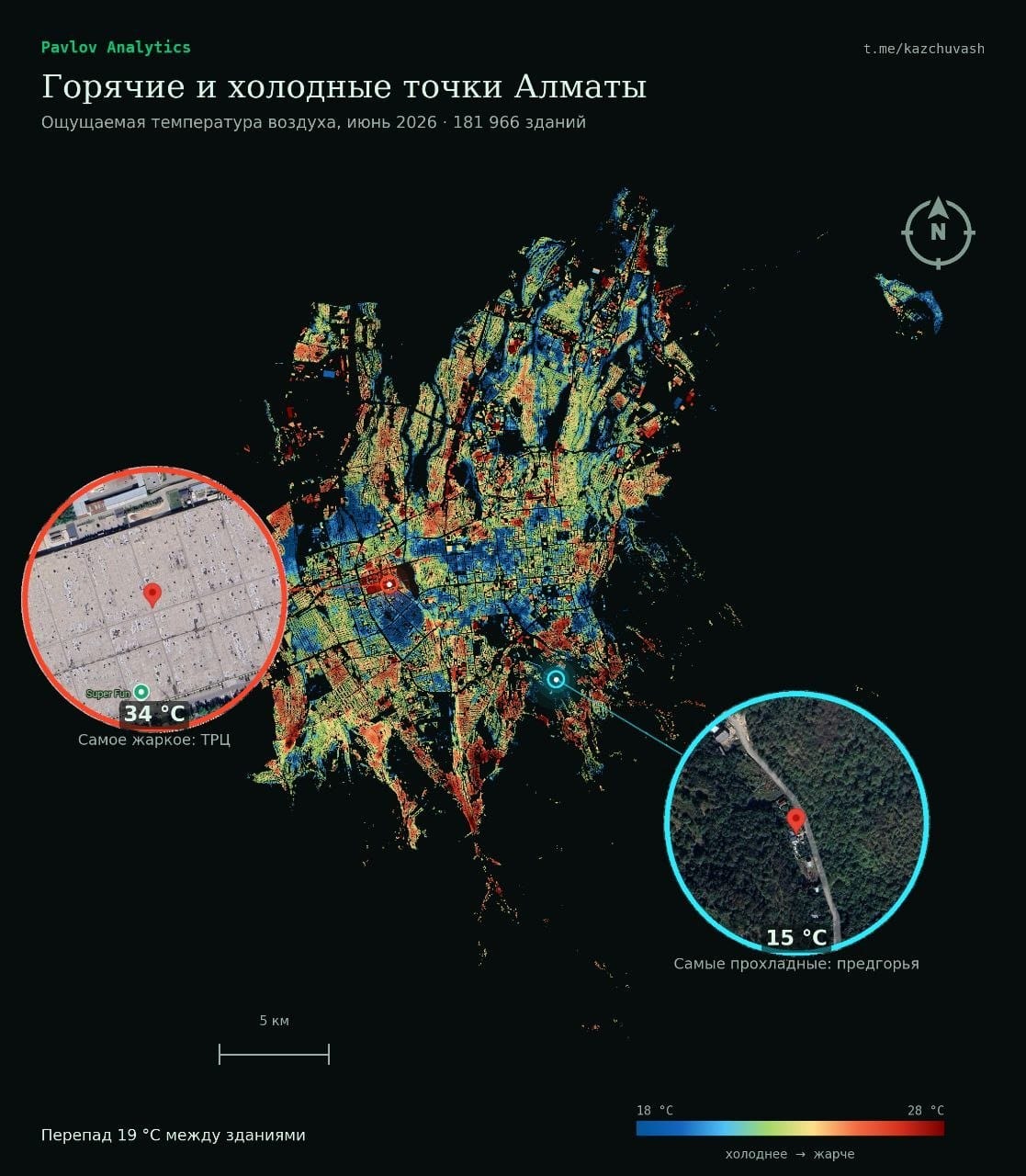
Even within a single city, the temperature can feel completely different. Analysts at Pavlov Analytics calculated the perceived temperature around 181,966 buildings in Almaty and found that the difference between the hottest and coolest locations reaches 19 degrees.
In a Nutshell
· The perceived temperature around 181,966 buildings in Almaty was analyzed.
· The difference between the hottest and coolest locations was 19 °C.
· The hottest building was identified as the GRAND PARK shopping mall on Kabdolov Street.
· The most comfortable conditions were recorded in the suburban garden areas of the foothills.
· A similar analysis for Astana was conducted earlier. The studies confirm a general pattern.
The City Heats Up Unevenly
The calculations were carried out on one of the hottest June days. The goal of the study was to determine how features of the urban environment affect the perceived temperature in different parts of Almaty.
It was found that the most unfavorable conditions occur in areas with dense development, large expanses of asphalt and concrete, and a minimal amount of green space.
Where It Was Hottest
The hottest object in the study was the GRAND PARK shopping mall on Kabdolov Street. According to analysts' estimates, the perceived temperature here reaches about 34 °C.
The reason is attributed to a combination of several factors: a large flat roof, extensive asphalt parking lots, and an almost complete lack of trees. During the day, these surfaces heat up intensely and then continue to release accumulated heat for a long time, amplifying the urban "heat island" effect.
The Coolest Areas Are in the Foothills
At the other end of the ranking were the garden plots located in the foothills of Almaty. Here, the perceived temperature is about 15 °C.
Thanks to dense tree vegetation, the air remains significantly cooler. Trees create shade, reduce surface heating, and evaporate moisture, forming a more comfortable microclimate even during periods of intense heat.
Why This Matters
Earlier, Hunn.kz published the results of a similar study by Pavlov Analytics for Astana. At that time, an analysis of 49,500 buildings showed that the difference in perceived temperature within the capital reached 16 °C. The new data for Almaty demonstrates an even more pronounced contrast — 19 °C.
Comparing the two studies shows that the urban "heat island" effect is characteristic not only of individual districts but of Kazakhstan's largest cities as a whole. At the same time, the decisive role is played not so much by climatic features as by the quality of the urban environment — the presence of trees, the area of hard surfaces, and building characteristics.
The study shows that the level of comfort in a city is determined not only by the weather but also by the quality of the urban environment. Landscaping, architectural solutions, and the amount of hard surfaces can change the perceived temperature by tens of degrees even within a single populated area.
In the context of increasingly frequent heatwaves, such data become an important benchmark for urban planning and improvement.
Author's Conclusion
Almaty and Astana clearly demonstrate that the fight against heat begins not with air conditioners, but with competent design of the urban environment. The more trees, shaded areas, and permeable surfaces a city has, the lower the "heat island" effect and the more comfortable the conditions for residents. The study by Pavlov Analytics once again confirms: landscaping today is becoming not just a matter of aesthetics, but also one of the key tools for adapting cities to climate change.


Comments ()