The protective wall around the mercury lake near Pavlodar is leaking, according to an ecologist
What is happening at the infamous mercury lake Balkyldak.
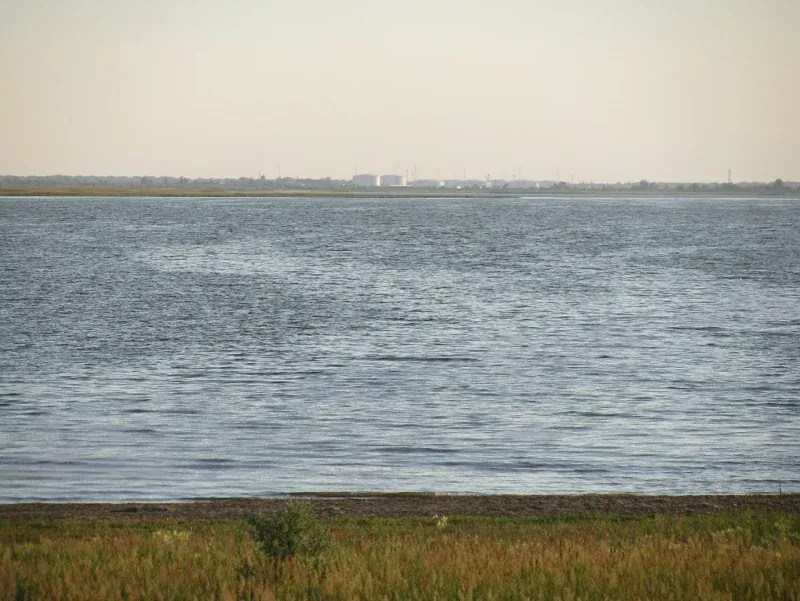
Officially, the situation has been kept under control for twenty years of monitoring. But, according to an independent ecologist, the barrier that was supposed to contain the mercury has turned into a sieve — and the contamination is already moving toward the Irtysh, Almaty.tv reports.
The essence in brief
- Lake Bylkyldak near Pavlodar is an artificial storage reservoir for industrial effluent from the former Khimprom plant, where waste from the mercury shop was dumped for decades; the enterprise was closed in 1993, but full cleanup of the territory has still not been completed.
- Continuous mercury monitoring has been carried out since 2005, and in 2023 construction of an anti-filtration curtain ("slurry wall") on the western side of the reservoir was completed; air, soil, and water samples are taken three times a year, bottom sediments twice, and snow and biosamples once a year.
- Previously, a Japanese demercurization technology was already used at the site, but it did not solve the problem; now, according to Doctor of Chemical Sciences at Torighyrov University Alexander Svidersky, an investor is being sought, and there is already a proposal from China to process and fully dispose of the mercury — demercurization exclusively at the state's expense would cost billions of tenge.
- Ecologist Yuri Pavlenko considers the protective barrier ineffective: according to him, the "slurry wall" is now a sieve through which mercury, together with water, escapes toward the Irtysh — a river that supplies several regions of the country at once.
Two views of the same situation
The official version and the independent assessment diverge not in the facts, but in their interpretation. The press service of the Department of Subsoil Use, Environment and Water Resources of Pavlodar Region confirms regular monitoring since 2005 and the completion in 2023 of the construction of the protective curtain — that is, from a formal point of view, the work is being carried out systematically and continuously. Pavlenko does not dispute the fact of monitoring itself, but points to its practical insufficiency: observation records the movement of contamination but does not stop it. According to him, the danger is posed not only by reserves of metallic mercury, but also by its compounds, which are capable of accumulating in the environment and affecting human health.
Why the previous technology did not work
The Japanese demercurization method that was already tried here binds mercury with a special reagent, converting it into a safe state — but it did not fully solve the problem. Now, according to Svidersky, work in this area has been suspended, and the department is looking for an investor capable of financing full disposal; one of the options is a proposal from China. Pavlenko proposes a different technical approach — not point treatment with a reagent, but complete isolation of the bottom and silt deposits with a membrane, followed by removal of the metallic mercury, of which, according to him, there is especially a lot right on the shore of the reservoir.
The human factor on top of the official ban
Despite the current ban on fishing, local residents, according to Almaty.tv, periodically catch fish in the lake and sell it. In 2018, fish with obvious abnormalities were recorded here. This adds to the purely environmental problem yet another issue — control over compliance with the ban — especially since the risk affects not only those who come into direct contact with the body of water, but also potentially a wider circle of people through the food chain.
Author's conclusion
The divergence between the official and independent assessments is not unusual for such long-running environmental stories, but the scale of the consequences makes it especially significant here: if Pavlenko's warning about the leaking wall is correct, the conversation is not about local contamination of a single reservoir, but about the gradual spread of mercury into the Irtysh basin — a river on which the water supply of several regions depends at once. Studies of the territory are planned to continue for at least until 2030, and the planned emphasis on monitoring and containment rather than full elimination leaves open the same question that was heard here decades ago: how many more years will the problem be studied before it is finally solved.
Comments ()