The world divided the most scarce water — Kazakhstan got half as much in 2026
A direct link emerges between the global water scarcity ranking and new quotas for the Syr Darya and Amu Darya: Turkmenistan, a world leader in per capita water use, shares the same river basin as southern Kazakhstan.
While analysts at Visual Capitalist rank countries by freshwater scarcity per person, Kazakhstan's neighbors in Central Asia have already divided up specific cubic meters for the next year — and the division did not turn out in our favor. A direct link is emerging between the global water scarcity ranking and the fresh quotas for the Syr Darya and Amu Darya: one of the world leaders in water consumption per person — Turkmenistan — sits in the same river basin from which southern Kazakhstan also draws water.
The Gist
- According to data from the World Bank and Our World in Data, the leaders in renewable freshwater scarcity per capita remain the countries of the Persian Gulf and North Africa — Kuwait, Bahrain, and Egypt.
- Turkmenistan ranks only 16th in the scarcity ranking, but is the world leader in absolute water consumption per person — due to cotton farming and water withdrawal from the Amu Darya.
- Following the 91st meeting of the Interstate Commission for Water Coordination of Central Asia, the five countries in the region divided the limits for the Amu Darya and Syr Darya for 2026.
- Kazakhstan was allocated 460 million m³ from the Syr Darya for 2026 — almost half of what it received the previous year (909 million m³ in 2025).
Who in the World is Least Provided with Water
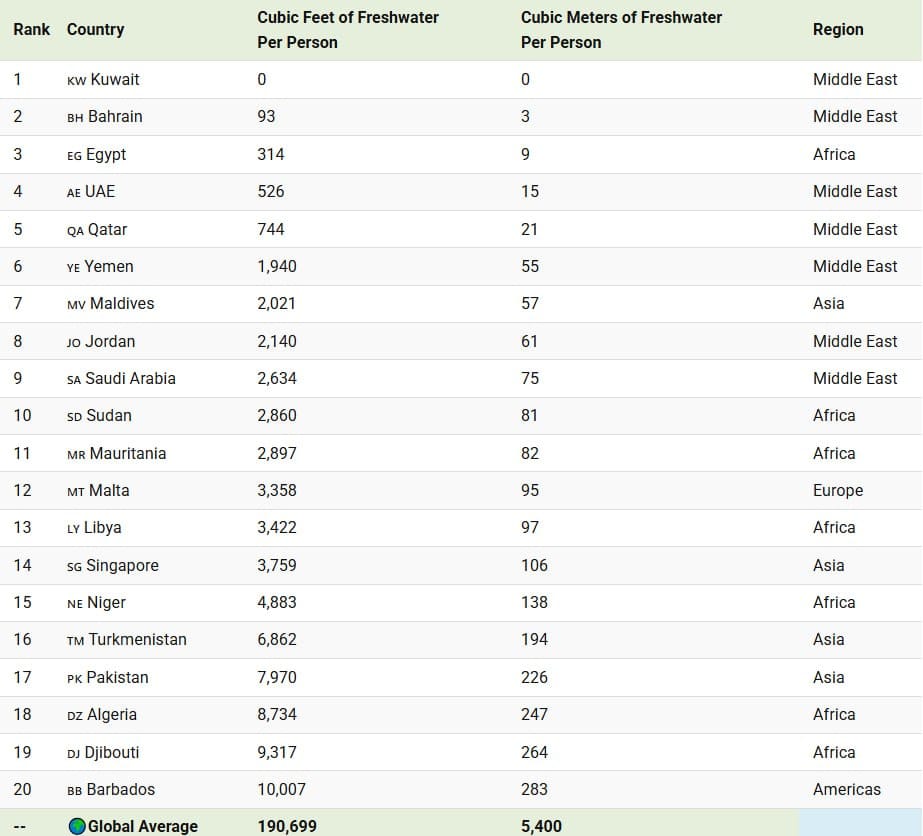
According to a visualization by Visual Capitalist, based on data from the World Bank and the Our World in Data platform, the first place among countries with the smallest renewable internal freshwater resources per person is held by Kuwait — the country has no rivers or lakes, and its supply depends entirely on seawater desalination.
In second place is Bahrain with just 93 cubic feet (2.6 m³) per person, and in third is Egypt with 314 cubic feet (8.8 m³), despite the Nile flowing through its territory.
For comparison, the global average is 190,700 cubic feet (5,400 m³) per person — more than 2,000 times the level of Bahrain. Seven of the twenty countries in the ranking are located in the Middle East, and another seven are in Africa.
Turkmenistan — Scarcity and Wastefulness Simultaneously
Among Asian states, the ranking includes the Maldives, Singapore, Turkmenistan, and Pakistan. Turkmenistan ranks only 16th in water scarcity per person, but remains the world leader in absolute water consumption per capita — driven by cotton farming and large-scale water withdrawal for irrigation from the Amu Darya River. This is a key detail for its basin neighbors: the intensive water use by one country directly affects the volumes that reach the lower reaches, where the southern regions of Kazakhstan and the shrinking Aral Sea are located.
How the Syr Darya and Amu Darya are Being Divided for 2026
Following the 91st meeting of the Interstate Commission for Water Coordination of Central Asia, the five states of the region agreed on water withdrawal limits for 2026.
The total limit for the Syr Darya for the non-growing season was 4.2 billion m³, of which Kazakhstan received only 460 million m³ via the Dustlik-Dostyk Canal, Kyrgyzstan — 47 million m³, Tajikistan — 365 million m³, and the main share of 79.3% — 3.347 billion m³ — went to Uzbekistan.
For the Amu Darya, for the water year from October 2025 to October 2026, the total limit was about 55.4 billion m³, of which Tajikistan was allocated 9.8 billion, and Turkmenistan and Uzbekistan — 22 billion m³ each. Separately, 4.2 billion m³ was set aside for the needs of the Aral Sea and the Amu Darya delta.
Why Kazakhstan Was Left with Less Than Half
The reason for the reduction is not a political decision, but a hydrological paradox of the 2025 season. The inflow of water to the upper reaches of the Syr Darya turned out to be record-breaking — 119% of the norm, but by the end of the season, the cascade reservoirs were underfilled: the Toktogul reservoir was short by more than half a billion cubic meters, and the Shardara reservoir by 576 million m³. To prevent the lower reaches of the river from turning into a salt marsh, the services of Kazakhstan, Kyrgyzstan, Tajikistan, and Uzbekistan agreed on increased water releases from reservoirs last season — almost 1.8 billion m³ more than planned. This saved the 2025 irrigation season but left a smaller safety margin for the next year: the total reserves in the Syr Darya basin reservoirs at the beginning of winter were estimated at approximately 14.9 billion m³, or about 90% of the average annual level.
What This Means for Kazakhstan's Fields
The Government of Kazakhstan has already responded to the risk of a low-water season. According to the press service of the Cabinet of Ministers, the inflow of water into the Naryn-Syr Darya cascade has significantly decreased, creating a risk of deficit during the 2026 growing season, so the agency has developed several forecast scenarios for reservoir operation in case of minimal inflow.
Kazakhstan's farmers have been advised to review their crop structure for the upcoming season in advance, taking into account the limited volumes of irrigation water. This is not an isolated episode — it is part of the same global picture of water inequality that the World Bank ranking captures, only at the level of specific hectares of irrigated land in southern Kazakhstan rather than countries.
Author's Conclusion
The global water scarcity ranking and the regional quotas for the Syr Darya are, in essence, the same story at different scales. Kuwait and Bahrain have no rivers at all, so they rely on desalination. Kazakhstan has rivers, but most of them originate outside the country, meaning the volume of water on Kazakhstan's fields depends not only on snow and glaciers but also on negotiations with its basin neighbors. As long as Uzbekistan and Turkmenistan hold the main shares of the Syr Darya and Amu Darya, water security for southern Kazakhstan will be measured not only by precipitation but also by the outcomes of the next ICWC meeting.
Comments ()