Thousands of leaking barrels of radioactive waste found at the bottom of the Atlantic
A decision made half a century ago still echoes decades later.
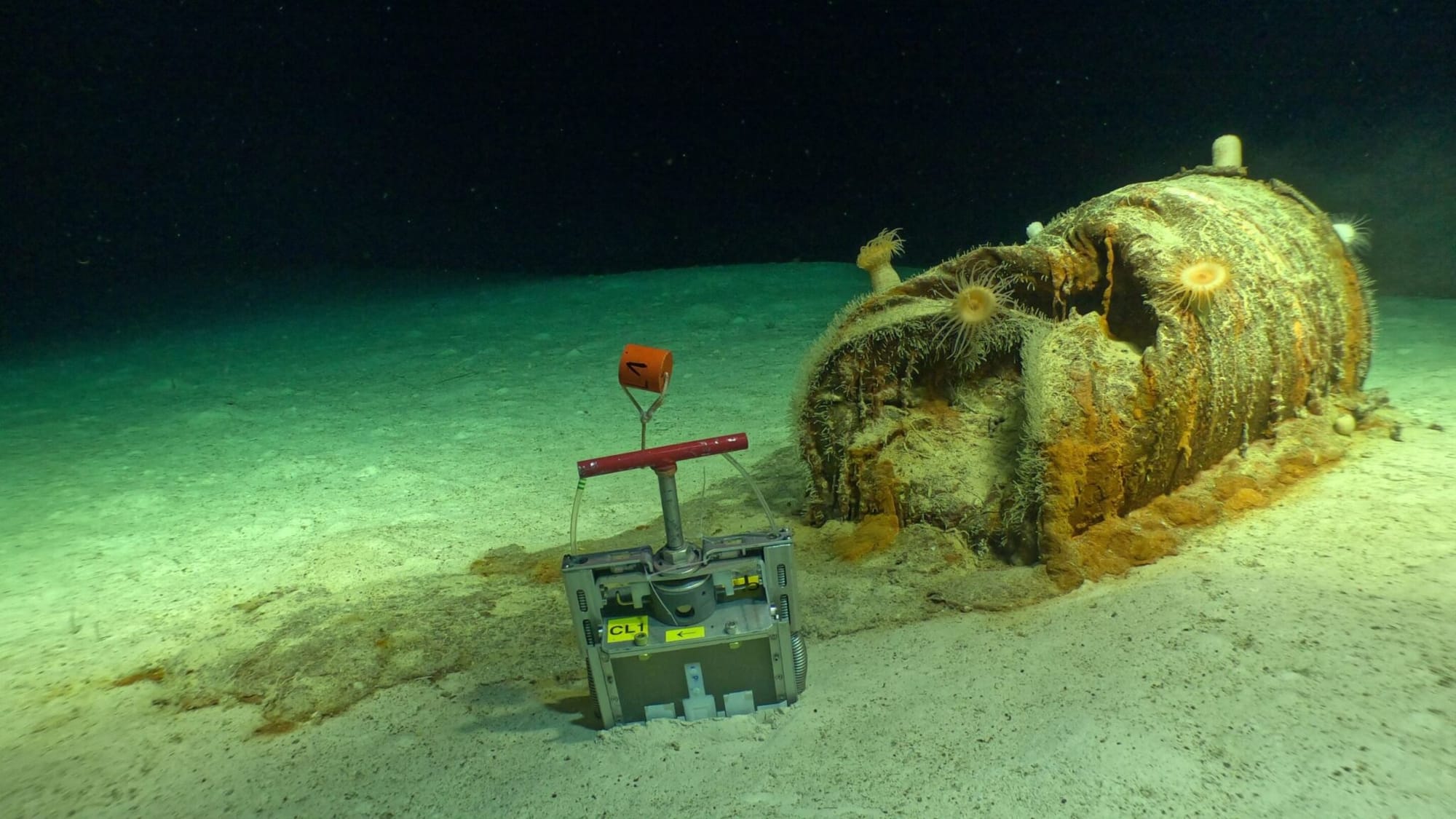
French scientists have for the first time conducted a detailed survey of thousands of containers with radioactive waste resting on the bottom of the Atlantic Ocean — and found that some of them are already failing the test of time, reports Sciencealert.com.
The gist in brief
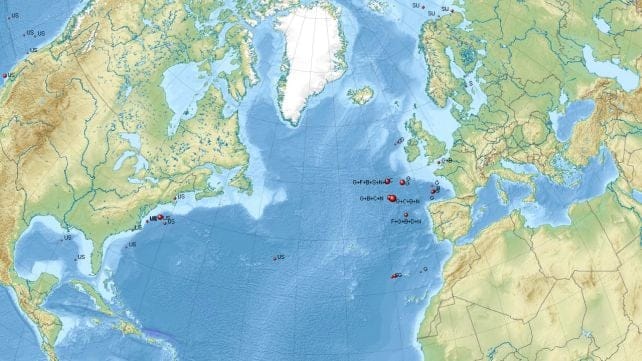
- Between 1949 and 1982, European countries dumped low-level radioactive waste into the Atlantic Ocean — at depths of 3 to 5 km there ended up more than 200,000 barrels containing over 150,000 tons of materials of medical, industrial, and scientific origin.
- The French project NODSSUM in June 2025, using the autonomous vehicle UlyX, discovered and mapped 3,355 barrels, and in May 2026 conducted 20 dives of the submersible Nautile to a depth of over 4.7 km for direct inspection of the containers and sampling.
- Some of the barrels turned out to be heavily damaged by corrosion — their contents are already leaking out and mixing with bottom sediments; instruments recorded cesium-137 and americium-241 at concentrations above the expected background level.
- Around the damaged containers, local hotspots of life unexpectedly formed — anemones, sponges, sea cucumbers, fish, crustaceans, and especially often crabs — but it has not yet been established whether radioactive substances accumulate in the organisms of these animals.
The miscalculation of half a century ago
The disposal logic applied in the mid-20th century looks naive today: it was believed that the containers only needed to remain sealed until short-lived isotopes lost their activity — after which gradual seepage into the ocean would no longer pose a serious danger. The problem is that alongside short-lived isotopes, the barrels also contained long-lived radionuclides — cesium-137, plutonium isotopes, and tritium, some of which persist in the environment for thousands of years. An engineering solution designed for decades collided with materials whose decay period is measured in centuries and millennia.
No serious threat for now, but with caveats
According to preliminary expedition data, the recorded level of radioactivity did not pose a serious threat to the researchers themselves, and the submersible's equipment and the samples taken showed no signs of dangerous contamination. But the study's authors explicitly emphasize: this does not mean the waste is completely safe — analysis of the collected samples is currently underway to determine whether the detected substances accumulate in the organisms living near the barrels. It is precisely this uncertainty — and not the mere confirmation of leaks — that makes the expedition's results significant: for the first time, thousands of containers have been mapped in detail, which opens the possibility for systematic long-term monitoring rather than a one-time recording of the problem.
A lesson for modern planning
The story of the Atlantic barrels is a practical argument for why modern radioactive waste disposal is designed on fundamentally different time horizons than the solutions of the mid-20th century. We have already written about how the countries of the region — from Uzbekistan, where the overflow of existing radioactive waste storage facilities forced the authorities to hastily prepare the first comprehensive law on this topic, to Kazakhstan, which headed the CIS Regional Council of Competencies on Radioactive Waste Management — are today building planning horizons into their programs measured not in decades but in centuries. A similar logic can be traced in the fact that an international IAEA Low-Enriched Uranium Bank has already been placed in Ust-Kamenogorsk — a trusted reserve of raw material requiring the same careful long-term control as any accumulated radioactive waste. The disposal of waste from the future Kazakh nuclear power plant on the territory of the Semipalatinsk test site, which has already been announced, is being developed with precisely such a long-term approach in mind, drawing on the experience of countries like Finland, where waste is buried at a depth of 400 meters in specially engineered geological formations, rather than simply dumped in a remote location in the hope of natural decay of activity.
Author's conclusion
The Atlantic barrels are not an archival curious anecdote but an active reminder that radioactive waste management decisions made without regard for the long-term perspective continue to create problems many decades after the institutions responsible for them ceased to exist in their former form. For countries only now building their own nuclear energy infrastructure and waste storage systems, this is a concrete argument for establishing planning horizons centuries ahead from the very start, rather than relying on the hope that future generations of scientists and engineers will deal with the consequences themselves — as French researchers off the coast of the Atlantic are now forced to do.



Comments ()