To Gain Access to Central Asian Minerals, Europe Is Offered to Invest in Processing
Europe seeks critical minerals in Central Asia, while regional producers, especially Kazakhstan and Uzbekistan, want investment and technology to process raw materials locally.
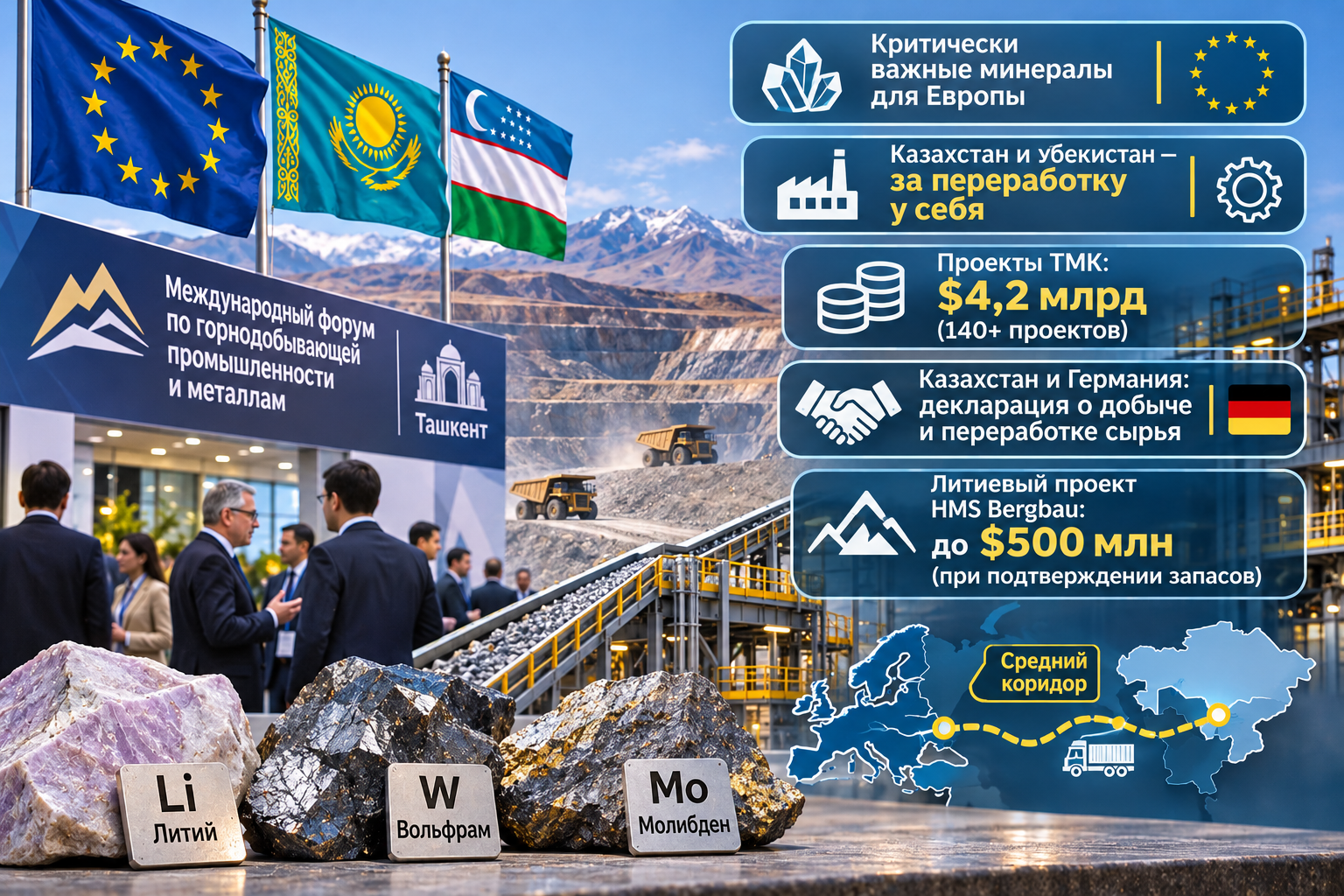
The topic was discussed at the International Forum on Mining and Metals in Tashkent, Euronews reported.
The gist in brief
- Participants at the Tashkent forum discussed technology transfer, financing for processing, and transport routes, including the Middle Corridor.
- Uzbekistan's TMK, which processes tungsten and molybdenum, presented European companies with a portfolio of more than 140 projects worth approximately $4.2 billion.
- Kazakhstan and Germany adopted a declaration on September 29 that addresses the extraction and processing of critical raw materials.
- German company HMS Bergbau's lithium project in eastern Kazakhstan could attract up to $500 million, but only if reserves are confirmed.
What was discussed at the forum in Tashkent
Founder of the Brussels Energy Club Marat Terterov stated that Brussels expects not just agreements, but long-term investment partnerships with Uzbekistan and Kazakhstan. According to him, investment is needed in processing, supply chains, and transport infrastructure, including the Middle Corridor.
Germany's Ambassador to Uzbekistan Matthias Vollert noted that his country needs large quantities of critical minerals for renewable energy, electric vehicles, and high technology. The European Union (EU) classifies lithium and tungsten as critical materials due to their economic importance and supply risks, and Germany wants to diversify its sources.
Timur Khikmatullaev, TMK's special representative for global integration, said that the main goal of domestic processing is to create added value at every stage.
What Uzbekistan's TMK is doing
TMK is a state-owned company established in 2024 to develop processing. It works with tungsten and molybdenum and produces tungsten oxide and carbide, molybdenum rods and briquettes. Germany became its first export market. Products are also supplied to Belgium, the Netherlands, Turkey, the United States, Canada, South Korea, and Japan.
In September, TMK held a roadshow in Berlin attended by about 20 German companies and international financial institutions. The company presented a portfolio of more than 140 projects worth approximately $4.2 billion. Then, on October 16, TMK and French bank Société Générale signed a preliminary term sheet for pre-export financing. It continues a June mandate for 50 million euros. A final loan agreement has not yet been announced.
What other foreign companies are doing in Uzbekistan
Azerbaijan's AzerGold has opened its first foreign subsidiary in Uzbekistan. It is seeking permits for an 18-month geological exploration of the Akba gold deposit in the Kashkadarya region. General Director of AzerGold Uzbekistan Ilyas Ismayilli reported that if exploration results are positive, the company plans to create a joint venture.
Separately, a trilateral joint venture with Uzbekgeologorazvedka and an Azerbaijani-Uzbek investment company is being prepared. It is aimed at searching for gold and rare earth metals in the Navoi region. A preliminary agreement was signed in July, but the enterprise has not yet been officially established.
What is known about Kazakhstan
On September 29, the presidents of Kazakhstan and Germany adopted a joint declaration. It prioritizes attention to the extraction and processing of critical raw materials, the creation of joint production facilities, and the growth of added value within the country. The parties also welcomed the roadmap for industrial, technological, and raw materials cooperation for 2026-2028. The declaration does not specify which types of raw materials it covers.
German company HMS Bergbau is running a lithium extraction and processing project in eastern Kazakhstan. According to Euronews, investments could reach $500 million, but only if commercially viable reserves are confirmed. The project is still at the exploration and development stage.
What is happening with critical minerals in Kazakhstan
The processing issue is also arising in Kazakhstan. At a briefing in Astana in September, Director General of the Center for Trade Policy Development Nurlan Kulbatyrov responded to concerns that tungsten would be exported as cheap unprocessed raw material. The discussion concerned projects by foreign investors at the Severny Katpar and Verkhneye Kairakty deposits in the Karaganda region. According to him, primary processing and localization of production in Kazakhstan remain the priority. In 2025, the country exported tungsten ore and concentrate for the first time: 3,700 tonnes to China for $71 million.
According to government data, Kazakhstan has identified 935,400 tonnes of predicted resources of rare earth metals, with the Kuirektykol area in the Karaganda region named as the most promising. At the same time, registration does not always mean the discovery of a new deposit; more often it is a refinement of reserves at known occurrences, and industrial extraction may begin years later.
Beyond Europe, others are also showing interest in the topic. In June, Kazakhstan joined the Pax Silica technology alliance, the first in Central Asia: it brings together countries around artificial intelligence, critical minerals, semiconductors, and data centers. And at the Shanghai Cooperation Organization conference in Moscow, participants discussed creating joint ventures for the extraction of critical minerals, but there are no specific agreements, investment volumes, or timelines yet.
Author's conclusion
The headline that Europe is seeking minerals in Central Asia is so far backed more by words than by money: statements from an expert and an ambassador, a declaration without a list of raw materials, preliminary documents. Specifically in the Euronews article, only Uzbekistan's TMK is mentioned, and even for it the main document is a term sheet for 50 million euros, not a loan agreement. In Kazakhstan, the only named project, the lithium one, depends on whether exploration finds reserves. Therefore, for the region, what matters more than Europe's interest are the terms: whether wishes about local processing can be turned into commitments to build plants.
Comments ()