Tungsten from Vietnam may replace Chinese for Japanese buyers
Since the start of the year, China has restricted tungsten and compound supplies to Japan, forcing Japanese firms to seek alternative suppliers.
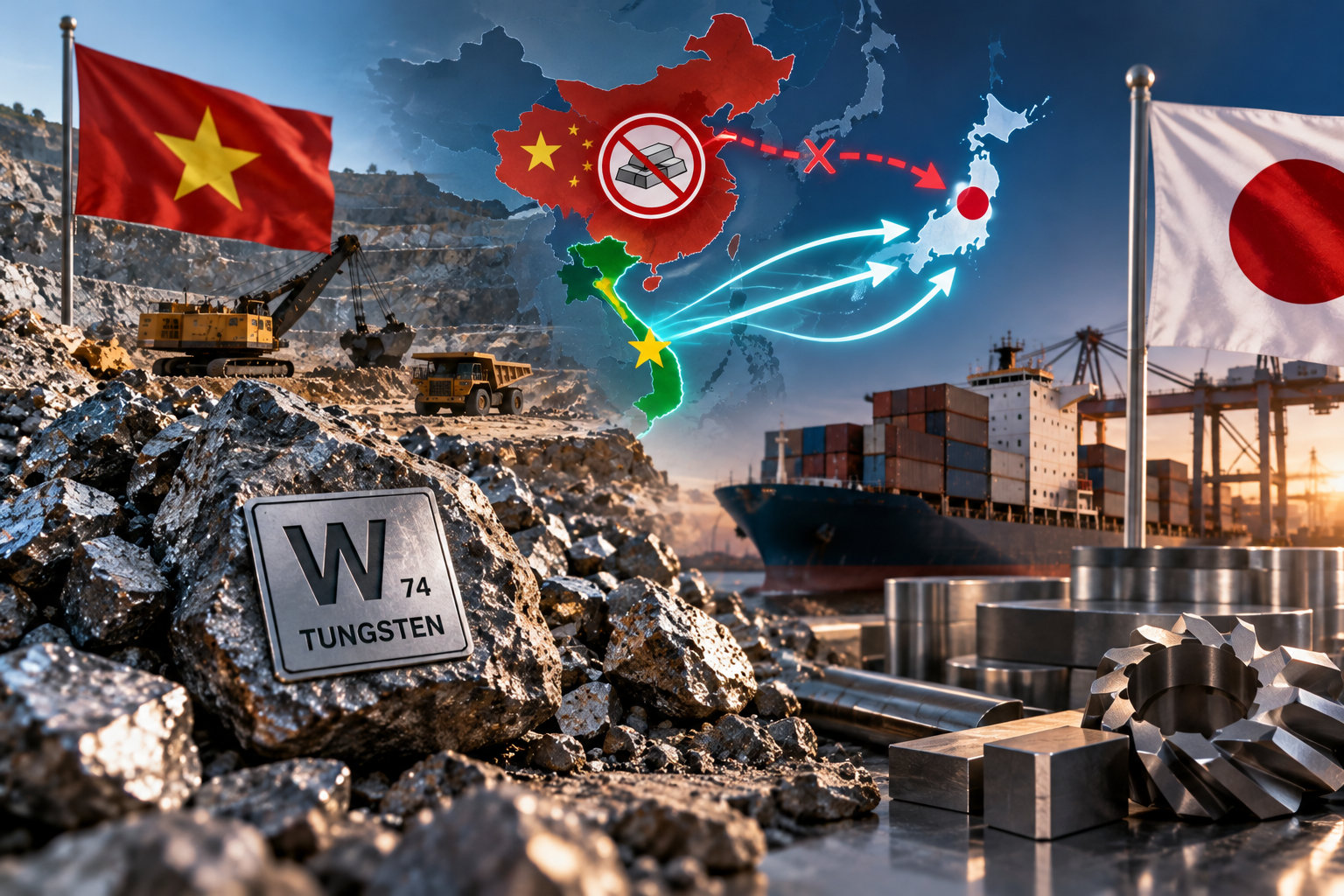
Vietnamese Masan High-Tech Materials, which operates the world's second-largest tungsten mine by output, is looking for strategic investors and buyers. Among the Japanese companies linked to it is Mitsubishi Materials, which in 2024 bought a stake in German tungsten producer H.C. Starck from Masan.
The gist in brief
- In January 2026, China banned supplies of dual-use goods to Japan, including tungsten compounds.
- Vietnam mined about 3,000 tonnes of tungsten in 2025, more than anyone after China, and Masan plans to increase its tungsten oxide capacity to more than 8,000 tonnes per year.
- Mitsubishi Materials has been linked to Masan since 2024 through the H.C. Starck deal.
- In March 2026, Kazakhstan became the world's third-largest tungsten producer, according to Zakon.kz.
Why buyers are looking for an alternative to China
China tightened export controls on tungsten in February 2025. On January 6, 2026, China's Ministry of Commerce announced a ban on supplies to Japan of dual-use goods that could be used by the military. The list included ammonium paratungstate (APT), tungsten oxide and tungsten carbide. According to Fastmarkets, in January-November 2025 China exported about 138 tonnes of APT to Japan, roughly 57% of all Chinese exports of this product. The APT price on January 7, 2026, was $1,090-1,150 per mtu, a standard trading unit. China's exports of tungsten products in May 2026 fell by 17.9% year-on-year, according to SMM estimates.
What Vietnam can offer
Masan operates the Nui Phao mine in Thai Nguyen province, with a license valid until 2034. According to the U.S. Geological Survey, Vietnam was the second-largest tungsten producer after China in 2025, at about 3,000 tonnes. The company plans to increase its tungsten oxide capacity to more than 8,000 tonnes per year and estimates the potential resources for expanding the mine at 115 million tonnes of ore. At the same time, Masan is looking for strategic investors and offering them phased supplies, while, as Bloomberg reported, Japanese, Australian, European and American parties have shown interest. The link with Japan has existed for a long time: in 2024, Masan sold Mitsubishi Materials a stake in H.C. Starck.
What this means for Kazakhstan
Kazakhstan is also vying for a place in the tungsten supply chain outside China. The largest operating project is the Boguty deposit in the Almaty region: China's Jiaxin International Resources, based on the results of the first half of 2026, earned $202.4 million in net profit on revenue of $345.5 million. But the company has not yet built deep processing, that is, APT production: the project is at the design stage.
This is important because the state has a different task. According to a representative of the Center for Trade Policy Development, Kazakhstan does not intend to export raw materials: primary processing and localization of production were named as priorities. At the same time, in 2025 the country exported tungsten ore and concentrate for the first time, about 3,700 tonnes worth $71 million, all to China.
Another bid for the future is a project by the American Cove Capital and Tau-Ken Samruk (70% and 30%) at the Severny Katpar and Verkhneye Kairakty deposits in the Karaganda region. Investments are estimated at about $1.1 billion, with a design capacity of about 12,000 tonnes of tungsten per year, about 15% of current global production. Launch dates have not yet been announced.
Author's conclusion
China's restrictions are forcing buyers to look for other suppliers, and Vietnam is already offering them an operating mine and plant. Kazakhstan has a chance to take a place in this chain, but to do so it is not enough to mine ore: without its own processing, the country will remain a supplier of raw materials.
Comments ()