UNDP discussed three environmental projects for the Caspian Sea with Kazakhstan.
A consultative meeting on UNDP regional initiatives was held at the Kazakh Research Institute of the Caspian Sea.
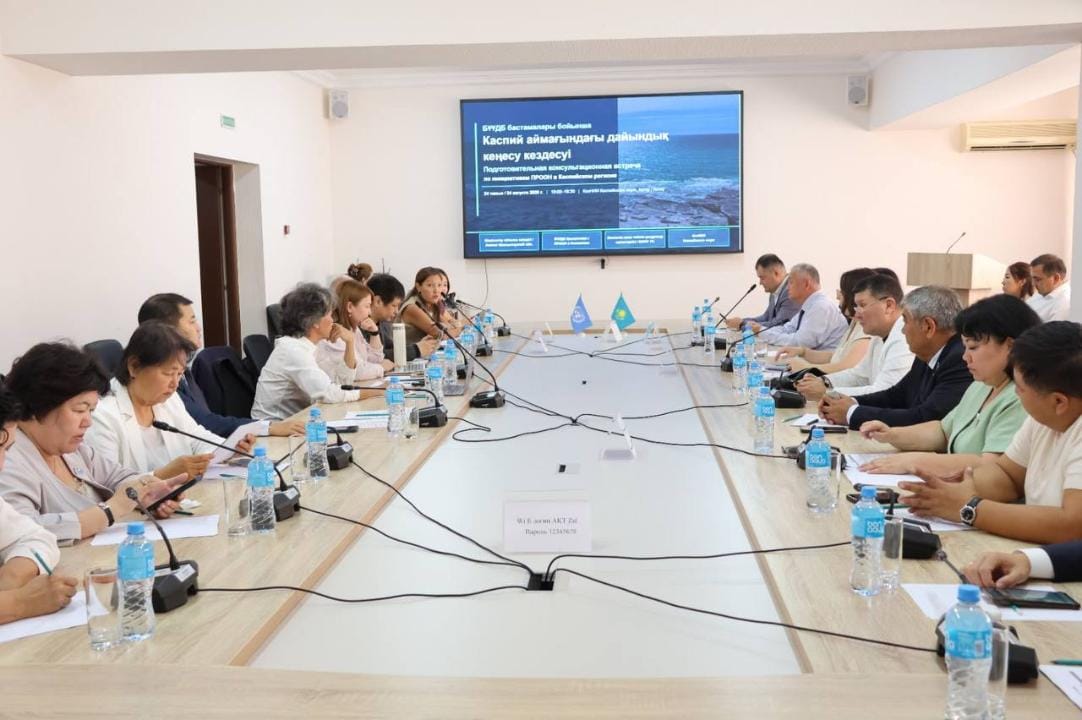
The very choice of venue is telling — an institute created less than a year ago is already becoming a platform for coordinating international environmental projects around the Caspian Sea.
The gist in brief
- On August 24, 2026, a consultative meeting on UNDP initiatives was held at the Kazakh Research Institute of the Caspian Sea, organized by the program's office in Kazakhstan with the participation of the Ministry of Ecology, the akimat and maslikhat of Mangystau Region, Kazhydromet, and environmental NGOs.
- Three projects were at the center of discussion: integrated management of marine and coastal resources of the Kazakh part of the Caspian Sea financed by the Global Environment Facility (Atyrau and Mangystau regions), development of circular economy and waste management, and combating marine plastic pollution and marine debris.
- Funding from the Government of Japan jointly with UNDP was singled out separately — for strengthening monitoring of the Kazakh sector of the Caspian Sea, enhancing regional cooperation, and data exchange.
- Director of the Department of Environmental Culture and Policy of the Ministry of Ecology and Natural Resources of the Republic of Kazakhstan Daulet Yesmagambetov emphasized the need for active involvement of the Kazakh Research Institute of the Caspian Sea itself in the implementation of current and future international projects.
Three UNDP projects
The most large-scale of the three is the project on integrated management of marine and coastal resources, financed by the Global Environment Facility. It covers biodiversity and ecosystem conservation, sustainable management of land and water resources, and the development of nature-based solutions directly in Atyrau and Mangystau regions — areas with the highest concentration of industrial activity on the Kazakh coast of the Caspian Sea. The other two projects address narrower but equally pressing tasks: developing a circular economy and waste management system, as well as preventing marine pollution from plastic and marine debris — with a focus on recycling, attracting "green" investment, and supporting local environmental initiatives.
Japan's role
A separate area of cooperation is joint funding with Japan for a project to strengthen monitoring of the Kazakh sector of the Caspian Sea. In addition to monitoring itself, the project aims to strengthen regional cooperation and data exchange among Caspian littoral states — that is, the logic is the same as already seen in other Kazakh initiatives around the Caspian: standalone national monitoring is less effective than a coordinated regional approach based on unified data collection standards.
The institute as a coordination hub
The choice of the Kazakh Research Institute of the Caspian Sea as the venue for the UNDP meeting is logical. The institute has been operational since September 2025 and already conducts regular observations on 50 parameters in the open water area and 26 parameters in the coastal zone — meaning it has its own scientific base necessary for full participation in such international initiatives, not just for playing the role of host. Yesmagambetov's words about the need to more actively involve the institute in international projects confirm: the Kazakh side views it not as a one-off scientific center, but as a permanent partner for future programs.
Part of a broader Caspian picture
The environmental agenda is developing in parallel with the growing infrastructural burden on the Caspian Sea. We have already written that the laying of the Trans-Caspian fiber-optic communication line between Kazakhstan and Azerbaijan has been completed along the seabed, and in the future a "green" energy cable under the Caspian — Black Sea — Europe project may follow a similar route. The denser the infrastructural load on the water area becomes, the more important it is to build a scientific and environmental protection base in parallel — and this is precisely the role that the combination of the Kazakh institute with international partners such as UNDP and Japan is now taking on.
Author's conclusion
The consultative meeting at the institute's venue is not a one-off event, but another step in the institutionalization of Kazakhstan's work on the Caspian Sea: from isolated scientific observations to coordinated international projects with clear roles and funding sources. The three projects discussed address different but interconnected aspects of a single problem — preserving the ecosystem of a sea that is simultaneously under industrial, transport, and climate pressure — and how quickly these initiatives move from consultations to concrete results on the water will become clear in the coming years.

Comments ()