US ready to lend $400 million to Australian scandium mine
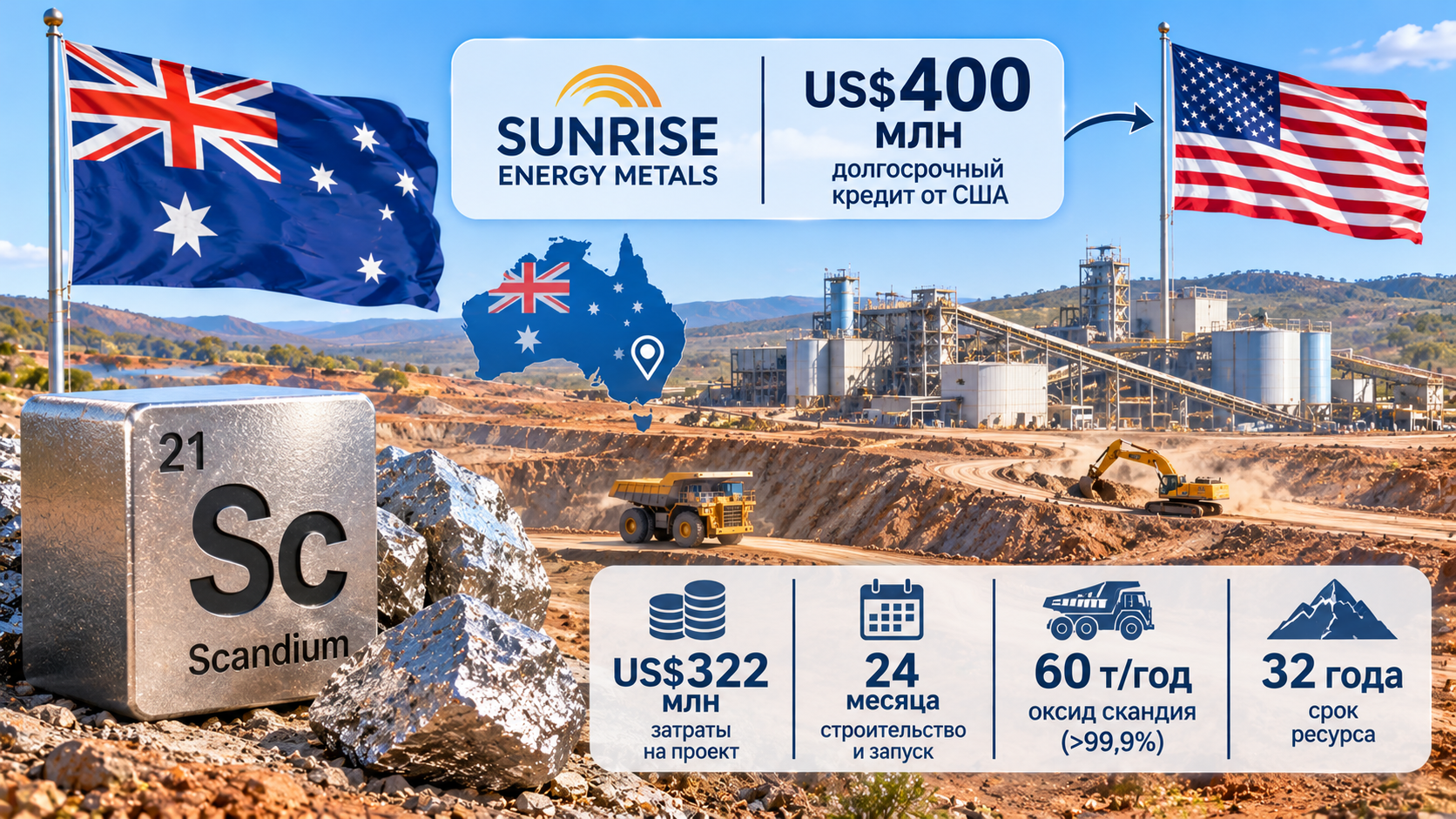
Australia's Sunrise Energy Metals, led by billionaire Robert Friedland, has approved construction of the Syerston scandium mine and processing plant in New South Wales.
The company plans to obtain its first production in the second half of 2028. The decision to launch the project was published in Sunrise's exchange announcement.
The essence in brief
- The final investment decision on the Syerston project was made on November 2, 2026.
- Development costs are estimated at US$322 million, and construction and launch will take 24 months.
- The plant will produce 60 t per year of scandium oxide with a purity of more than 99.9%, and the mine's resource life is estimated at 32 years.
- For a long-term loan of up to US$400 million, the company has a conditional commitment from the U.S. Department of Defense's Office of Strategic Capital.
What will be built
Syerston is located in New South Wales and is wholly owned by the company. The mine will process 64,000 t of ore per year and produce scandium oxide, that is, a compound from which the metal is then made. The average scandium concentration in the first ten years will be 690 g per tonne of ore. The mine is designed for 32 years: 21 years of open-pit mining, followed by another 11 years of processing stockpiled ore.
Work is already underway. Construction of a water pipeline began on October 9, and an autoclave is being built on site, that is, an apparatus in which ore is leached under pressure. The facility that converts oxide into metal was not included in the cost estimate: it is still only being studied.
Why scandium matters
Scandium is classified as a rare earth element. It is used in the defense industry, in fuel cells for artificial intelligence data centers, and in modern semiconductors. The company notes that after China introduced export controls on critical minerals in 2025, scandium supplies to key Western markets virtually ceased.
Friedland said that the decision to launch the project followed extensive technical work, and that Syerston is capable of "fundamentally changing" the current dynamics. According to him, the use of scandium has been constrained by the lack of reliable large-scale supplies.
Where the money comes from
The Office of Strategic Capital's conditional commitment for a long-term loan of up to US$400 million remains the main stated source of borrowed funds for the project. The amount exceeds the estimated development costs, and the loan terms are not disclosed in the announcement. In addition, Sunrise is preparing a change of registration: the parent company will be moved from Australia to the United States through a new holding company in the state of Delaware, and a listing of shares on the Nasdaq exchange is planned. The agreement to implement this scheme was signed on October 2, and a brochure for shareholders is promised soon.
What is happening with rare and rare earth metals in Kazakhstan
In October, the authorities announced that the country will create a regional research center for rare earth metals with the participation of EU institutes. Construction of the laboratory complex is planned to begin in 2027, with full operation expected by the end of 2028. The EBRD helped prepare a preliminary feasibility study.
The Ulba Metallurgical Plant, a subsidiary of Kazatomprom, is searching for beryllium, tantalum and niobium in the Karaganda region because the plant's stockpiles of these metals are declining. Geological exploration at the Vostochny-1 site is planned for 2027-2029.
Europe is also showing interest in the region's minerals: it is being invited to invest in processing. The authorities estimate Kazakhstan's inferred rare earth metal resources at 935,400 t.
Author's conclusion
The project shows how critical mineral supplies are being built around China: an Australian mine, an American loan, and the relocation of the company's registration to the United States. But the scale is still modest, only 60 t of oxide per year, and the launch is planned no earlier than the second half of 2028. The U.S. loan remains conditional, and its terms have not been disclosed, so the launch date is still only a plan.
Comments ()