Uzbek greenhouse growers ask to be allowed to import coal directly, including from Kazakhstan
Greenhouse owners in Uzbekistan propose tying coal import volumes to greenhouse area and paying for coal with export foreign currency earnings.
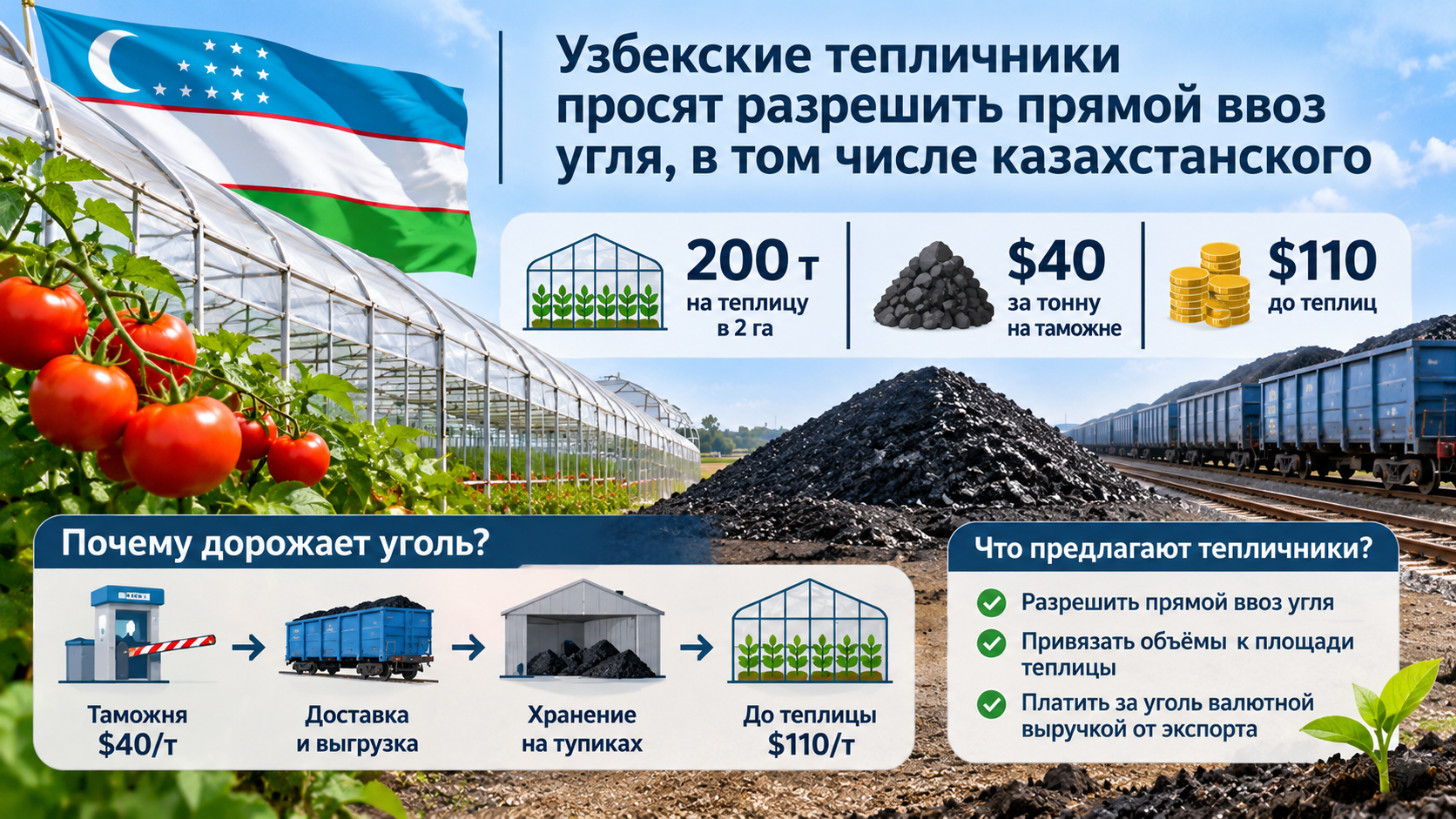
According to entrepreneurs, Kazakh "Shubarkol" coal costs 40 US dollars per ton at customs and reaches greenhouses at about 110, writes Spot.uz.
The gist in brief
- Greenhouse owners are asking to be allowed to import coal directly in order to reduce heating costs.
- They propose tying import volumes to greenhouse area, for example 200 tons per greenhouse of 2 hectares.
- In return, they promise to legalize the business, report on exports and pay for coal with export earnings.
- From December 1, only greenhouses with a positive conclusion from the state environmental review will be able to use coal.
What greenhouse owners are asking for
On November 16, entrepreneurs met with government representatives at the Chamber of Commerce and Industry. Entrepreneur Khurshid Akhmedov said that labor in Uzbekistan is cheap, and the main problem for greenhouses is fuel: it accounts for about 90% of the cost of a kilogram of greenhouse tomatoes.
Greenhouses are asking to be allowed to import coal directly and to tie volumes to area, for example 200 tons per greenhouse of 2 hectares. In return, they are ready to legalize the business, report on exports and buy coal with currency earned from exports. They are not asking for loans or subsidies; they need clear conditions, the possibility of import and a small customs concession.
How much coal costs and why it is getting more expensive
According to Akhmedov, Kazakh "Shubarkol" coal clears customs at 40 US dollars per ton and arrives at the greenhouse at 110. At the Chernyaevka border crossing, coal is offered at 32 US dollars per ton with delivery by trucks. Customs posts near Tashkent accept coal only by rail. Through Kyrgyzstan, trucks take no more than 20 tons, a trip costs about 1000 US dollars, and the price per ton still remains around 100 US dollars.
Last year the president abolished one enterprise's monopoly on 66 railway sidings where coal is unloaded, and now various importers can use them. But unloading and storage costs remain high. Akhmedov himself imported Kazakh coal in 2022 but stopped because of additional payments to the owner of the siding. In winter there is a shortage of railcars, and coal is first taken to remote villages.
What will change from December 1
For greenhouses in Tashkent and five neighboring districts, a special environmental regime has been proposed: farms that heat with solid fuel must switch to gas, electricity or other permitted energy sources by December 1. Only greenhouses with a positive conclusion from the state environmental review will be able to use coal. They will have to install filters, continuous emissions monitoring systems and build warehouses for coal and ash. Earlier, the Ministry of Energy of Uzbekistan advised greenhouse farms to switch to other fuel, since gas reserves are being depleted, but producers say they are not ready for this.
What about Kazakh coal
Kazakhstan remains a notable supplier of coal to foreign markets. At the beginning of 2026, exports grew by 5% to 12.6 million tons, while production in the country decreased by 1.8% to 45 million tons. Russia remained the largest buyer, while Uzbekistan bought 916.6 thousand tons, 1.6 times more than a year earlier.
Within the country, coal supplies for the heating season are monitored centrally: in August, the Ministry of Energy launched a unified digital platform that tracks coal from extraction and shipment to delivery to the regions and sale to consumers.
Author's conclusion
The greenhouse owners' request shows that the price is determined by the import chain: between customs and the greenhouse, coal becomes more expensive because of unloading and storage at railway sidings, restrictions on delivery methods and a shortage of railcars. Until these conditions change, Kazakh coal for Uzbek greenhouses will keep getting more expensive along the way, even if it is inexpensive at customs.

Comments ()