Green Climate Fund supported forest and pasture restoration in Central Asia
The Green Climate Fund (GCF) approved the "Climate-Resilient Landscapes in Central Asia" program for Uzbekistan, Kyrgyzstan and Tajikistan.
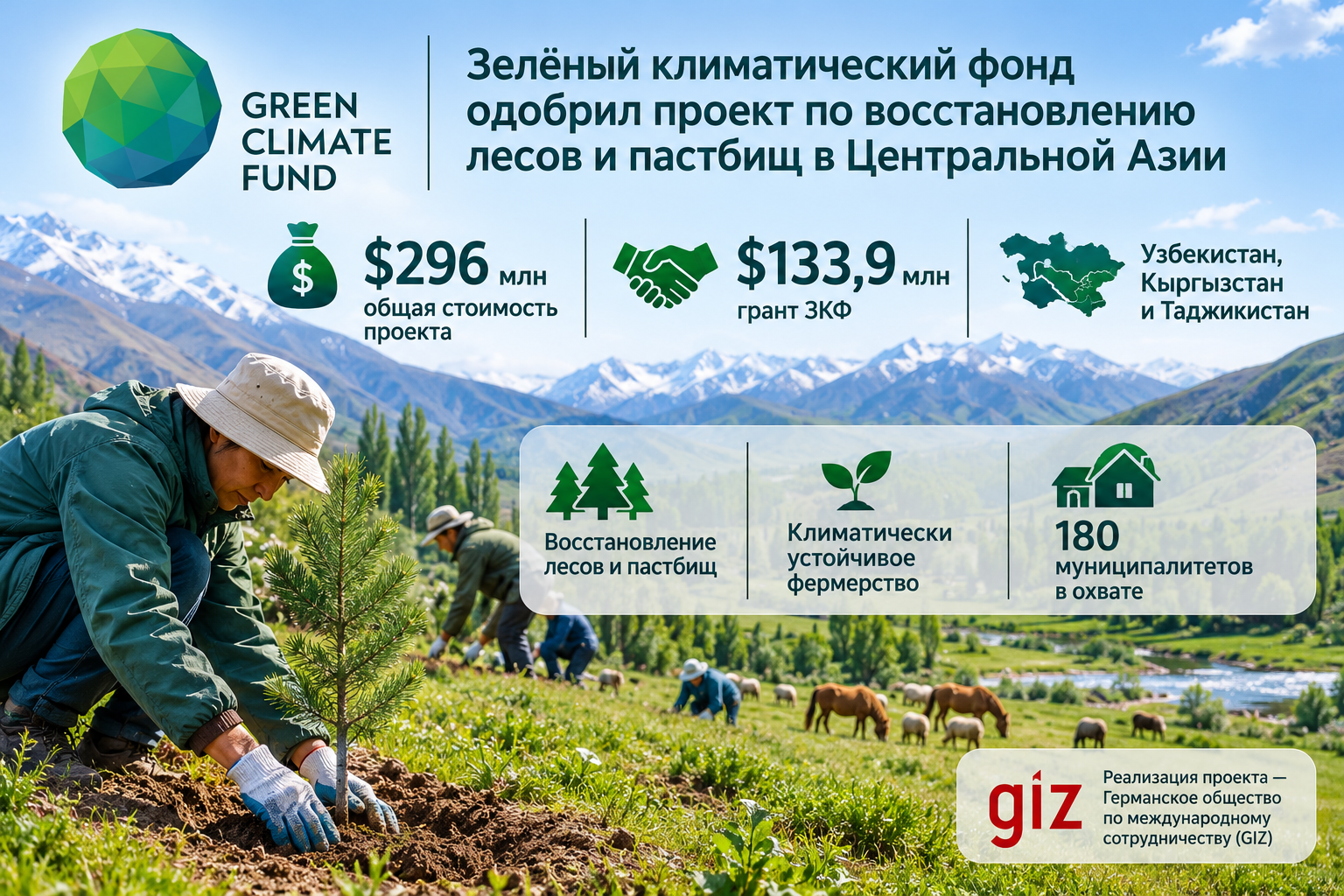
The total project cost is $296 million, of which the fund's grant is about $133.9 million, and the rest is co-financing, a significant part of which will consist of loans, reports the Green Climate Fund on the FP322 project page.
The gist in brief
- The fund's board approved the project on October 28, 2026; according to the fund, implementation has not yet begun.
- Total cost is $296 million, the GCF grant is about $133.9 million.
- The project will cover 180 municipalities: adaptation plans, restoration of forests and pastures, climate-resilient farming.
- The organization through which the fund implements the project is the German Society for International Cooperation (GIZ).
What is known about the program
The project falls under the areas of "forests and land use," "livelihoods," and "ecosystems." In 180 municipalities, district adaptation plans, restoration of forests and pastures, climate-resilient farming, as well as training, consultations, and grant co-financing are envisaged. At the national level, the project is expected to improve climate and land information, integrate climate accounting into planning, and strengthen the capacity of local financial institutions to lend for climate-resilient investments. The regional component includes knowledge exchange, a climate investment platform, and adaptation plans for transboundary landscapes.
According to the fund's estimate, the project will prevent emissions of about 7 million tonnes of CO2 equivalent and increase the resilience of approximately 2.5 million people. The beneficiaries are identified as small farmers, women, youth, rural enterprises, and users of forests and pastures without access to commercial financing.
How much money and from where
Of the $296 million, the GCF grant accounts for about $133.9 million, and co-financing for about $162.1 million. On the fund's page, the co-financing includes a grant, a loan, and in-kind contributions, but it does not specify who provides each part. Lending is envisaged through the European Investment Bank and local financial institutions.
"Fergana", citing the fund's documents, gives the same amounts in euros: 264.4 million euros in total, of which about 119.6 million euros are GCF grants and 144.8 million euros are co-financing, which includes grants from Germany, loans from the European Investment Bank, and country contributions. According to the publication, the loan financing still requires additional approvals. The fund and the publication cite amounts in different currencies, so there is no conversion in the text.
What each country will receive
According to "Fergana," in euros, Uzbekistan is allocated 103.75 million, Kyrgyzstan 74.49 million, Tajikistan 72.25 million, and another about 13.89 million will go to regional activities and administrative expenses. The program is designed for seven years; practical implementation, as the publication writes, should begin in 2027. In the three countries, sustainable management practices are planned to be introduced on approximately 939 thousand hectares.
In Uzbekistan, the projects will cover 15 districts of the Andijan, Namangan, Fergana, and Surkhandarya regions: there they want to restore 18 thousand hectares of forests and 123 thousand hectares of pastures, introduce drip irrigation and drought-resistant crops, and 12 thousand farmers will receive consultations. In Tajikistan, the main work will be concentrated in vulnerable areas of the Khatlon region and the Fergana Valley: restoration of mountain ecosystems, slope stabilization, protection of catchment areas, and modernization of irrigation. In Kyrgyzstan, special attention will be given to the preservation of mountain landscapes, forests, and pastures.
Why the region needs this program
"Fergana" cites a report by the World Meteorological Organization (WMO): the period from 2021 to 2025 became one of the driest for rivers since observations began in 1991, and terrestrial water reserves remained below normal for the second year in a row, especially in the Aral Sea basin. According to WMO estimates, more than half of Central Asia's river flow is formed by snow and ice, and the mass balance of the region's glaciers turned out to be one of the three most negative in the entire history of observations.
What is happening with land restoration in Kazakhstan
Kazakhstan is not participating in the program, but it has its own projects, and in terms of the area of land covered by restoration, the country, according to the UN report "Nature's Comeback," turned out to be third in the world. The law on soil protection has come into force, and landowners are now obliged to preserve the fertile layer and prevent erosion and soil depletion. Kazakhstan and FAO have launched three projects: on soil carbon, on combating locusts with drones, and on reviving the aport apple. On the bottom of the Aral Sea, phosphogypsum from fertilizer waste is being tested for restoring saline soils, and environmentalists have proposed creating a commission to restore pastures where 26 million hectares have degraded.
Author's conclusion
The GCF approval is a financing decision, not the start of work: the fund states that the project has not yet begun, and the loan portion, according to "Fergana," requires additional approvals. Real results will become visible when the program begins work in the municipalities and the first reports on restored hectares appear, which are not yet available on the fund's page.
Comments ()