Uzbekistan and Austria discussed expanding trade in breeding livestock
Uzbekistan’s Food Safety Committee discussed with the Austrian Agricultural Cluster (AAC) expanding trade in breeding cattle and joint livestock projects.
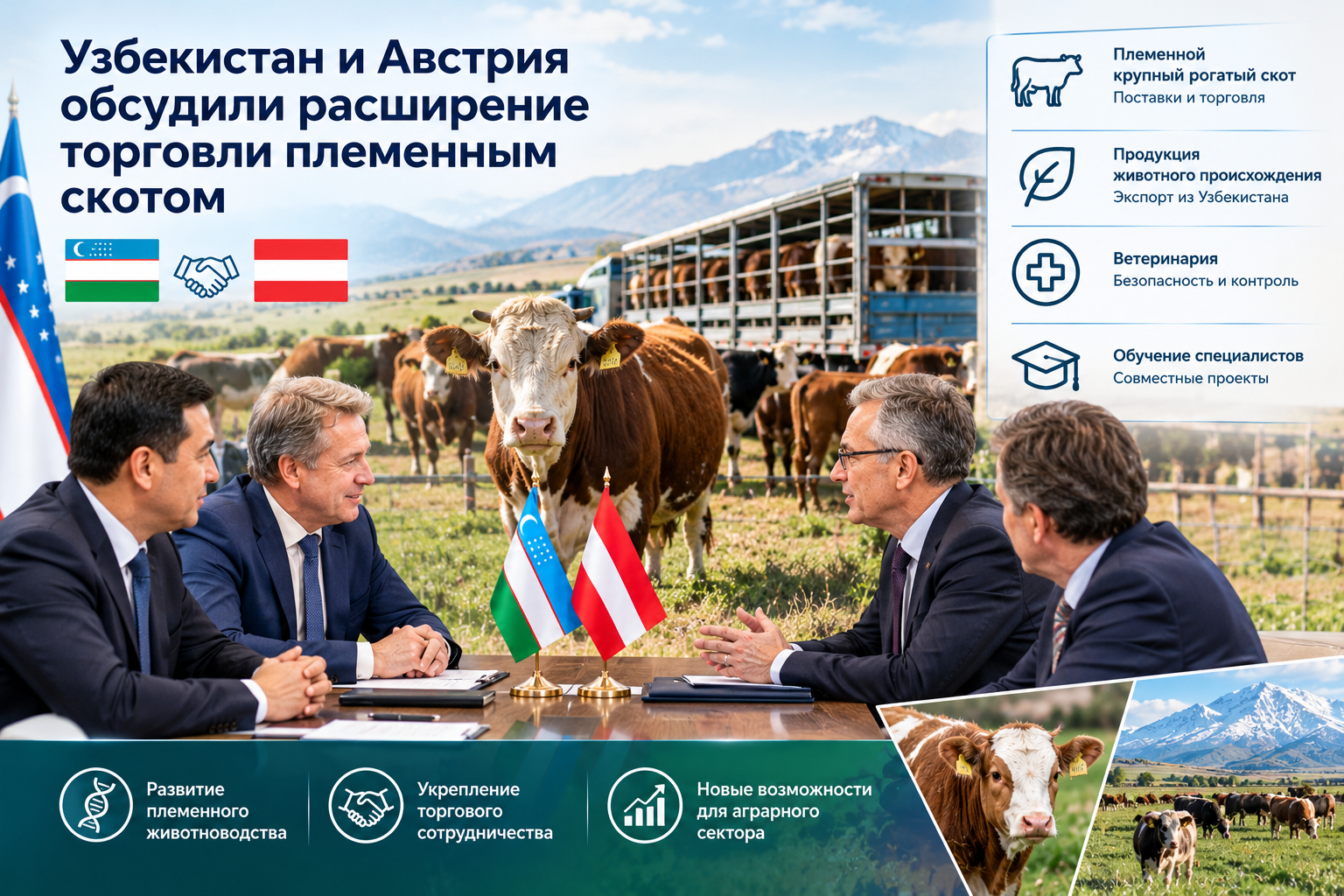
The Chairman of the Committee for Food Safety Azizbek Urunov met with the General Director of the Austrian Agricultural Cluster (AAC) Hermann Wieser and the Trade Counselor of the Austrian Embassy Rudolf Lukawski. The parties discussed livestock supplies, exports of Uzbek products of animal origin, veterinary medicine, and specialist training, reports UzDaily.
The essence in brief
- Uzbekistan and Austria discussed expanding trade in breeding livestock and the export of Uzbek products of animal origin.
- According to the committee, 1,500 head of Simmental breeding cattle, 714 tons of veterinary drugs and feed additives, and 4.7 tons of dairy products were imported from Austria.
- Uzbekistan sent 34.5 tons of products of animal origin to Austria.
- The parties considered joint projects on the production and transplantation of breeding livestock embryos, training of veterinarians, and seminars with Austrian experts.
What was discussed
The meeting discussed trade in breeding livestock, organizing exports of products of animal origin from Uzbekistan, and the exchange of experience in veterinary medicine. A separate topic was the application of Austrian practices in breeding livestock and genetics. Breeding livestock refers to cattle kept to produce offspring with desired qualities, rather than for meat or milk.
What is already being supplied
According to the committee, as of October 2026, 1,500 head of Simmental breeding cattle were imported from Austria to Uzbekistan. The Simmental is a dual-purpose beef-and-dairy breed developed in Switzerland and widespread in Austria. In addition, 714 tons of veterinary drugs and feed additives and 4.7 tons of dairy products were imported. In the opposite direction, Uzbekistan sent 34.5 tons of products of animal origin to Austria.
Embryos and training
The parties considered joint projects on the production of breeding livestock embryos and their transplantation. The method makes it possible to obtain offspring from valuable animals without transporting the animals themselves: embryos are obtained from a breeding cow and transplanted into others. For Uzbek veterinarians, advanced training in Austria was discussed, and in Uzbekistan itself, practical seminars and trainings with the participation of Austrian experts.
What this means for Kazakhstan
Uzbekistan also purchases meat and livestock from Kazakhstan. In 2025, it bought about 32 thousand tons of beef and 34 thousand tons of lamb from us for a total of about $300 million, which is more than 90% of Kazakhstan's meat exports. In August, the Chairman of the Chamber of Commerce and Industry of Uzbekistan Davron Vakhabov proposed leasing up to 50 thousand hectares in Kazakhstan for livestock fattening. For now, this is an idea without agreed terms.
Trade in live livestock is also growing: in January-May 2026, Kazakhstan sent 48.7 thousand head of sheep to Uzbekistan, which is 3.3 times more than a year earlier. About 17.6 thousand head of horses went to the neighbor.
Author's conclusion
The meeting consolidates Uzbekistan's interest in Austrian genetics and expertise: breeding livestock are already being imported, and the next step is embryos and specialist training. For now, these are intentions: there are no timelines or funding volumes for new projects. Whether the Uzbek market will become a permanent one for Austrian partners will be shown by the first joint embryo projects.

Comments ()