Uzbekistan prepares for construction of second nuclear power plant
Uzbek President Shavkat Mirziyoyev announced upcoming preparations for a second nuclear power plant, citing the need for stable, cheap electricity to attract investment.
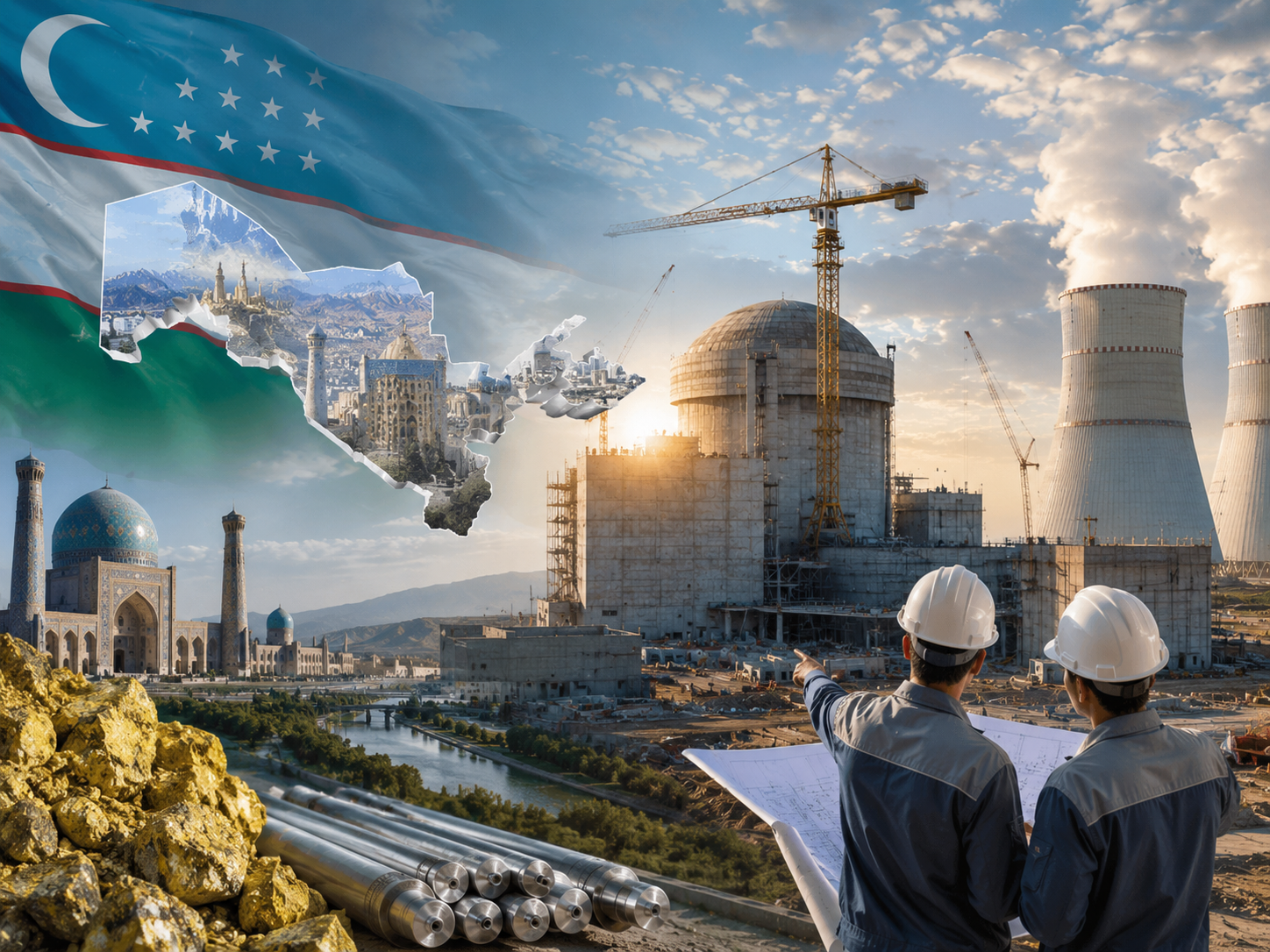
In Kazakhstan, Rosatom has already been officially selected as the partner for the Balkhash NPP, and field work at the site is being completed — but while the country is occupied with its first plant, neighboring Uzbekistan is already thinking about the next one. President Shavkat Mirziyoyev has announced that preparations for a second nuclear power plant will begin soon — even though construction of the first plant has only just entered its active phase.
The gist in brief
- The President of Uzbekistan, Shavkat Mirziyoyev, has announced that preparations for the construction of a second nuclear power plant in the country will begin soon, linking this to the need to provide the economy with stable and cheap electricity supply to attract investment.
- The current integrated NPP project in the Jizzakh region provides for two large power units with VVER-1000 reactors of generation 3+ and two small-capacity power units with RITM-200N reactors of 55 MW each — the total capacity of the plant will exceed 2.1 GW.
- On June 4, 2026, a ceremony was held in the Farish district to lay the first power unit — the pouring of the first concrete marked the official start of construction.
- Uzbekistan has significant uranium reserves — 10th place in the world in reserves and 5th in production, and the country's demand for electricity could double within the next 10 years.
The logic behind the second plant
Mirziyoyev announced the plans at a ceremony launching new projects in the Khorezm region on August 17:
"Today I want to reveal a secret to you: in the near future, we are beginning major preparations for a second nuclear power plant."
The President directly linked the development of nuclear energy to the country's investment attractiveness — according to him, potential investors are primarily interested in the cost of electricity and guarantees of its supply, and without reliable and affordable energy supply, the country's development strategy until 2030 cannot be implemented.
What has already been built — the first integrated NPP
The current project in the Jizzakh region is being implemented jointly with Rosatom and, since September 2025, has an updated configuration: two large power units with VVER-1000 reactors of generation 3+ and two small-capacity power units with RITM-200N reactors of 55 MW each.
In October 2025, earthworks for the excavation pit began at the small NPP site, in March 2026 the first concrete works started, and on June 4 the official ceremony for laying the first power unit took place.
The site in the Jizzakh region, according to former head of Uzatom Azim Akhmedkhodjaev, has already been sufficiently studied and allows additional power units to be placed relatively quickly — which is why the Farish district was considered a promising site even before the announcement of the second plant.
Uzbekistan's uranium base
One of the key advantages cited by the Uzbek leadership is its own resource base: the country ranks 10th in the world in confirmed uranium reserves and 5th in production volume.
For comparison, Jordan recently announced a similar strategy — turning uranium reserves into a tool for long-term energy independence, having declared proven reserves of 42 thousand tons of uranium, enough for 80 years of operation of future nuclear plants. The difference in scale is significant — Kazakhstan, as the world's largest uranium producer, is incomparable to Uzbekistan, let alone Jordan — but the overall trend is telling: countries with their own uranium are increasingly viewing nuclear energy not only as a way to solve the problem of energy shortages, but also as a way to monetize available resources. The growing interest in nuclear energy naturally raises questions about its safety — we have already examined this case in detail using the example of the VVER-1200 reactors that are also being built in Kazakhstan.
Why this matters for Kazakhstan
Nuclear energy in Central Asia and neighboring regions is experiencing a synchronized surge across several countries at once. Kazakhstan is building its first plant near Balkhash, Armenia is conducting parallel negotiations with five countries at once for a plant to replace the operating Metsamor facility, and now Uzbekistan is moving from preparing its first NPP to announcing a second, without yet completing construction of the first.
For Kazakhstan's nuclear program, this means growing regional competition for equipment suppliers, contractors, and qualified personnel — but also a growing pool of regional experience that can serve as a reference as the Uzbek project in the Jizzakh region goes through the same stages that lie ahead for Balkhash.
Author's conclusion
Uzbekistan's readiness to announce a second plant before pouring concrete on most of the first plant's power units demonstrates the level of confidence in its own nuclear program — or, at the very least, the level of political determination to project that confidence. For Kazakhstan, where the public discussion around the Balkhash NPP is still ongoing, Uzbekistan's pace serves as a practical benchmark for how quickly such a project can develop with consistent state support and partnership with the same technology supplier.

Comments ()