Uzbekistan reforms environmental assessment — and studied Kazakhstan's experience
Uzbekistan shifts its environmental impact assessment to new international standards — with e-filing, screening and scoping procedures, and broader public participation.
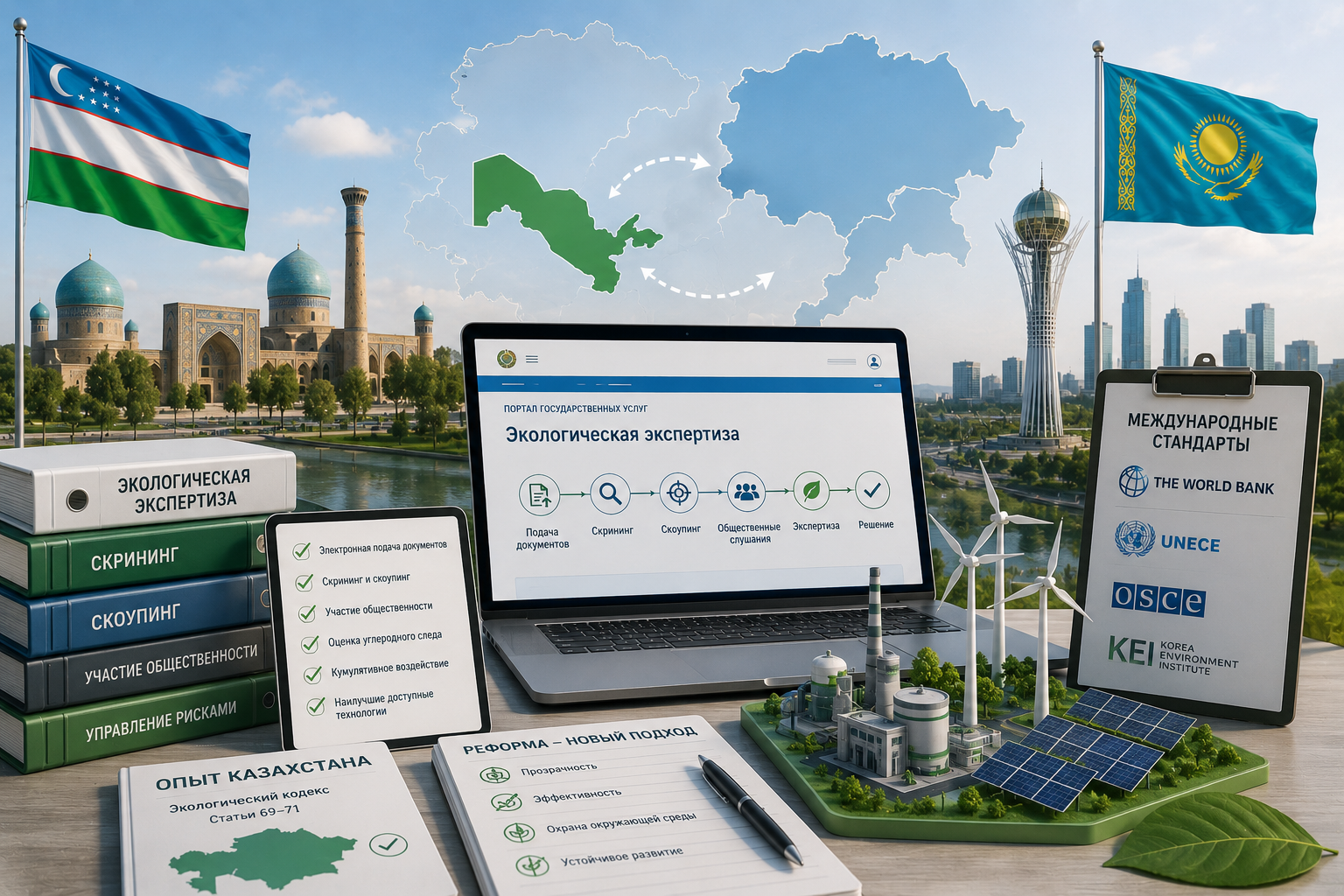
When developing the reform, the experience of other countries was studied, including Kazakhstan, although Kazakhstan itself enshrined such mechanisms in its Environmental Code several years earlier.
The gist in brief
- The Cabinet of Ministers of Uzbekistan, by Resolution No. 234 of May 11, 2026, is introducing a comprehensive modernization of state environmental review and environmental impact assessment (EIA).
- For the first time in the country, international screening and scoping procedures are being introduced — they determine the need for environmental assessment and its scope at an early stage of project preparation.
- In developing the document, the experience of 11 countries was studied, including Kazakhstan, as well as expertise from the World Bank, the UN Economic Commission for Europe, the OSCE, and the Korea Environment Institute.
- Environmental review is being fully transitioned to an electronic format through a unified government services portal, and the classification of facilities has been reduced from four categories to three.
What is changing in Uzbekistan
As reported by Uzdaily, the reform covers not only the procedural part but also the substantive content of the review. For the first time, the system introduces an assessment of the carbon footprint and greenhouse gas emissions, consideration of the cumulative impact of several facilities on the same territory, and a requirement to apply the best available environmental technologies. Public participation is being expanded separately — an institution of public environmental review is being introduced, and the number of official categories of facilities by degree of environmental impact is being reduced from four to three, which should simplify the system for businesses. As emphasized by the Director General of the State Center for Environmental Expertise, Gairat Mukhamedov, the review ceases to be an exclusively permitting procedure and is being transformed into an environmental risk management system that identifies possible consequences at the project planning stage.
Kazakhstan has already traveled this path
A telling detail of the Uzbek reform is the list of countries whose experience the developers studied: Japan, Germany, the Republic of Korea, European Union countries, Canada, the United States, Turkey, Georgia, Singapore, Russia, and Kazakhstan. At the same time, the screening and scoping procedures that Uzbekistan is only now introducing are enshrined in separate articles of the Kazakh Environmental Code — Article 69 defines the screening of impacts of proposed activities, Article 70 establishes criteria for the significance of impacts, and Article 71 describes the determination of the scope of the assessment. The Code also provides for a separate procedure for strategic environmental assessment of government programs and concepts — the same thing that is now appearing in Uzbek legislation. In other words, Kazakhstan in this story acts not so much as a neighbor repeating a common trend, but as one of the practical sources relied upon in developing the new Uzbek regulation.
Why neighbors study each other
The convergence of environmental regulation in Kazakhstan and Uzbekistan with international standards is not a coincidence, but part of a broader competition for foreign investment in Central Asia. International investors and development banks — from the World Bank to the EBRD — when choosing a location for large projects, assess, among other things, the predictability and transparency of environmental regulation; a country with an unclear or overly bureaucratized EIA system risks losing out to neighbors with more understandable rules. Studying each other's experience in such a situation is a rational strategy: why create a procedure from scratch when you can evaluate what has already worked for a neighboring country with similar economic conditions.
Author's conclusion
The reform in Uzbekistan is interesting not in itself, but as a reason to look at one's own system from the outside: what looks new and international to Uzbek officials has been in effect in Kazakhstan for several years as part of the Environmental Code. This is not a reason for complacency — the formal presence of screening and scoping procedures in the law does not guarantee their high-quality application in practice — but it is a useful benchmark for assessing the Kazakh EIA system not in a vacuum, but in comparison with where regional neighbors are now heading.

Comments ()