Uzbekistan's radioactive waste storage facilities will last only 5 years
Uzbekistan has finally confronted a long-deferred issue: its radioactive waste storage facilities are reaching full capacity.
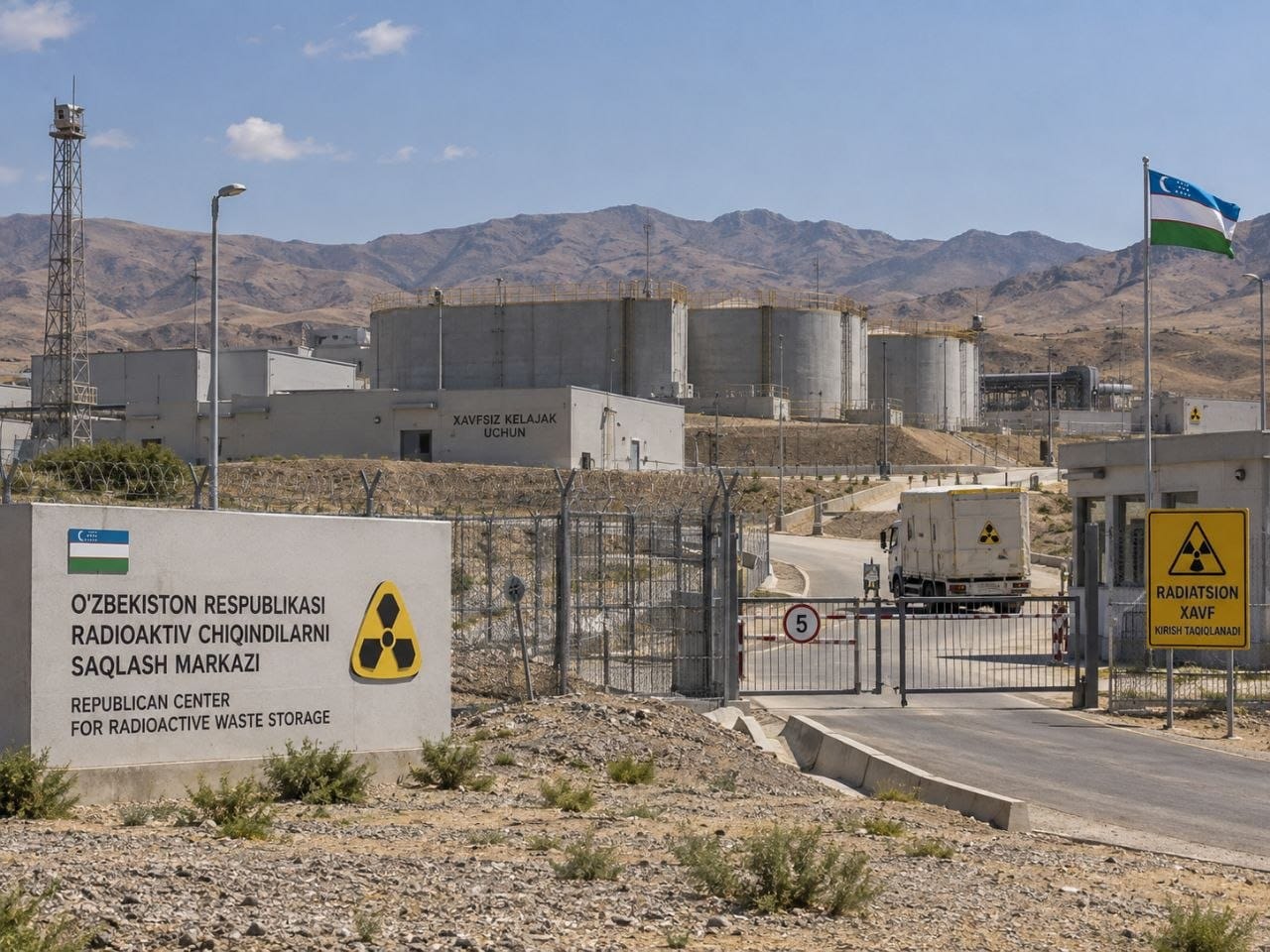
While existing capacities are still holding, the country is hastily adopting the first comprehensive law in its history regulating this entire sphere, and in the process of drafting it directly references Kazakhstan's experience.
The gist in brief
- The capacity of the existing Republican Radioactive Waste Storage Center of Uzbekistan may last for approximately another 4–5 years — of the 10 storage facilities, 4 are already full, while the rest are filled to 50–92%.
- The Legislative Chamber of the Oliy Majlis has passed in the first reading the draft law "On Radioactive Waste Management" — the first comprehensive document on this topic in the country's history, even though Uzbekistan already operates a research nuclear reactor and is building a nuclear power plant.
- A separate problem is the Soviet uranium legacy: from 1964 to 1994, more than 57 million tons of uranium waste accumulated at the tailings pond of Hydrometallurgical Plant No. 1 of the Navoi Mining and Metallurgical Combine, and the absence of a legal framework for long-term monitoring of already buried waste limits the possibilities for their further remediation even with foreign funding available.
- In drafting the bill, the experience of eight countries was studied, including Kazakhstan, and out of 181 IAEA member states, only 81 countries regulate radioactive waste management with a dedicated law.
Five years until overflow
Deputy Chairman of the Committee for Industrial, Radiation and Nuclear Safety under the Cabinet of Ministers of Uzbekistan Sardorbek Yakubekov described the situation without embellishment: "Currently, of the 10 storage facilities at the center, 4 are full, and the fill level of the rest ranges from 50% to 92%. The available capacity for receiving waste may last for approximately another 4–5 years."
The country today has about 2,500 radioactive sources used by approximately 176 organizations — and all spent sources must ultimately end up at this center. At the same time, until now Uzbekistan has not had a separate law comprehensively regulating the entire cycle of managing such waste — from generation and processing to storage, transportation and disposal.
Uranium legacy without a legal framework
The part of the report devoted to the Soviet uranium legacy is particularly telling. Over 30 years of operation of the Navoi Mining and Metallurgical Combine (1964–1994), more than 57 million tons of uranium waste accumulated at the tailings pond of Hydrometallurgical Plant No. 1. In 2023–2025, with a grant from the European Bank for Reconstruction and Development in the amount of €9 million, it was possible to remediate facilities in Yangiabad and Charkesar — but, according to Yakubekov, further work is hampered precisely by the absence of a legal framework for long-term monitoring of already buried waste, which limits the ability to attract new tranches of financing from the same EBRD.
Kazakhstan's experience as one of the models
The drafters of the bill directly studied the practices of eight countries — the United States, Belgium, Germany, France, Sweden, South Korea, Russia and Kazakhstan — and also obtained conclusions from six foreign experts and eight specialists from Uzbek agencies. The reference to Kazakhstan's experience is natural: Kazakhstan previously chaired the CIS Regional Competence Council on Radioactive Waste Management, established on the basis of the National Nuclear Center in Kurchatov, and the international IAEA Low-Enriched Uranium Bank has already been placed in Ust-Kamenogorsk. But Kazakhstan also has a far more concrete, recent example of a practical solution to precisely the task Uzbekistan is only now approaching: Deputy Chairman of the RK Atomic Energy Agency Gumar Sergazin reported back in November 2025 that radioactive waste from the future Kazakhstani nuclear power plant — about 50 cubic meters from two reactors — will be disposed of on the territory of the former Semipalatinsk nuclear test site, and the National Nuclear Center will begin field work in 2026 to create the disposal facility itself. According to him, the disposal rules are being developed taking into account the experience of Finland, where high-level waste is buried at a depth of 400 meters, and the function of the national operator for radioactive waste management is planned to be assigned specifically to the National Nuclear Center.
A common document for the entire CIS
The Uzbek-Kazakhstani exchange fits into a broader regional framework: in April 2026, the CIS Economic Council approved the main directions of cooperation among member states in the field of radioactive waste management, spent nuclear fuel and decommissioning of nuclear and radiation hazardous facilities for the period up to 2030. The document was developed by TVEL — the fuel division of Rosatom, which serves as the CIS basic organization on this topic — and covers harmonization of legislation, infrastructure development, personnel training and technology exchange among Commonwealth countries. The fact that Uzbekistan is now adopting its own national law shortly after the emergence of this common regional framework shows that CIS countries are moving toward the nuclear legacy topic in sync — from general declarations to specific national laws and practical solutions such as Kazakhstan's choice of a site in Semipalatinsk.
Controversial provisions of the law
Not everything in the draft law went smoothly even in the first reading. Deputy Zafar Khudoyberdiev drew attention to a contradiction between the provisions on "ownerless" radioactive waste and state ownership of waste containing nuclear materials. Yakubekov explained that ownerless waste primarily refers to facilities of former Soviet-era uranium mines that were effectively left without an owner, whereas the specialized long-term storage center in the Parkent district is state property. The drafters agreed to refine the controversial provisions for the second reading — a working, though not final, compromise.
Author's conclusion
The story of the Uzbekistani draft law illustrates a typical scenario for countries that have accumulated nuclear and uranium legacy for years without a unified legal framework: the real shortage of storage capacity arrives earlier than systematic regulation, not the other way around. The fact that Uzbekistan directly studied Kazakhstan's experience in drafting its own law is practical confirmation that Kazakhstan in recent years has built not just individual nuclear facilities, but a full-fledged regional expertise in this sphere that is in demand among its neighbors.

Comments ()