“We are throwing away energy we have already paid for” — how Europe wants to use waste heat
Two-thirds of all energy produced worldwide in 2024 simply vanished into the air as heat.
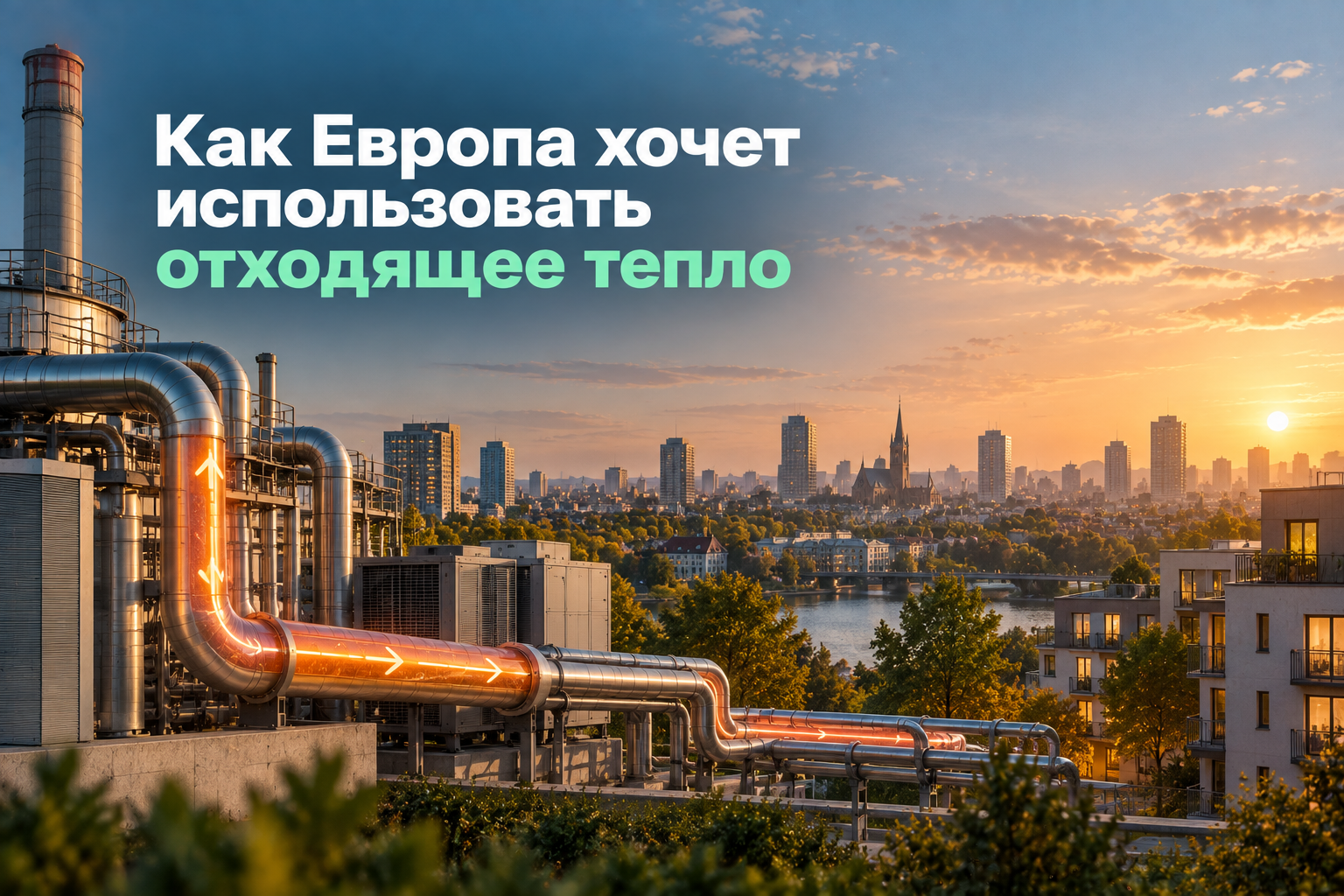
A new report from Danish company Danfoss calls this waste the largest untapped energy source on the planet — and proposes starting to treat it as a resource rather than an inevitable cost, writes Euronews.
The gist in brief
- According to a new report by Danish engineering company Danfoss, in 2024 two-thirds of all energy produced worldwide was lost as heat; as energy consumption grows, this figure could reach 55% by 2030.
- Waste heat — from supermarkets, factories, wastewater treatment plants, and data centers — is called by experts the world's largest "untapped" energy source; captured with heat pumps, it can be returned to the same building or to a district heating network.
- Reusing waste heat could save Europe around €140 billion per year, based on 3,100 TWh of heat lost in 2023 — enough to power all of Paris for 48 years.
- In Germany, existing sources of industrial waste heat could cover over 30% of the country's demand for heat in district heating systems — and that's without accounting for the more than 3,000 data centers operating in the country.
How heat recovery works in practice
The mechanism is relatively simple: instead of allowing excess heat — for example, from a supermarket's refrigeration equipment — to simply dissipate into the air and intensify the urban heat island effect, it is captured by heat pumps, "upgraded" in temperature, and directed back into the same building or into a neighboring district heating network. One illustrative example from the report is an aluminum plant in Denmark that completely eliminated gas use at its site thanks to heat recovery: the savings are equivalent to the annual gas consumption for heating and hot water in 132 Danish homes.
What is hindering the spread of the technology
President of Danfoss Climate Solutions Kristian Strand summed up the problem succinctly: "We are throwing away energy we have already paid for."
According to him, to fully unlock the potential of industrial waste heat, industry must make its recovery standard practice, energy companies must simplify the connection of such sources to networks, and governments must remove regulatory barriers that often make electricity for such investments more expensive than gas. This is the key practical nuance: the technology already exists and has proven effective at specific sites, but economic and regulatory conditions do not yet always make it more profitable than conventional heat sources.
Data centers as a source of heat
The mention of data centers among the largest potential sources of waste heat deserves special attention — as computing power for artificial intelligence grows, the amount of heat they generate will only increase. This directly echoes the topic we have already examined with regard to Kazakhstan's AI hub "Valley of Data Centers" in Ekibastuz: data centers of such scale under construction generate not only computing load but also a significant byproduct flow of thermal energy, whose fate — to dissipate uselessly or to find use — depends on the initial engineering design of such facilities.
Kazakh context
The idea of recovering waste heat for urban heating is not alien to Kazakhstan — we recently examined the opinion of a specialist from KAEС LLP that nuclear reactors can provide not only electricity but also district heating, water desalination, and process steam for industry. The logic of the Danish report applies far more broadly than nuclear power alone: any large heat source — from an industrial enterprise to a data center — could potentially become part of such a system if infrastructure and regulation build in that possibility from the start. For Kazakh cities with harsh winters and significant dependence on district heating, such an approach could become another avenue for reducing the burden on traditional heat sources.
Author's conclusion
The Danfoss report articulates not a technical discovery but a managerial and regulatory challenge: waste heat recovery technology works and has proven it at specific sites like the Danish aluminum plant, but its mass adoption runs up against economic incentives and administrative barriers, not a lack of suitable engineering solutions. As long as electricity for such investments remains more expensive than gas in most countries, waste heat risks remaining the world's largest resource that everyone knows about but no one uses — regardless of how many billions of euros in savings it could theoretically bring.

Comments ()