Almaty unveils small reactor simulator for training nuclear specialists
A training classroom with an SMR-300 small modular reactor simulator has opened at the Institute of Nuclear Physics in Almaty.
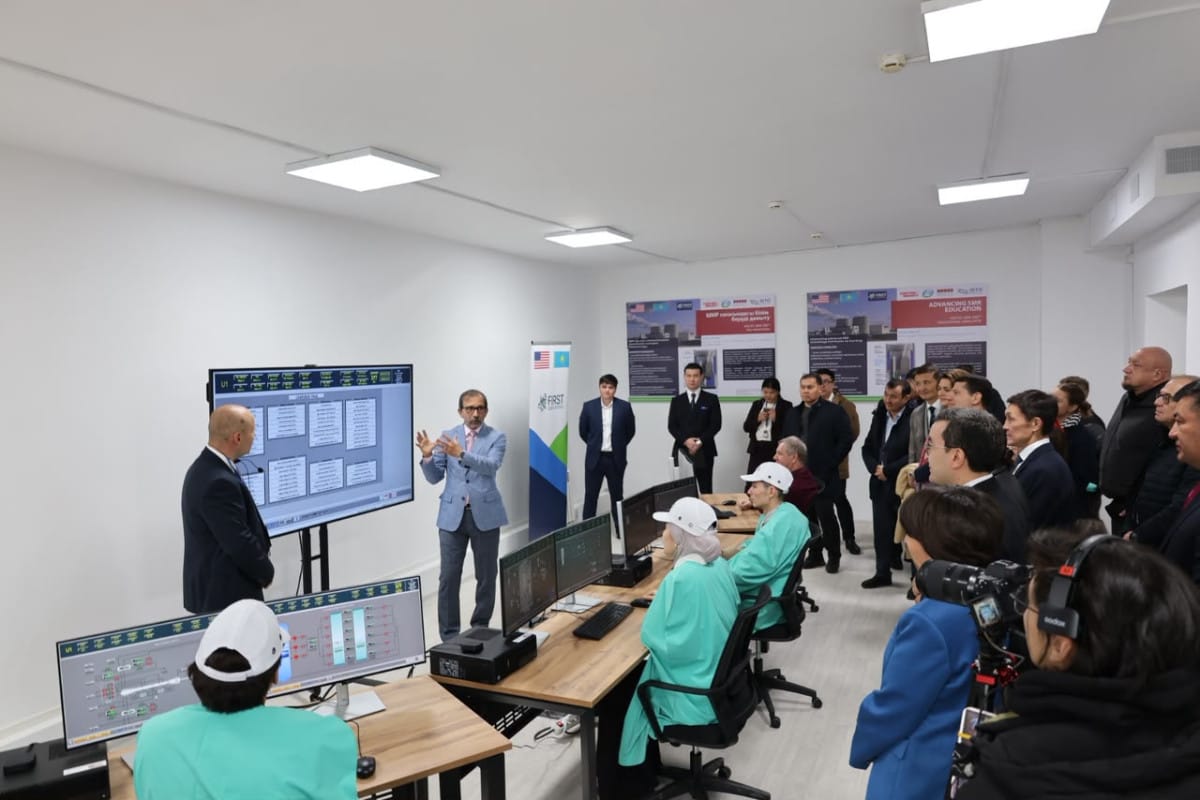
The simulator is intended for practical training of nuclear industry specialists from Kazakhstan and neighboring countries, reports Baq.kz.
The essence in brief
- The simulator is built on a software model of the SMR-300 reactor by the American company Holtec International; the equipment has been installed and has undergone testing.
- The classroom was created under the FIRST program of the U.S. Department of State; Kazakhstan has participated in it since 2022 and became the first partner in Central Asia.
- Nuclear specialties in the country are taught at 12 universities with more than 1,300 students; the annual need for new specialists is estimated at 200-300 people.
- The next stage is the development of curricula, scenarios, and exercises together with the creators of the simulator.
What was opened in Almaty
The classroom is built on a software model of the small modular reactor SMR-300 by Holtec International. Students, young specialists, engineers, and researchers will be able to study how plants based on such reactors and their systems operate, and to practice the control procedures embedded in the model. A small modular reactor is a low-power reactor assembled from prefabricated modules.
The simulator was developed by Holtec International and the American company WSC Inc., a subsidiary of Curtiss-Wright. The project was supported by the International Science and Technology Center and is financed by the U.S. Department of State under the FIRST program. The U.S. Embassy reported in December 2025 that the institute would receive such a simulator. Similar centers under this program have already opened in Romania and Ghana.
Why the institute needs this
The Institute of Nuclear Physics operates the VVR-K research reactor and produces radioisotopes for medicine and industry. The institute has three training centers: for radiation safety, non-destructive testing, and nuclear security. Over the years, they have trained more than 5,000 specialists, including for Central Asian countries.
Institute Director Sayabek Sakhiyev recalled that, according to IAEA recommendations, university-educated personnel for nuclear power plants should be trained specifically on research reactors like the institute's. According to him, the new facility continues the institute's many years of work. The new classroom is regarded as a regional training center.
How many specialists are needed
According to Vice Minister of Science and Higher Education Gulzat Kobenova, nuclear energy in Kazakhstan is taught at 12 universities. They enroll more than 1,300 students, 96% of them under state grants. The annual need for new specialists is estimated at approximately 200-300 people.
Deputy Chairman of the Atomic Energy Agency Aset Makhambetov emphasized that the significance of the complex goes beyond being equipped with modern equipment.
"It will make it possible to improve the knowledge of Kazakh specialists and develop their practical skills," he noted.
The institute is also preparing a separate classroom for senior students in the "Nuclear Energy" specialty.
Author's conclusion
The classroom covers the practical part of training: more than 1,300 students study at 12 universities, while the industry needs 200-300 new specialists annually, and they need not only lectures but also work on a reactor model. However, for now the simulator has only been installed, and the programs and scenarios for it have yet to be developed together with Holtec. They will determine how fully the classroom can meet the industry's needs.
Comments ()