A whole season instead of lectures — how FAO trains farmers in the Fergana Valley
Instead of usual lectures — a full farming season of observation right in your own field.
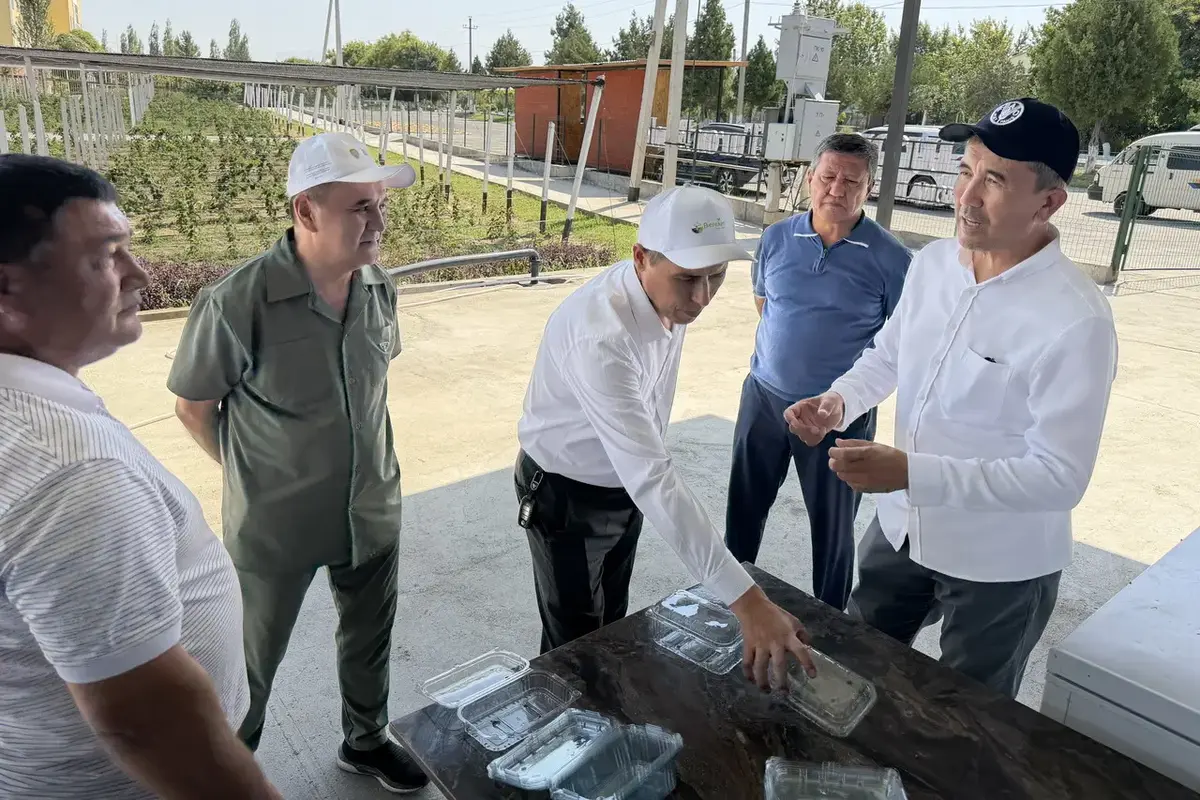
This is exactly how training is structured at the new field schools that the FAO has launched for farmers in the Fergana Valley, Nuz.uz reports.
The gist in brief
- The Food and Agriculture Organization of the United Nations (FAO), together with Tashkent State Agrarian University, has opened three farmer field schools in the Fergana Valley — as part of a regional project on sustainable agricultural development bringing together Uzbekistan, Kyrgyzstan, and Tajikistan.
- Each school specializes in the agricultural profile of its district: in the Kurgan-Tepa district of Andijan region, farmers study potato cultivation; in Namangan district, resource-saving greenhouse farming; in Fergana district, raspberry growing.
- The training format is fundamentally different from lecture courses: participants observe crops throughout the entire growing season, analyze emerging problems together with specialists, and test various solutions on their own plots — the methodology is built on the "from seed to seed" principle.
- The accumulated practices are planned to be extended to other districts of the Fergana Valley.
Three schools — three specializations
The programs of all three schools are built around the specific practical tasks of the particular district where they operate. In Kurgan-Tepa district, classes cover potato nutrition and care, soil cultivation, and integrated plant protection against diseases and pests. In Namangan district, farmers master preparing greenhouses for planting, temperature and humidity control, and the rational use of water and fertilizers — a focus that is especially relevant for a region with limited water resources. In Fergana district, participants study raspberry cultivation techniques — from determining the plants' nutrient needs to biological and chemical methods of pest control.
Why "from seed to seed" is more effective than lectures
The key difference of the approach is that training is stretched across the entire production cycle rather than being a compressed course over several days. Project coordinator Mukhammadjon Kosimov outlined the essence of the method: in this format, the farmer becomes not just a listener but an active participant in the learning process. By observing the development of the crop from planting to harvest, school participants encounter real rather than hypothetical problems — and learn to solve them together with specialists and other farmers in real time, instead of memorizing abstract recommendations in advance.
Part of a broader FAO program
The opening of the schools in Fergana is not a one-off initiative but a visible result of the work the FAO has been conducting in the region long before this. Back in January 2025, the organization's regional and country offices held the first training of lead trainers in Uzbekistan specifically on the farmer field school methodology — as part of the regional project "Small Farmers as Agricultural Innovators for Sustainable Agri-Food Ecosystems," which brings together several countries. At that time, specialists were being prepared to subsequently create and run such schools themselves on the ground — and the current three sites in Andijan, Namangan, and Fergana regions appear to be a direct practical consequence of that training: just over a year passed from preparing the trainers to launching actual classes with farmers. This sequence — first investing in training specialists, then replicating the methodology at specific farms — is typical of how the FAO generally structures its work in Central Asia: not through one-off grants but through the gradual building of local capacity that can then operate independently.
Author's conclusion
The three field schools are a modest project in terms of geographic reach compared with major regional initiatives, but it is precisely this training format — stretched across the entire season, tied to a specific crop and a specific plot — that usually yields more sustainable practical results than one-off seminars. If the methodology is indeed replicated in other districts of the Fergana Valley, as the organizers claim, neighboring countries in the region, including Kazakhstan, will have a ready-made, already-tested model for training farmers that can be adapted to their own agro-climatic conditions.


Comments ()