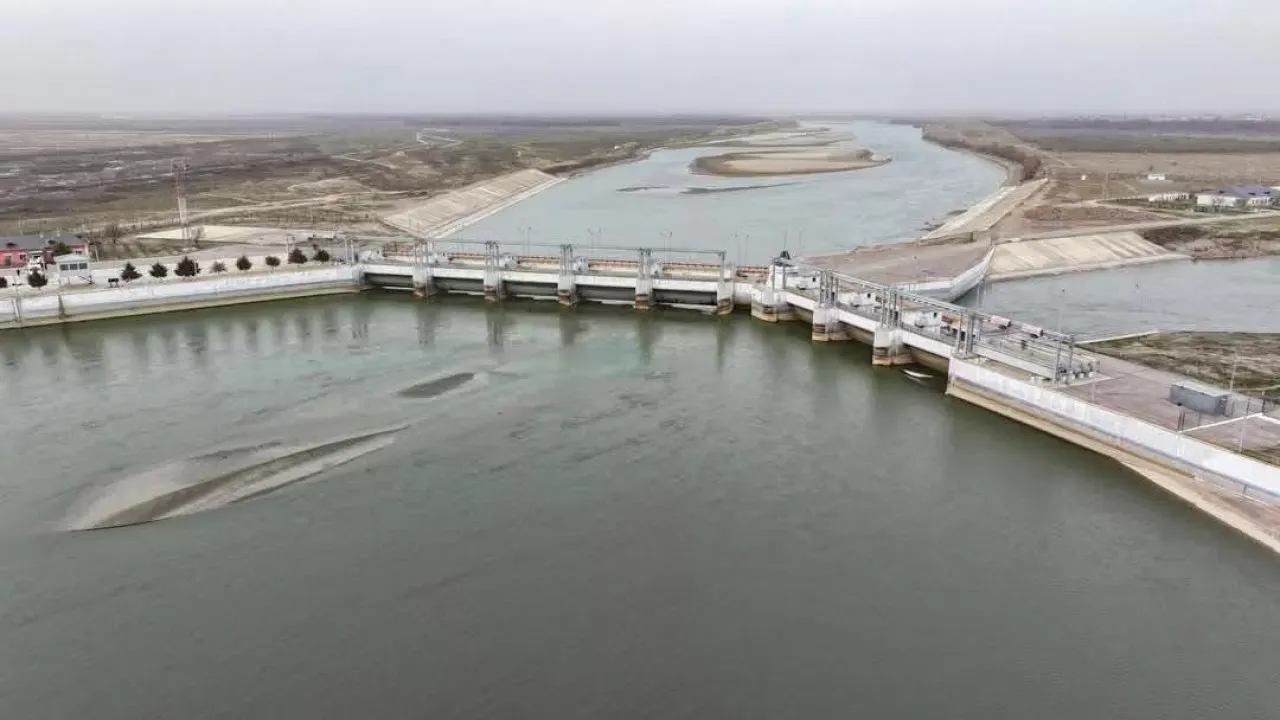
About 10 billion cubic meters of water expected in Shardara Reservoir over autumn and winter
Kazakhstan, Tajikistan, Turkmenistan and Uzbekistan agreed on the forecast for water inflow into the Shardara Reservoir for autumn and winter 2026-2027.
The agreement was reached at a meeting of the interstate water management commission in Turkmenbashi.
The essence in brief
- The forecast for inflow into the Shardara reservoir for the non-vegetation period of 2026-2027 is about 10 billion cubic meters.
- The actual inflow during the 2026 vegetation period was about 3.69 billion cubic meters, 840 million more than the forecast.
- The countries also approved water intake limits and reservoir operation regimes for 2026-2027.
- The next meeting of the commission is planned for the first quarter of 2027 in Uzbekistan.
What was agreed
At the 95th meeting of the Interstate Coordination Water Commission of Central Asia (ICWC) in Turkmenistan, the parties agreed on a forecast for the non-vegetation period, that is, for autumn and winter, when fields are not irrigated. This is reported by Kapital.kz. Kazakhstan was represented by the Minister of Water Resources and Irrigation Nurzhan Nurzhigitov, Tajikistan by the head of the main department of water and energy policy Daler Abdukhalok, Turkmenistan by the chairman of the State Committee for Water Management Durdy Gendzhiev, and Uzbekistan by the Minister of Water Management Shavkat Khamraev.
In addition to the forecast, water intake limits and forecast reservoir operation regimes for 2026-2027 were approved. Kyrgyzstan's Ambassador to Turkmenistan Azizbek Madmarov participated in the high-level meeting on the Amu Darya and Syr Darya, but Kyrgyzstan did not participate in approving the forecast.
How the vegetation period went
The 2026 vegetation period in the Syr Darya basin passed in a stable regime. According to the commission, the actual inflow into the Shardara reservoir was about 3.69 billion cubic meters, 840 million more than forecast. Nurzhigitov noted that interaction among the region's water agencies "made it possible to ensure a stable passage of the past vegetation period."
The year began alarmingly: in January the reservoir was filled to about 79% of normal versus 98.6% a year earlier, and the Syr Darya quotas for 2026 had to be cut almost in half. In August, the Ministry of Water Resources reported that the inflow exceeded expectations thanks to negotiations: since the beginning of the year, Kazakhstan held 38 meetings with its neighbors on transboundary waters.
What was decided beyond the forecast
The commission agreed on a working group for the plan to introduce an automated water accounting system in the Syr Darya basin. It also reviewed the implementation of tasks set at the summits of the heads of state - founders of the International Fund for Saving the Aral Sea. To work out joint transboundary projects, the World Bank allocated $20 million to this fund: by 2031, up to six projects are to be prepared.
What remains unresolved
The structural water deficit in the region persists. In Kazakhstan, 4,600 km of irrigation canals are being modernized, but water losses during transportation in some systems reach 40-60%.
Author's conclusion
The agreed forecast gives farmers in the south predictability for the winter, but it does not eliminate dependence on the upstream countries. The results of the 2027 vegetation period will show how sustainable these agreements are.

Comments ()