Afghanistan became the main buyer of Kazakh rice.
Kazakhstan's grain exports and imports. Infographics.
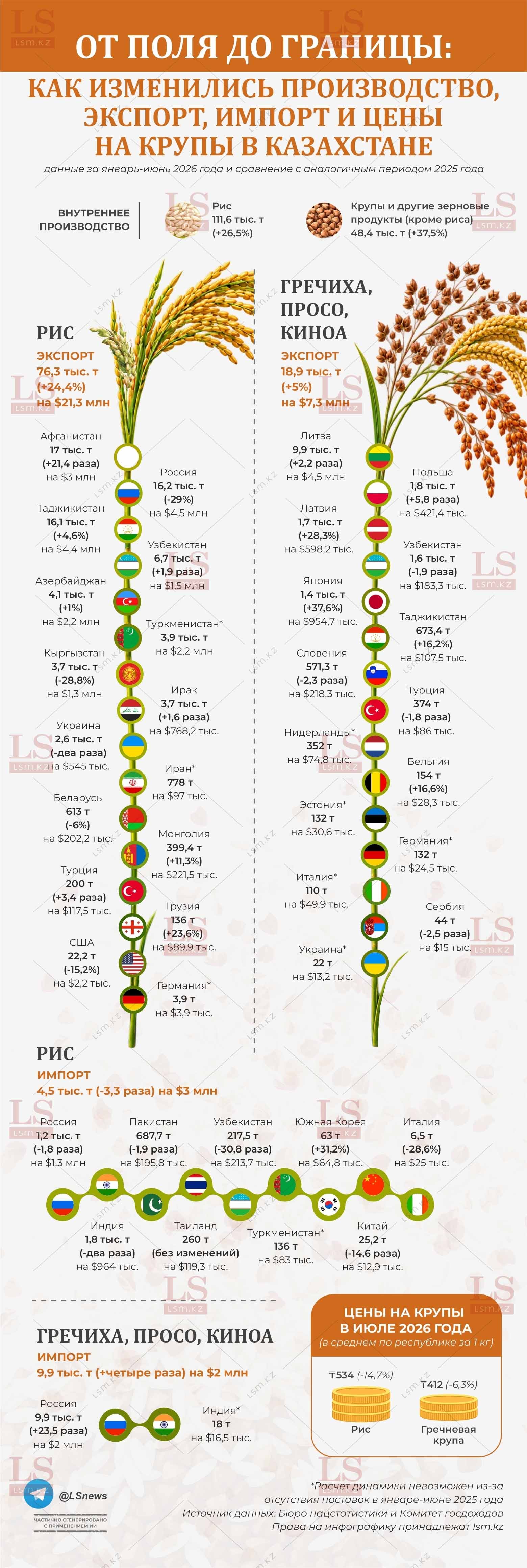
Afghanistan has sharply increased purchases of Kazakh rice and unexpectedly taken first place among all buyers of this product, reports lsm.kz. At the same time, Kazakhstan has almost eliminated the need to import rice from abroad — imports have fallen more than threefold.
The gist in brief
- Afghanistan has sharply increased purchases of Kazakh rice and taken first place among its buyers — in January–June 2026, 17 thousand tons were shipped there, which is 21.4 times more than a year earlier.
- Rice production in Kazakhstan grew by 26.5%, to 111.6 thousand tons, while exports rose by 24.4%, to 76.3 thousand tons worth $21.3 million; rice imports meanwhile fell 3.3-fold, to 4.5 thousand tons.
- Exports of buckwheat, millet and quinoa grew by 5%, to 18.9 thousand tons worth $7.3 million — Lithuania became the largest buyer (9.9 thousand tons, a 2.2-fold increase), while Poland and Latvia noticeably increased their purchases.
- Grain prices are declining: in July 2026, rice across the country fell in price by 14.7% year on year, to 534 tenge per kg, and buckwheat — by 6.3%, to 412 tenge.
Afghanistan — the new largest buyer
The surge in Afghan rice purchases is the most notable detail in the latest statistics. In January–June 2026, Afghanistan purchased 17 thousand tons of Kazakh rice worth $3 million — almost 21.5 times more than in the same period a year earlier, which put the country in first place among all importers. For comparison, far more traditional buyers follow — Russia (16.2 thousand tons, but with a decline of 29%) and Tajikistan (16.1 thousand tons, +4.6%). The sharp turn toward Afghanistan fits into an already familiar trend: earlier we wrote that Kazakhstan significantly increased live livestock exports to Afghanistan and China, and now crop-based food products are being added to that list.
Rice imports have fallen sharply
The flip side of growing domestic production is a noticeable reduction in dependence on imported rice. In the first half of 2026, only 4.5 thousand tons were brought into the country — three times less than a year earlier. Supplies from Uzbekistan (by 30.8 times) and China (by 14.6 times) fell most sharply, while India and Russia remain the main foreign suppliers, although their volumes also roughly halved. This simultaneous combination — growth in domestic production, growth in exports and a collapse in imports — usually indicates that Kazakh rice farms have increased yields and volumes faster than domestic consumption is growing.
Buckwheat finds a market in the Baltics
The export geography of buckwheat, millet and quinoa differs noticeably from that of rice — here Lithuania turned out to be the main buyer, with 9.9 thousand tons shipped there over the half-year, more than double last year's volume. Supplies to Poland (5.8-fold increase, to 1.8 thousand tons) and Latvia (+28.3%, to 1.7 thousand tons) grew markedly, as did those to Japan (+37.6%, to 1.4 thousand tons) — meaning Kazakh buckwheat is simultaneously gaining a foothold in both European and Asian markets. At the same time, imports of this same grain category, on the contrary, quadrupled, to 9.9 thousand tons, almost entirely due to supplies from Russia, which increased 23.5-fold — the picture here is the opposite of rice: domestic production does not yet fully cover growing demand.
Why prices are falling amid export growth
At first glance, it may seem strange that grain prices in Kazakhstan are declining at the same time as export shipments are growing — usually rising external demand pushes domestic prices up. But in this case, growth in domestic production (+26.5% for rice) outpaces the rate of export growth (+24.4%), creating a surplus of product on the domestic market even taking into account growing foreign purchases. For Kazakh consumers, this means a rare combination: the country is simultaneously increasing sales abroad while prices fall on shelves at home.
Author's conclusion
The rice statistics for this half-year are a good example of how production growth can simultaneously solve several tasks at once: replace imports, increase exports and lower prices for domestic consumers. Afghanistan's emergence as the largest buyer of Kazakh rice is not a random spike but part of a broader picture of growing food and agricultural exports to that country, which we have already observed with live livestock. The question remains open whether this pace of growth will prove sustainable in subsequent seasons or will turn out to be a one-off effect of a successful harvest year.



Comments ()