Seed exchange between farmers could lead to criminal charges — UN report
A practice that for centuries was the backbone of farming — saving part of the harvest, sharing seeds with a neighbor, selling them at the local market — is becoming a legal risk in more and more countries.
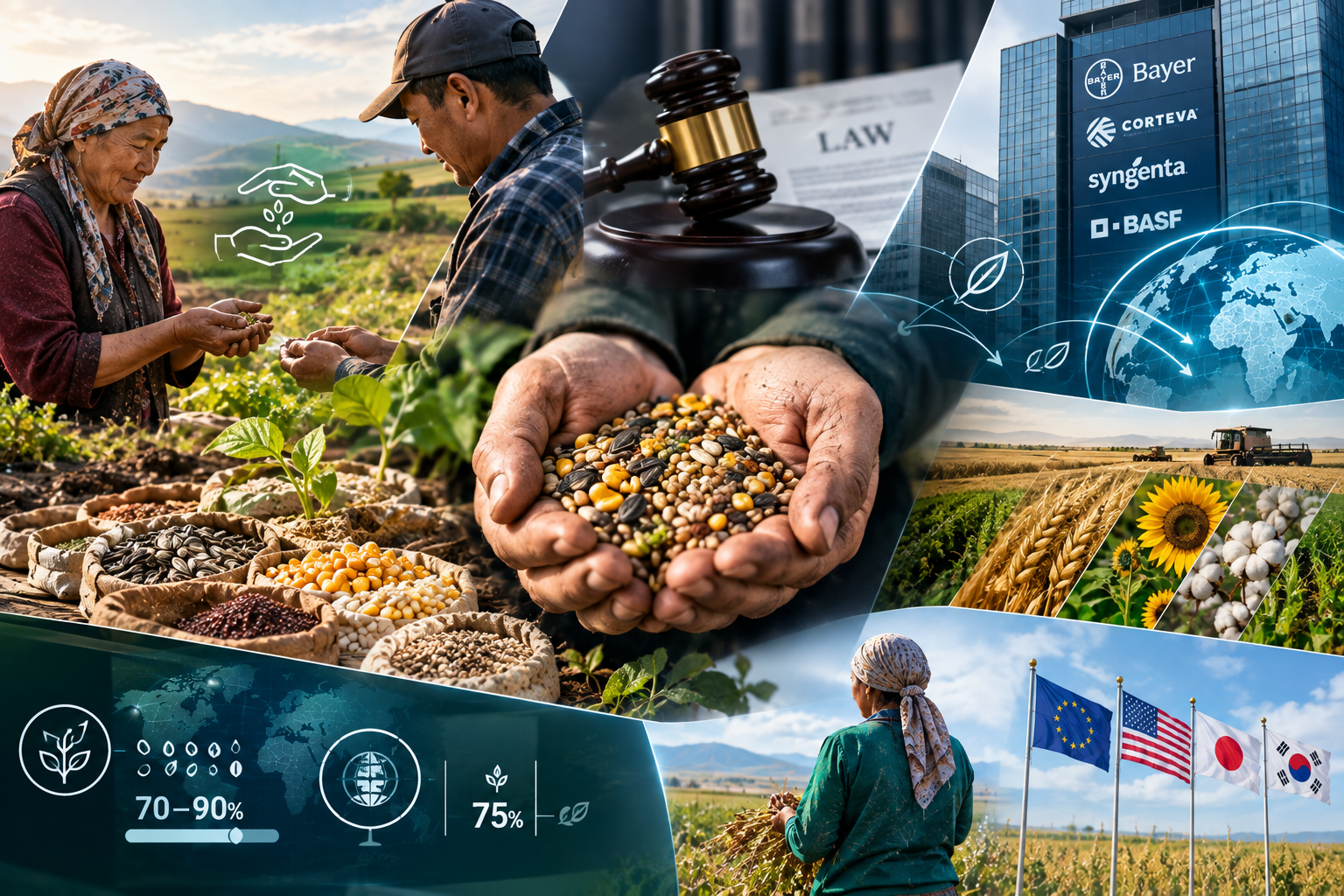
A new UN report has gathered dozens of such cases from around the world.
The gist in brief
- The UN Working Group on the rights of peasants presented a report to the Human Rights Council on the growing legal risks for traditional seed breeding: in Tunisia, a farmer faces trial for exchanging traditional seeds; in Indonesia, small-scale farmers were persecuted for independent selection; and an Italian tomato producer received a suspended sentence and a fine of about €100,000.
- In some countries, violations of rights to protected commercial varieties carry serious sentences — in Ghana, up to 10–15 years in prison; in Japan, up to 10 years; in the Philippines, from 3 to 6 years.
- At the same time, between 70 and 90% of the seeds sown worldwide still come from traditional systems, while the global commercial seed market reached $81 billion in 2026, with more than half controlled by just four corporations — Bayer, Corteva, Syngenta, and BASF.
- Since 1900, the world has lost 75% of the genetic diversity of agricultural plants — it is traditional, not commercial, varieties that the report's authors call the main reserve of resilience for food systems against disease and climate change.
From neighborly exchange to lawsuits
The Chair-Rapporteur of the working group, Shalmali Guttal, captured the essence of the problem vividly: "Seeds are the beginning of every meal, the memory of every harvest, and the hope for future life."
For peasants and indigenous peoples, she said, they are not merely a commodity but a living heritage created over generations. Nevertheless, legal systems increasingly treat seeds precisely as an object of intellectual property: under contract farming, farmers are often obliged to use a specific company's seeds, and in some industrial systems they must buy them anew before each season, along with fertilizers and pesticides — this increases farm costs and, as the report's authors note, can drive families into debt. Certification requirements for genetic purity and varietal uniformity were originally developed for industrial crops and are poorly suited to local varieties, whose value lies precisely in their diversity and ability to adapt to local conditions.
Biopiracy and patents on others' heritage
A separate section of the report is devoted to cases where companies obtain patents on genetic resources or knowledge that peasants and indigenous peoples developed over generations. One of the best-known examples is a patent granted in the United States related to basmati rice, which has been grown in South Asia for centuries; similar disputes have arisen around neem and turmeric. Modern technologies complicate the situation even further: a plant's genetic code can now be obtained from a digital database and patented without even having physical seed samples — this makes it possible to conceal the origin of the material and circumvent obligations to share benefits with the communities that originally preserved it.
Women as seed keepers
The report specifically notes the role of rural women in preserving local varieties. In Bangladesh, it is thanks to their work that plants resistant to soil salinity and flooding have been preserved in vulnerable coastal areas. In West Africa, women select varieties of sorghum and millet whose stalks are suitable for fencing and roofing, and at local markets and fairs they exchange not only seeds but also knowledge about where to grow them and what conditions they can withstand. That is why the report's recommendations include special attention to the rights of rural women, including access to land and recognition of their role as keepers of seed heritage.
Signs of change
The report also records the opposite trend. In 2021, the Supreme Court of Honduras struck down a law that violated the right to food, and in November 2025, the High Court of Kenya ruled unconstitutional the provisions imposing criminal liability on farmers for exchanging seeds, stating directly: "Sharing seeds is not a crime." The working group recommends that states enshrine the right of peasants to save, use, exchange, and sell seeds grown on their own farms, direct more state support to traditional seed systems and community seed banks, and adopt effective laws against biopiracy that oblige companies to disclose the origin of genetic resources and fairly share benefits with communities.
The Kazakh context
The topic of seed regulation also concerns Kazakhstan — since 2003, the country has had a separate law "On Seed Production," which provides for mandatory certification of seed producers and sellers, certification of varietal and sowing qualities, and state control through a network of inspectors. Since 2026, regulation has tightened even further: state funding for seed testing has been abolished, and farmers are now required to pay for it out of their own funds, while a separate department for monitoring farmers' compliance with seed legislation has been created within the state inspection committee of the Ministry of Agriculture. The country's total need for seeds meeting classes 1 and 2 of the sowing standard is estimated at 2.3 million tonnes. So far, there is no talk of cases like those described in the UN report — Kazakh legislation focuses on certification rather than criminal prosecution for exchange — but the general vector toward stricter and more costly control for farmers is worth keeping in view precisely in light of the report's warnings about where such trends could lead if tightened further.
Author's conclusion
The UN Working Group's report articulates a dilemma that affects far more countries than those directly listed in it: on the one hand, certification and seed quality control are objectively needed for food security and predictable harvests; on the other, excessively strict regulation risks crowding out traditional seed breeding, which for decades ensured agriculture's resilience to local conditions and climate shocks precisely through diversity unattainable under the dominance of a few global corporations. Finding a balance between these goals is a task that sooner or later every country whose seed policy continues to move toward increasingly formalized control will have to resolve.

Comments ()