African swine fever spreads across Italy and 13 other EU countries
Since early 2026, Tuscany has recorded 638 African swine fever cases in wild boars — Italy's highest this year; the virus has hit two farms in Massa-Carrara and Pistoia.
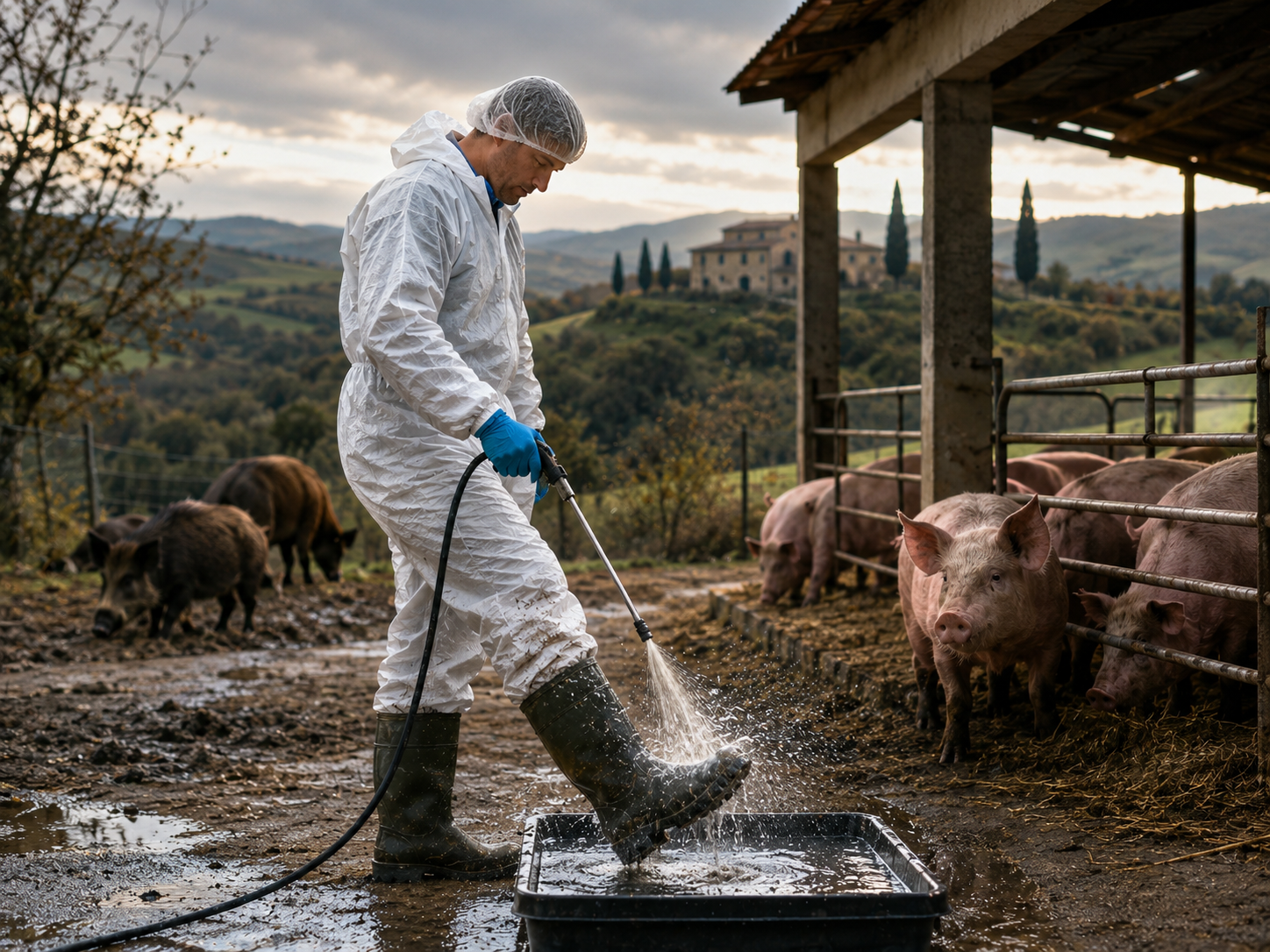
The African swine fever outbreak in Italy's Tuscany region has reached record proportions for the country and has already spread to pig farms, reports Euronews. The problem has long gone beyond one region: according to the European food agency, the virus accelerated its spread across the entire European Union in 2025 and has now affected 14 member states, including those where it had not been seen for decades or had never been seen at all.
The gist in brief
- Since the beginning of 2026, 638 positive cases of African swine fever (ASF) have been recorded in Tuscany among wild boars — a record figure for Italy this year; the virus has already spread to two pig farms in the provinces of Massa-Carrara and Pistoia.
- In Piedmont and Liguria, 2,194 cases have been detected among wild boars and 10 outbreaks on pig farms, covering 205 municipalities.
- According to the European Food Safety Authority (EFSA), in 2025 the EU recorded 11,036 cases of ASF among wild boars — the highest since 2021 and 44% more than the previous year; the disease has already affected 14 EU member states, including Finland, which was affected for the first time, and Spain, which saw its return after a 31-year hiatus.
- ASF is not dangerous to humans, but humans can become "passive carriers" through dirty footwear, clothing, and vehicles; there is no vaccine or cure for the disease.
How the outbreak is spreading in Tuscany
The epidemic in Tuscany began in the province of Massa-Carrara but has spread to Lucca and Pistoia over the past months. On August 18, the region's mayors held an online meeting to coordinate measures to combat the spread of the disease — provincial territorial task forces will be deployed, and information campaigns and inspections of public areas are planned in affected municipalities. President of ANCI Toscana Susanna Cenni emphasized:
"The most important thing we must avoid is each municipality acting on its own," calling for coordination to be entrusted to the provinces, especially for tasks such as locating and collecting wild boar carcasses.
Humans as carriers
One of the most challenging aspects of combating ASF is that the virus can spread even without the movement of an infected animal: footwear, clothing, equipment, vehicles, and other contaminated items can carry it from one area to another. The ASF emergency commissioner Giorgio Briganti explained that humans do not contract the disease themselves but can become "passive carriers" — dirt and organic material left on shoes or bicycle wheels can contribute to the spread of the virus. Hence the call to thoroughly clean and disinfect footwear after visiting forests and rural areas and to avoid any contact with wild boar carcasses.
Scale across the EU
The problem is by no means limited to Italy. The Spanish episode, against which there is now talk of a "return after a 31-year hiatus," began back in December 2025 in the Collserola natural park near Barcelona — Catalonia at the time exported pork worth €3 billion a year, of which about €1 billion went to non-EU countries, and China immediately suspended imports from a dozen Barcelona-based enterprises.
One of the first versions of the outbreak's origin put forward by Catalan authorities was a sandwich with contaminated sausage thrown in the forest — from an area with heavy freight traffic. European Commission spokesperson Eva Hrnčířová then explained the mechanics of the virus's spread:
"This virus can spread very easily just through farmers' boots or tractor wheels."
According to EFSA data, the spread of ASF in the European Union accelerated throughout 2025: in addition to the rise in cases among wild boars, the number of outbreaks among domestic pigs increased by 76%, to 585. In late July 2026, Finland recorded its first-ever case of ASF.
Surveillance statistics are also telling: in 2025, the EU analyzed more than 518,000 samples from domestic pigs and 618,000 from wild boars, while passive surveillance — examination of animals found dead or suspected — helped identify 73% of all outbreaks among the wild population.
Why this matters for Kazakhstan
ASF is a disease category requiring immediate eradication measures upon detection, and any outbreak on pig farms means culling of livestock, restrictions on animal movement, and trade barriers for an entire region.
For Kazakhstan, this is not an abstract scenario: the country is already going through similar epizootic pressure with another disease — FAO notes risks of the spread of a new SAT1 foot-and-mouth disease serotype in Asia, with Kazakhstan finding itself at the center of an epizootic ring of neighboring countries where the virus has already been confirmed. A similar story previously unfolded with another neighbor: Mongolia strengthened safety measures after an outbreak of the SAT-1 strain new to the country, culling hundreds of animals and urgently ordering a vaccine. Against this backdrop, Kazakhstan is also preparing its own offensive initiative in international standardization of meat products — a proposal to develop the first ISO standard for horse meat products.
Both sides of the same coin — defensive (control of transboundary epizootics) and offensive (shaping standards) — show that biosecurity is becoming as significant a factor of competitiveness for Kazakh livestock farming as the quality of the products themselves.
Author's conclusion
The situation in Tuscany is telling in that a virus safe for humans can deliver a tangible economic blow to an entire industry — through culling of livestock, trade restrictions, and the need for large-scale, coordinated efforts across dozens of municipalities simultaneously. The 44% year-on-year increase in cases across the European Union and the emergence of the disease in countries where it had not been seen for decades indicate that the European biosecurity system has faced a challenge requiring not piecemeal but systemic solutions — exactly what Kazakh veterinary policy is also moving toward amid growing export ambitions.



Comments ()