John Deere to close two agricultural equipment plants in Iowa and move production to other facilities
John Deere announced Nov 4, 2026, the closure of two Iowa plants: Ottumwa Works and subsidiary Hagie's Clarion facility.
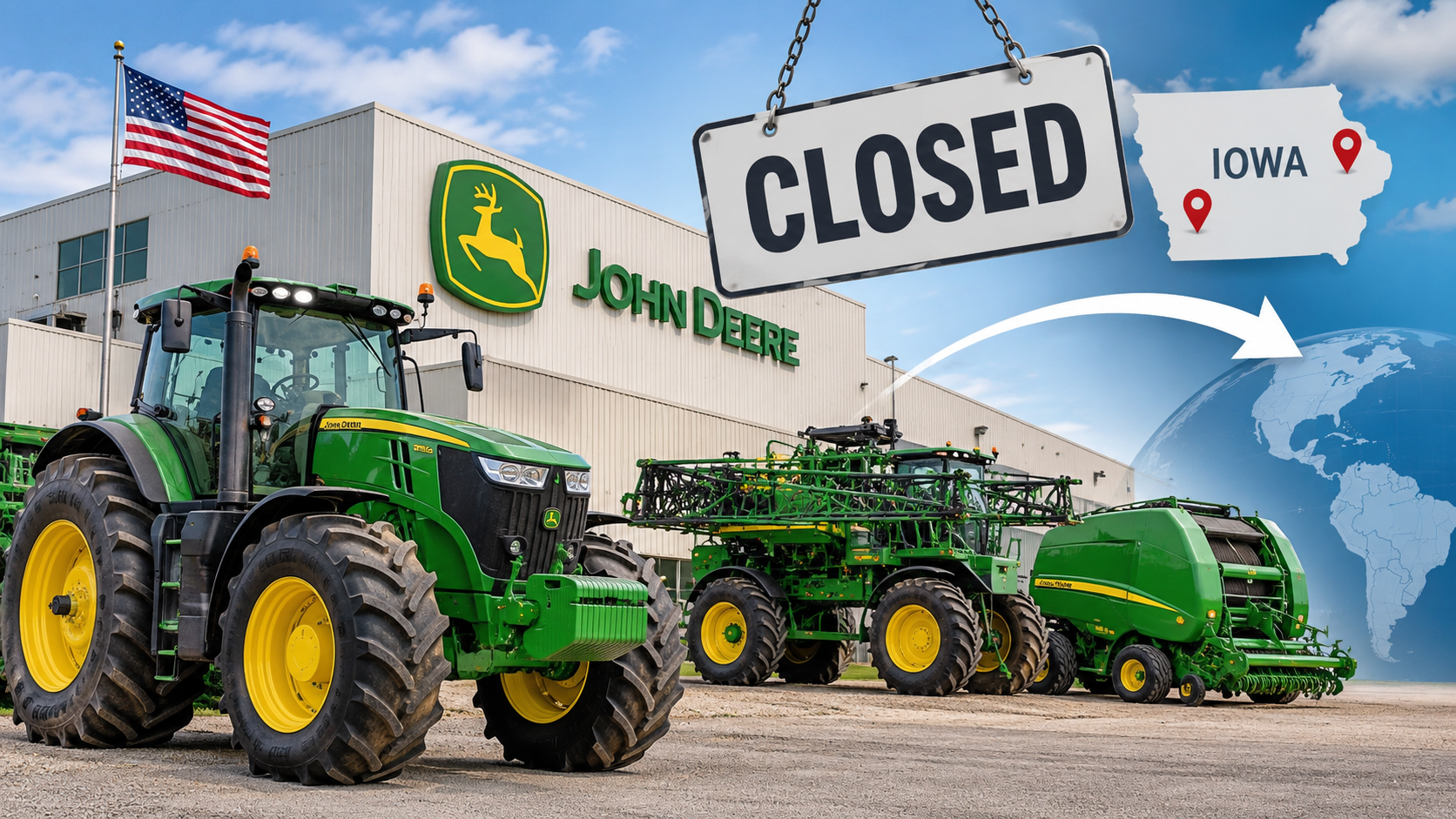
Production of self-propelled mower-conditioners, round balers and sprayers will move to other company plants, while sugarcane harvester production will go to Brazil. The company explains the decision by changing customer demand and available capacity at other plants, AgWeb writes.
The gist in brief
- The Ottumwa plant will be closed after production of windrowers is moved to Des Moines by the end of fiscal 2027 and round balers by the end of fiscal 2028.
- Production at the Hagie plant in Clarion will cease by fiscal 2029, and Hagie STS sprayers will begin to be assembled in Thibodaux (Louisiana) starting in fiscal 2028.
- Production of sugarcane harvesters, about 35 machines per year, will move from Thibodaux to Catalão, Brazil, by 2029.
- According to Wright County data, about 300 people work at the Clarion plant.
What Deere announced
The closure will be phased over fiscal years 2027-2029. Deere's fiscal year ends at the end of October. The company is moving production of small planters from Moline (Illinois) to Paton (Iowa) in fiscal 2027. In addition, Deere is exploring procurement options for its construction and forestry equipment division. The company said it intends, together with employees, unions and local authorities, to determine how to use the Ottumwa and Clarion sites in the future.
Why the company is moving production
Deere speaks of concentrating investment at modern and more heavily utilized plants. Sales of large agricultural equipment in 2026 were pressured by tariffs and low farm profitability, while small tractors and equipment sold better. According to AgNavigator, for the nine months of fiscal 2026 Deere's net income amounted to $3.808 billion, 4% less than a year earlier. Operating profit of the production and precision agriculture division in the third quarter fell to $527 million versus $580 million in the third quarter of 2025. According to CEO John May, the company still believes that 2026 will be the bottom of the current agricultural equipment cycle. Deere will publish its fourth-quarter and full-year report on November 25.
What will happen to the workers
Deere is considering internal transfers, retraining, relocation assistance, severance packages and career change assistance. There will be no layoffs at the Thibodaux plant because sprayer production is moving there. In October, the company announced the hiring of about 400 workers at seven plants, including in Ottumwa. The UAW union said it is outraged by the decision and intends to fight for jobs in the 2027 contract negotiations.
Which figures diverge
Sources give different closure dates for Ottumwa: 2028 and 2029. Round balers move to Des Moines in one report and to Ankeny in another. There is also no single figure for the number of Ottumwa workers: from 400 according to city authorities to 800 according to a local TV channel for 2022.
What is happening with the agricultural equipment market in Kazakhstan
President Kassym-Jomart Tokayev in his Address called it relevant to "increase production of modern tractors and combines in our country." Agricultural equipment output in 2025 in the country grew by 22.3%, including 1,236 grain harvesters assembled, and for 2026 it is planned to produce 9.9 thousand units of equipment (+6%). At the same time, leasing of equipment for 13 thousand farmers became more expensive by about 3.6% due to VAT at a rate of 16%, and the additional burden under existing contracts is estimated at 4.6 billion tenge. In parallel, localization of KUHN equipment has moved into a practical stage, although launch dates and investment volumes have not yet been agreed.
Author's conclusion
Deere is closing two old plants and at the same time hiring people at other sites, meaning it is scaling back not equipment output but excess capacity where utilization is low. This decision was made at the very bottom of the cycle, which the company, according to the CEO, expects precisely in 2026, and for the market it means that large manufacturers are preparing not for rapid demand growth but for a long recovery. The Kazakh market is in a different phase: output is growing, and 350 billion tenge has been allocated for subsidized leasing with a subsidy of up to 30% in 2026.


Comments ()