Aktau Port has begun dredging its water area to 7 meters due to the shallowing of the Caspian Sea
The Caspian Sea's decline has hit Kazakhstan's port infrastructure: the main phase of dredging has begun in Aktau, with 1.3 million cubic meters of soil to be removed.
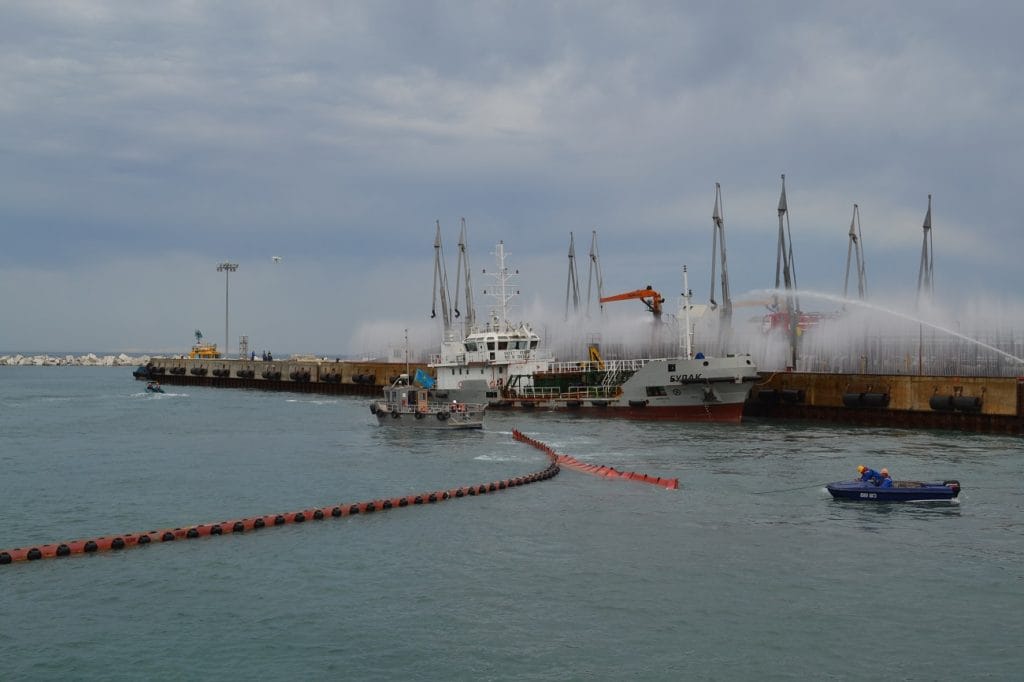
The project must preserve navigation along the Middle Corridor at a time when the sea continues to shallow.
The gist in brief
- The main stage of dredging has begun at the Aktau port; the water area is planned to be deepened to 6–7 meters, reports AqJaiyq.
- About 1.3 million cubic meters of soil will be extracted from the bottom.
- After completion of the work, the port's throughput capacity and the volume of transportation along the Middle Corridor (TITR) may grow by up to 30%, while the cost of sea transportation of cargo will decrease by 10–15%.
- The general contractor, the Chinese company China Harbour Engineering Company Ltd, has already mobilized a dredging fleet at the site; the work is planned to be completed by the end of the current year.
What is happening at the port
The main stage of dredging has started at the Aktau port: the water area is planned to be deepened to 6–7 meters. The reason is straightforward and leaves no choice — the level of the Caspian Sea continues to decline, and without deepening the bottom, large-tonnage vessels are gradually losing the ability to safely enter the port. As part of the project, about 1.3 million cubic meters of soil will be extracted from the bottom.
The general contractor, the company China Harbour Engineering Company Ltd, has already completed geodetic surveys and mobilized a specialized dredging fleet and the necessary equipment at the site. The work is proceeding according to the approved schedule, and the dredging is planned to be completed by the end of the current year.
Why this is needed
For Kazakhstan, Aktau is the key port on the Middle Corridor (Trans-Caspian International Transport Route), which in recent years has become one of the main alternative routes for delivering cargo between Asia and Europe bypassing Russia. The decline in sea level directly affects navigation conditions: the shallower the water area, the fewer vessels can safely enter the port, and the lower its real throughput capacity, regardless of how many berths and cranes have been built there.
According to estimates by the Kazakh authorities, after completion of the dredging, the port's throughput capacity and the volume of transportation along the TITR may grow by up to 30%, while the cost of sea transportation of cargo will decrease by 10–15%. This should improve both navigation safety and the port's attractiveness for new investors.
Part of a broader picture
Dredging in Aktau is not an isolated infrastructure project, but a direct consequence of a trend that the National Academy of Sciences of Kazakhstan spoke about literally a month ago: the level of the Caspian Sea has dropped by about two meters over the past 20 years, and this trend remains constant. At that time, scientists proposed creating a unified sea monitoring system based on satellite data and artificial intelligence specifically in order to more accurately predict such consequences of shallowing, including for port infrastructure.
The basis for such monitoring is already being formed in Kazakhstan. Since September 2025, the Kazakh Research Institute of the Caspian Sea has been operating in the country, conducting observations on 50 parameters in the open water area and 26 parameters in the coastal zone. At the site of this institute in August 2026, UNDP discussed with the Kazakh side three environmental projects for the Caspian, including integrated management of marine and coastal resources, which is also relevant for the Aktau port zone.
Shallowing concerns not only Kazakhstan, which is why in September 2026 five Caspian countries approved an interstate program for saving the Caspian within the framework of the Tehran Convention, agreeing on the exchange of data on water conditions and sea level fluctuations. Dredging in Aktau shows that for the Caspian countries this is no longer a matter of long-term planning, but an everyday engineering and economic reality.
Author's conclusion
The project in Aktau illustrates well how the abstract figure of "minus two meters over 20 years" turns into concrete millions of cubic meters of soil that must be removed from the bottom in order for the port to continue operating. Kazakhstan is responding to the shallowing at several levels simultaneously: building a scientific institute for monitoring the sea, participating in an interstate program with its Caspian neighbors, and at the same time investing in direct engineering adaptation of port infrastructure. The question is whether this adaptation is keeping pace with the rate of sea level decline, or whether dredging to 7 meters will turn out to be a temporary measure that will have to be repeated a few years later at an even greater depth.


Comments ()