Tens of thousands march for climate in Brussels ahead of UN conference
A climate march took place in Brussels on Sunday, October 11. Police estimated 45,000 participants; organizers put the figure at around 60,000.
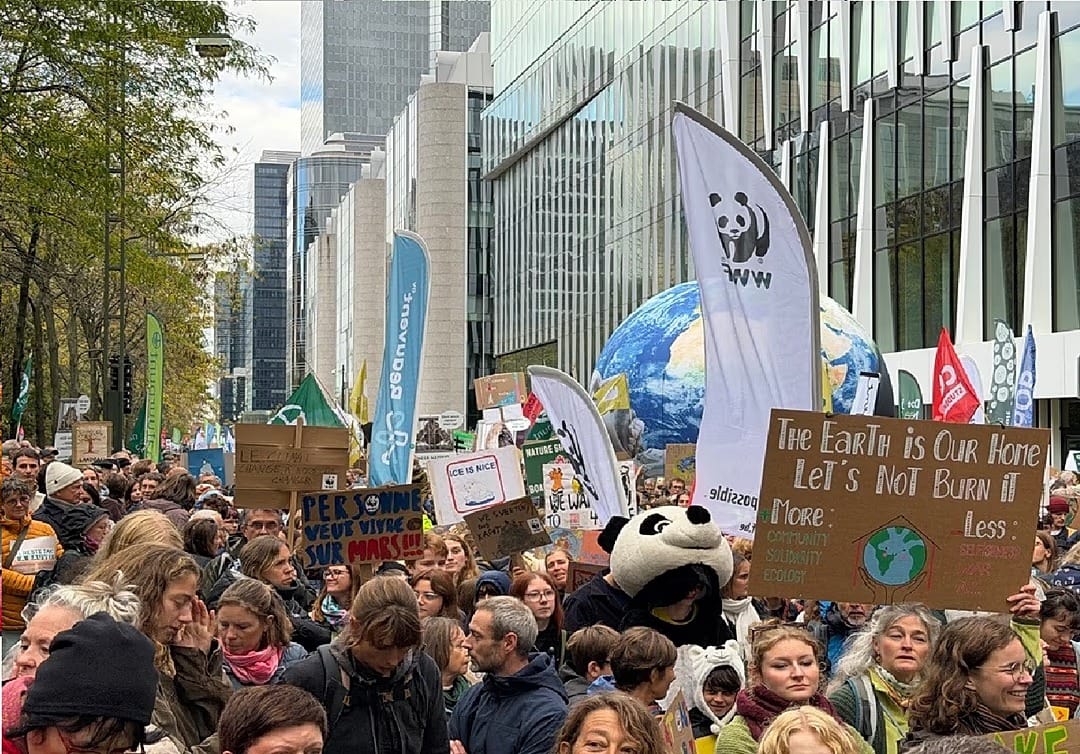
Participants reached the European Union headquarters and demanded an end to fossil fuel subsidies and a tax on the sector, Euronews reports. The action took place a month before the UN climate conference COP31 in Antalya, Turkey.
The gist in brief
- The march organizer is the Climate Coalition together with other groups, including the green party of Flanders, Groen.
- Participants put forward five demands: end fossil fuel subsidies and tax the sector, create more green zones, ensure a just transition, support citizens and businesses, and strengthen international cooperation.
- In September, the European Commission proposed postponing by a year, from 2027 to 2028, the application of the law on reducing methane emissions.
- Expectations for COP31 are low: the US under Donald Trump has withdrawn from the talks, and the EU has weakened part of its environmental legislation.
What the participants demanded
The organizers formulated five demands. They propose stopping subsidies for fossil fuels and introducing a tax on the sector, creating more green zones, and ensuring a just climate transition. In addition, citizens and businesses need support in phasing out fossil fuels, and international cooperation on climate must be strengthened. The demand to abandon fossil fuels is heard not only on the streets: in September, Germany presented a roadmap for a complete phase-out of coal, oil and gas by 2045, becoming the third European country with such a document after France and the Netherlands. Experts called it merely a starting point and considered the goals insufficiently ambitious.
What was said at the march
The chairman of Groen in Flanders and Brussels, Aymen Horh, said the demands have not changed, but the sense of urgency has become stronger than ever because people were dying from the heat. Belgium, like other European countries, faced a record rise in excess mortality during heatwaves this summer. Economist Etienne de Callatay said politicians should not fear electoral consequences if they take bold decisions to protect the environment. NGO employee Aurore Schreiber came with her family so that politicians would hear the voice of citizens.
Why little is expected from COP31
The conference in Antalya will take place in November. Expectations for it are low: after the disappointing results of last year's summit in Brazil, the EU is choosing modest goals, and the US under the Trump administration has withdrawn from the talks. In Europe, according to Euronews, the overall mood in favor of bold decisions has weakened, and the EU has softened some environmental norms to support business. At the same time, the European Union still calls itself a global leader in the fight against climate change. Against this backdrop, researchers are looking for areas where progress can accelerate on its own: the Earthshot Prize and the University of Exeter identified 51 solutions that can quickly change the situation in the next five years, and named clean energy as the main driver.
What this means for Kazakhstan
The heat that pushed people onto the streets of Brussels also affects Central Asia. In Astana, according to the analytical company Pavlov Analytics, the perceived temperature at different buildings on the same day differed by up to 16°C, and in Almaty the gap between the hottest building and cooler districts reached 19°C. This was reported by hunn.kz, analyzing the global ranking of urban greening: what matters in the ranking is not parks, but trees along sidewalks. The country is still only forming its climate financing: the Ministry of Ecology reported a portfolio of projects worth over $4 million, while most of the sum is still only under discussion and has not been approved.
Author's conclusion
The march shows that demand for climate measures in Europe remains high, but political readiness for them is weakening. What will come of this at COP31 will become clear in November.
Comments ()