Analytical report: lack of efficiency, corruption risks, and unrealized state initiatives in the field of irrigation and water supply in Kazakhstan for the period 1994 – 2024.
Analysis of the effectiveness and efficiency of government promises in the water sector.
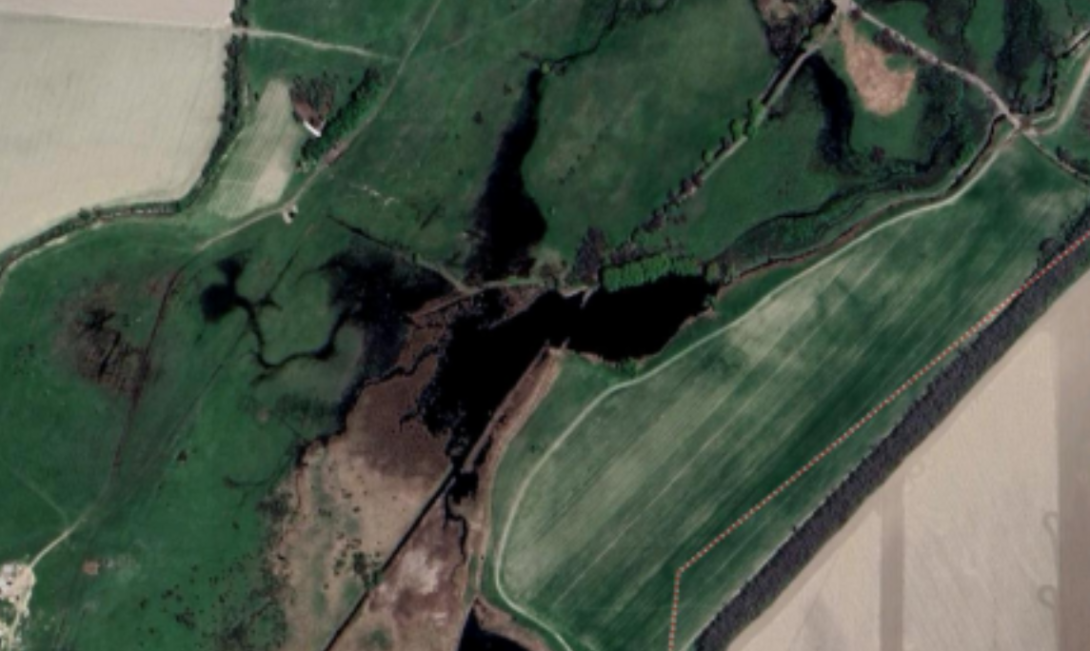
Over 30 years of independence, Kazakhstan has directed billions of tenge towards the development and modernization of irrigation infrastructure. However, the actual results and the state of the water sector raise questions. Water losses still reach 50–70%, and in certain regions (Turkestan, Zhambyl, Almaty regions), the infrastructure is in critical condition.
1. Macroanalysis: Leaking investments, unfulfilled promises, and institutional failures
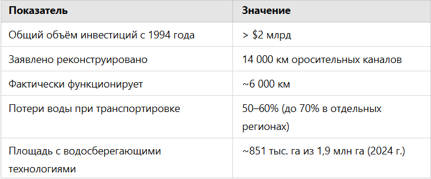
2. Discrepancy between promises and actual progress

Promises to reduce water losses:
- In 2021, the Ministry of Ecology announced its intention to reduce water losses in irrigation canals to 25% by 2025. This announcement was not accompanied by the publication of a methodology for calculating current losses or a plan for their reduction.
- In 2024, as part of the Comprehensive Plan, state bodies reiterated the intention to achieve a loss level of 30–35% by 2028, but again without specifying control mechanisms, baseline data, or the expected effect at the regional level.
In reality, as of 2024:
- According to official and independent sources, water losses during transportation still range from 50 to 70%. In the Turkestan, Zhambyl, Almaty, and Zhetysu regions, a high proportion of leaks persists through unrepaired and earthen canals.
- A number of reports (including materials from the Supreme Audit Chamber and media) indicate a lack of reliable accounting and documented data on which areas achieved efficiency and which did not. This makes it impossible to verify progress against stated goals.
3. Systemic dysfunction: Infrastructure, management, corruption
3.1. Infrastructure deterioration
- Most of the irrigation network in Kazakhstan consists of open canals laid in earthen beds without concrete or plastic lining. This leads to significant water losses through seepage and evaporation.
- Many reconstructions are formal in nature: work completion is recorded on paper, but without the introduction of technologies capable of actually reducing leaks.
- In several cases, outdated equipment is used, and canal replacement is limited to leveling or cleaning, without major modernization.
- Example: In the Almaty region, after the so-called "modernization" of irrigation networks under a project costing over 5 billion tenge, water continues to be lost, and farmers report interruptions in supply during the peak irrigation season.
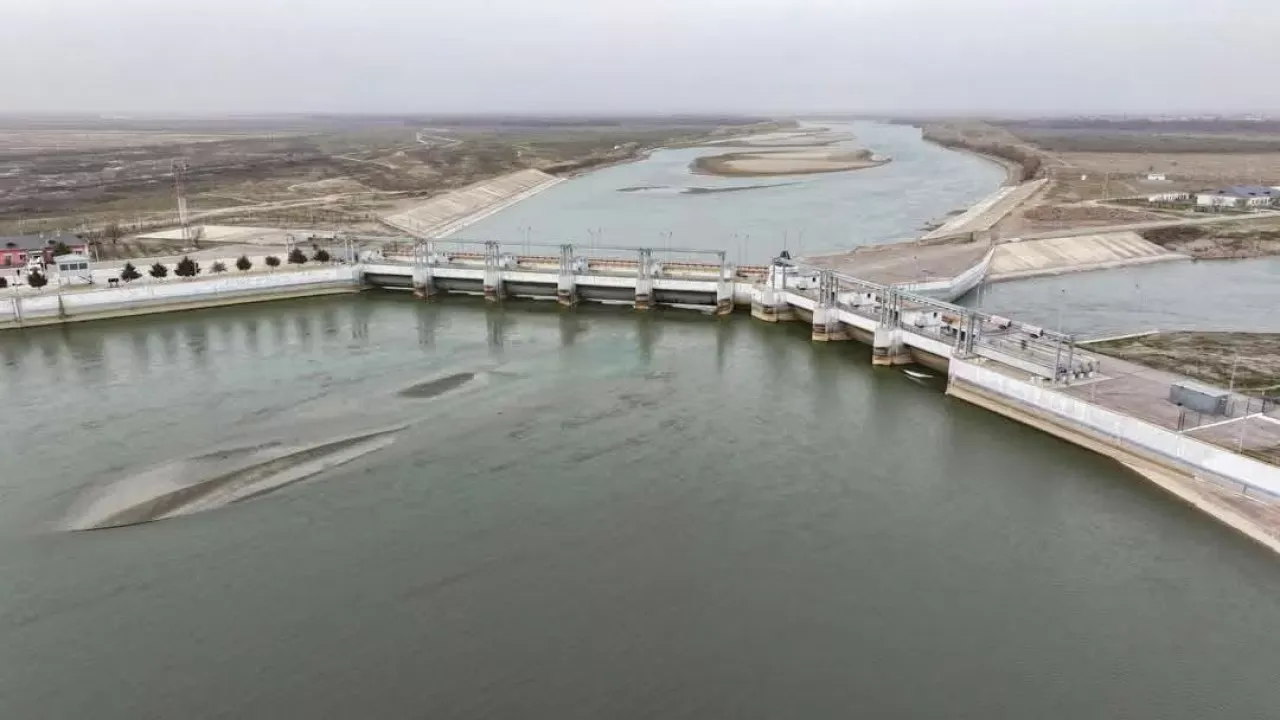
Example: Canal in the Talgar district of the Almaty region

3.2. Fragmented management
- The management of irrigation infrastructure in Kazakhstan is fragmented: Kazvodkhoz is only responsible for part of the main canals, while on-farm and inter-farm networks are under the jurisdiction of akimats, municipal enterprises, and water user associations.
- There is no unified technical cadastre or digital platform where the technical condition of canals can be tracked along with the organizations responsible for their maintenance.
- This leads to conflicts between structures, a lack of coordination in planning repairs, and difficulties in accounting for efficiency.
- Reports from the Accounts Committee also indicate that some funds allocated for modernization were distributed through local bodies without coordination with central services, which duplicated costs and reduced overall effectiveness.
3.3. Corruption and fictitiousness
- According to the Supreme Audit Chamber, in 2023 alone, five heads of Kazvodkhoz were held accountable for financial violations in the disbursement of budget funds.
- In the Almaty region, cases of fictitious reconstruction of irrigation canals were recorded, where contractors reported work that was not actually performed.
- In the Mangystau region, cases of embezzlement of budget funds by Kazvodkhoz officials were identified during the implementation of irrigation projects (fbrk.kz).
- In Southern Kazakhstan, according to media reports and investigations, there were instances of cronyism and the appointment of relatives to key technical positions in Kazvodkhoz branches.
- In the Almaty region, the director of a Kazvodkhoz branch hired relatives bypassing competitions, which was accompanied by violations in the distribution of contracts and the acceptance of work.
3.4. Lack of monitoring
- As of the publication date (March 2025), there is no mandatory practice for compiling, maintaining, and regularly updating technical passports for irrigation facilities, making it impossible to track their actual condition over time.
- State bodies have still not implemented a full-fledged monitoring system that includes measurable KPIs: reduction of water losses, increase in irrigation efficiency, level of automation and digitalization, and the physical condition of canals 1–3 years after reconstruction.
- Mechanisms for collecting feedback from farmers and water users are absent or have no legal weight, which limits the identification and resolution of problems on the ground.
- Reporting is reduced to formal acts of work completion without verification of results: data on the actual efficiency of canals before and after reconstruction, water savings, or cost reduction per hectare are not published at either the national or regional level.
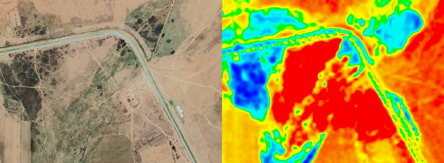
- Illustrative cases (including the Ordabasy district, Zhetysu, and the Almaty region) demonstrate that one or two years after the completion of work, canals either fall into disrepair again or never actually functioned properly, despite official reports of commissioning. (including the Ordabasy district, projects in Zhetysu) confirm that there is no control over the long-term effect of modernizations.
Example: Thermal satellite imagery clearly shows multiple leaks in a repaired canal in the Turkestan region
4. Losses and efficiency: What the data shows
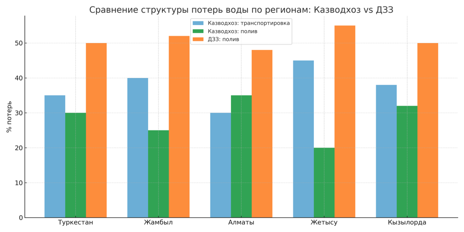
According to the EDB report "Central Asia: Irrigation Reset. Efficiency, Sustainability and Water Resources Management" (Eurasian Development Bank, 2023), the main part of water losses in irrigated agriculture in Central Asia occurs not in main canals, but in the irrigation process itself in the fields. This is also confirmed by our analysis of satellite data (remote sensing): in most regions, actual water consumption is close to Kazvodkhoz calculations, but the main share of losses (up to 2/3) occurs precisely at the field level. This underscores the need to focus not only on canal reconstruction but also on modernizing irrigation methods themselves and introducing modern water-saving technologies.
Example: Comparison of Kazvodkhoz data with remote sensing data
4.1. Adoption of water-saving technologies
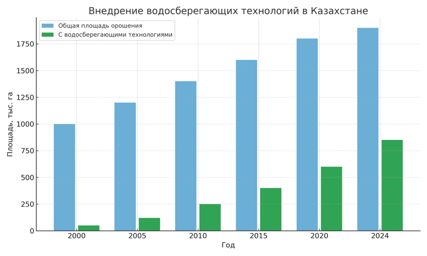
According to official data at the beginning of 2024, the area covered by water-saving technologies (drip and sprinkler irrigation) is about 851 thousand hectares, which is equivalent to approximately 30% of the country's total irrigated area.
However, this figure includes everything installed over the last 15–20 years, without breakdown by degree of actual operation, efficiency, or system condition.
Furthermore, there is no open calculation methodology — lists, maps, or technical passports by region are not published, which limits verification and control over the actual functioning of these systems.
4.2. Canal length: Plans, acts, reality
Over the past two decades, Kazakhstan has consistently announced major plans for the reconstruction of irrigation canals. According to official data, since 1994, the reconstruction of over 14,000 km of irrigation network has been announced. However, as of 2024, according to audit checks, no more than 6,000 km are actually functioning.
This discrepancy is due to several factors:
- Lack of independent control and verification of completed work;
- The practice of fictitious repairs and formal disbursement of funds;
- Accounting based on "acts," not on actual functionality;
- Unreasonably inflated volumes in reporting to improve indicators.
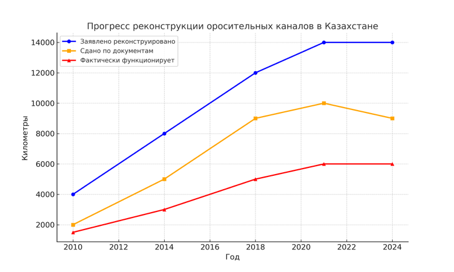
Example: Comparative analysis of the gap between plans, formal acceptance acts, and actually functioning facilities.
5. New investments: Why is trust at risk?
The Islamic Development Bank has announced the allocation of $1.15 billion for water sector projects. But given a 30-year history of: a) systemic failures, b) corruption scandals, and c) weak control and lack of transparency, there are no guarantees that these funds will not be squandered according to the same pattern. Passports, tenders, and control mechanisms are absent from the public domain.
6. Strategic recommendations
- An online monitoring platform and passports for all facilities.
- External independent audit — a mandatory element of all new projects.
- Implementation of clear KPIs: loss reduction, productivity increase, automation share.
- Separation of Kazvodkhoz functions: operation must be separated from investment; the current system encourages hiding failures.
- Publication of facility efficiency before/after modernization.
Related materials: how much water Kazakhstan loses due to corruption and carelessness

Comments ()