Another major European river has shrunk to a record low.
The list of major European rivers hitting historic lows this summer keeps growing. This time, the Po—Italy's largest river, supplying the industrial north and the famed Food Valley around Parma—set a new record.
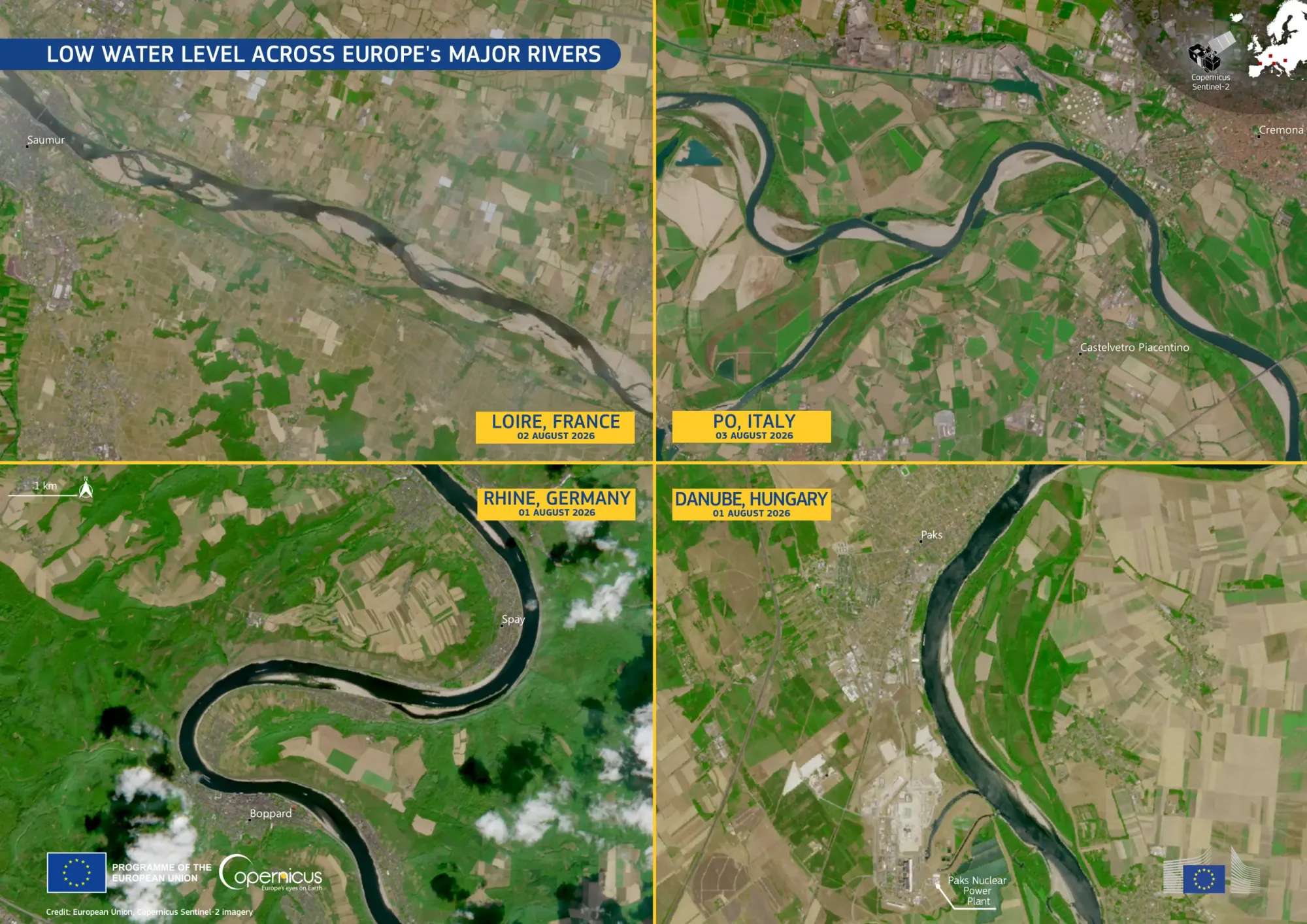
The problem has long since exceeded the boundaries of a single river basin: the Thames, Rhine, Danube, and Rhône are simultaneously at record-low levels.
In brief
- The Po River Basin Authority reports that water flow is significantly below seasonal averages, and at several gauging stations levels are approaching or exceeding the record drought marks of 2022 — on July 30 near Cremona, the river dropped 1 cm below the previous record, and flow fell to less than a third of the norm.
- The extremely low level is already affecting water supply: the Ansa agency reports water being delivered by tanker trucks to more than 100 municipalities in Piedmont and Lombardy.
- According to an AFP analysis based on Copernicus data, July water flow hit the lowest minimum since 1992 for several major rivers at once: 95% of monitored Thames sections, 85% of the Rhine, and about two-thirds of the Danube showed record-low discharge; the Rhône has shrunk along 30% of its length, and the Po along 40%.
- In the rice-growing region of Lomellina, authorities warn that without significant rainfall the situation could worsen, and farmers will have to rely increasingly on groundwater and emergency measures.
One river — many consequences
The shallowing of the Po is hitting several sectors of northern Italy's economy at once. At its confluence with the Ticino River, boats now sit in shallow murky water amid sand and gravel bars, while near Pavia the channel has narrowed to a shallow stream, hindering pleasure craft and rowing clubs. Downstream, around Parma, the tributaries and irrigation canals supporting intensive fruit and vegetable farming are drying up — farmers already report water-saving regimes affecting irrigation schedules. In Turin, the river has become a slow-moving channel covered in a carpet of algae, and municipal services have to clear aquatic vegetation using excavators on barges.
A continental-scale problem
The Po is far from the only victim of this summer. Satellite images from Copernicus Sentinel-2, taken in early August, recorded extremely low levels on four of Europe's largest rivers at once — the Loire in France, the Po in Italy, the Rhine in Germany, and the Danube near Hungary's Paks Nuclear Power Plant. On the Rhine, low water levels are already restricting freight traffic and disrupting industrial supply chains in Central Europe. It was against the backdrop of this same wave of abnormal heat that the Netherlands imposed water-use restrictions, while on the Danube Romania blasted rocks from the riverbed to save its nuclear power plant, and Hungary's Paks NPP, in the same satellite image, showed serious problems cooling its reactors due to the Danube's low flow — all these episodes can now be seen not as separate national stories but as manifestations of a single continental hydrological crisis.
Author's conclusion
When record-low water levels are simultaneously reported from Britain, Germany, France, Italy, Romania, and Hungary, it ceases to be a coincidence of individual countries' climatic conditions and becomes evidence that the entire river system of the continent has faced a burden it was not designed for. For readers following the topic of water security in Kazakhstan and Central Asia on hunn.kz, the European summer of 2026 is a rare opportunity to see how quickly a local drought on one river can escalate into a problem affecting energy, shipping, agriculture, and drinking water supply across several countries at once.



Comments ()