Australia culls chickens after bird flu outbreaks
Australia culled 2M chickens on farms across multiple states after bird flu detection. Under safety protocols, entire flocks are euthanized. This caused egg shortages in NSW, Victoria, and the ACT since June 9.
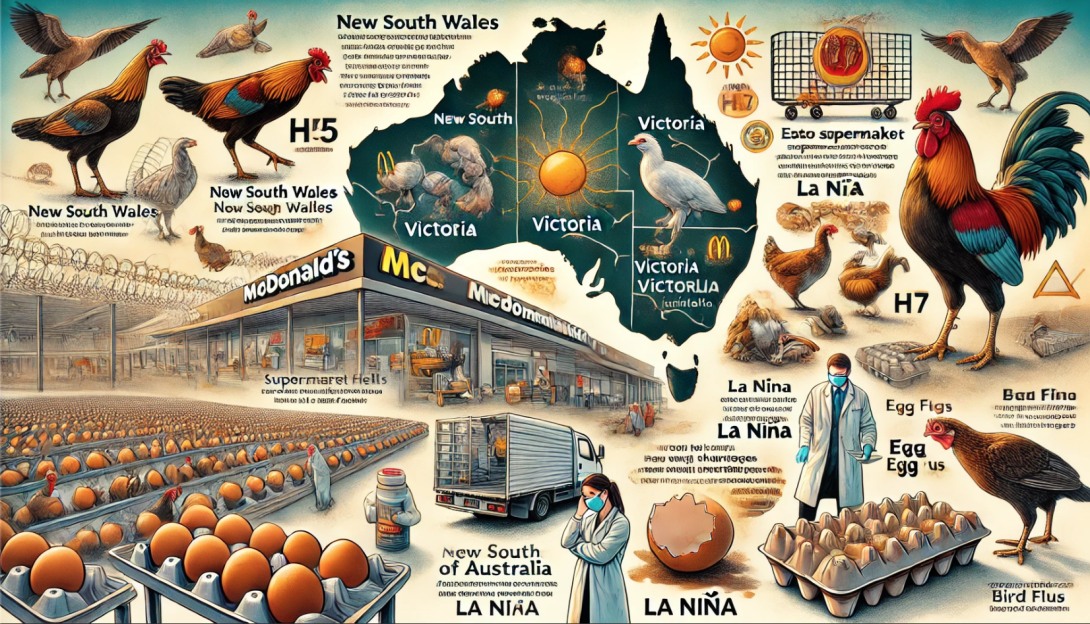
In Australia, 2 million chickens have been culled on poultry farms across several states. According to their safety protocols, if avian influenza is detected, the entire flock is "subject to euthanasia."
As a result, there is a shortage of chicken eggs on store shelves in New South Wales, Victoria, and the Australian Capital Territory.
Since June 9, many retailers in all states except Western Australia have introduced purchase limits.
McDonald's has shortened its breakfast hours from 12:00 PM to 10:30 AM.
All farms where the chickens were culled are free-range farms. However, while Mexico reports H5N2 — a new strain of H5N1 — in Meredith (western Victoria), the strain was H7N3, and in Terang, it was H7N9, linked to the infection in Meredith. Meanwhile, in the Australian Capital Territory, the strain is H7N8, which was also detected on two farms in June in the Greater Sydney Basin.
Australian scientists have already established a direct link between avian influenza outbreaks and the La Niña effect (an oceanic and atmospheric phenomenon). This was the case in 2020, 2021, and 2022.
But the most interesting point is made by Parwinder Kaur, Associate Professor at the University of Western Australia and Director of DNA Zoo Australia: if H5N1 reaches the population of Australian wild birds at the same time that H7 viruses are circulating, there is a risk that the two strains could mix within the poultry flock. And if two strains infect the same bird simultaneously, a so-called "antigenic shift" could occur, meaning the creation of a new virus strain.
Autumn is expected to be interesting…


Comments ()