Austrian engineers create solar panels that fold during storms and generate 40% more energy
Engineers at Graz University of Technology developed FLAPTrack, a solar panel system that tracks the sun on two axes and automatically folds up when a storm or hail approaches.
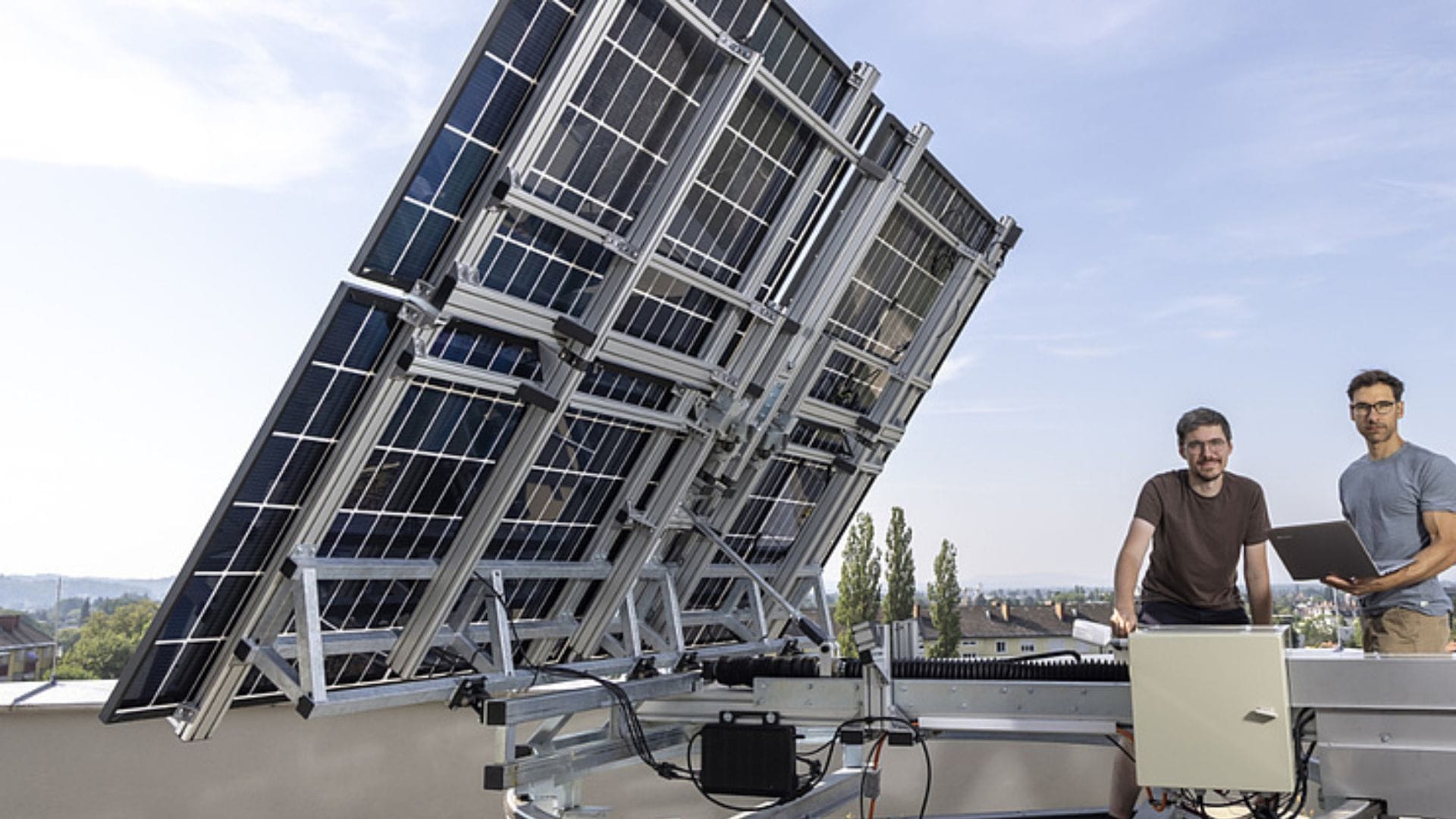
On average, the installation generates 40% more energy than fixed panels, and on the most favorable days — 56%. A working prototype with a capacity of 1.8 kWh is already operating on the roof of a campus in Graz, reports Interesting Engineering. For Kazakhstan, with its steppe winds, hail, and actively developing solar generation, this is a technology deserving the closest attention.
The Gist
- The FLAPTrack system from Graz University of Technology (Austria) tracks the sun's movement both horizontally and vertically, constantly keeping the panels at a 90° angle to the rays.
- Output increase averages 40%, and on the best days — 56% compared to stationary panels. In the morning and evening — during peak consumption periods — output exceeds traditional systems by more than double.
- When a storm, hail, or snowfall approaches, the panels automatically fold face-to-face and lower: wind load is reduced, and silicon wafers are protected from hail impacts — the main cause of "hot spots" that reduce efficiency.
- The folding mechanism simultaneously clears snow from the panels without manual intervention.
- The system receives weather data from local weather stations and regional forecast models — the solution is fully autonomous.
Why the Angle of Incidence Matters
Standard solar panels are installed at a fixed angle — typically optimal for the latitude at noon in mid-year. In the morning, evening, winter, and at high latitudes, the sun is much lower, and rays hit the panels at an acute angle — some light is reflected, some is scattered, and output drops.
Sun-tracking systems have long been known in the industry, but most commercial systems use single-axis rotation — horizontal. FLAPTrack adds a second axis — vertical: panels tilt not only left-right but also up-down following the sun. It is this dual-axis tracking that provides the maximum increase.
"In the morning and evening, when overall electricity consumption is particularly high, FLAPTrack generates more than twice as much electricity as traditional photovoltaic systems — this also helps relieve the grid," explains one of the developers, Armin Buchroithner.
A Storm Folds the Panels — Literally
A traditional vulnerability of tracker systems is their susceptibility to extreme weather: the tracker lifts the panel toward the sun, and a storm or hail strikes it directly. Large hail is the main cause of "hot spots" on silicon wafers, irreversibly reducing module efficiency.
FLAPTrack solves this conflict elegantly: the same patented linear actuator that rotates the panels to follow the sun, upon receiving a weather warning, folds them — face inward — and lowers them to the ground. In the folded state, the structure has minimal wind resistance, and the silicon is protected from impacts. An additional bonus: when unfolding after a snowfall, the mechanism automatically sheds snow from the surface.
Best in Winter and at High Latitudes
The 40% increase is an annual average. But the authors particularly note: FLAPTrack is especially effective in winter and at high latitudes, where the sun is low. This is precisely when fixed panels perform worst, and the dual-axis tracker compensates for this deficit to the greatest extent.
For regions where winter electricity consumption is high and generation traditionally drops, this is fundamentally important: the system smooths out the seasonal gap between production and consumption.
This is not the only unconventional development in the solar industry in recent months. We previously wrote about how the Swiss startup Sun-Ways successfully tested solar panels laid directly between railway tracks — without additional land and without competing with other land users. And the world's largest hybrid solar plant in the Gobi Desert already operates at night without batteries — using heat from molten salt. Solar energy is experiencing a technological surge across multiple fronts.
The Kazakhstan Context
Kazakhstan is one of the most promising markets for solar generation in Central Asia: high insolation in steppe regions, active construction of renewable energy facilities, and government support through an auction mechanism. However, the steppe conditions create specific problems: strong winds, dust storms, and large summer hail — all of which significantly affect the durability and efficiency of solar installations.
The FLAPTrack technology addresses precisely these risks: automatic protection from hail and storms combined with a 40% increase in output is a significant combination for Kazakhstan's conditions. Especially since the system is designed for high latitudes, where, as in much of Kazakhstan, the sun is low in winter.
Author's Conclusion
FLAPTrack is not just another concept on paper, but a working prototype on a real roof. The technology solves two problems that were once considered incompatible: maximizing output through dual-axis tracking and protection from extreme weather events.
The solar industry is increasingly seeking solutions beyond the standard stationary panel — and FLAPTrack fits into this trend organically. For markets with unstable weather and high winds — including the Kazakh steppe — this direction is worth monitoring as it transitions from prototype to commercial product.

Comments ()