Azerbaijan's green energy frees up gas for export — and the Caspian is getting crowded for two countries at once
Azerbaijan expands wind and solar not for climate goals but for export math: more renewables mean less gas burned domestically, leaving more fuel to sell to Europe.
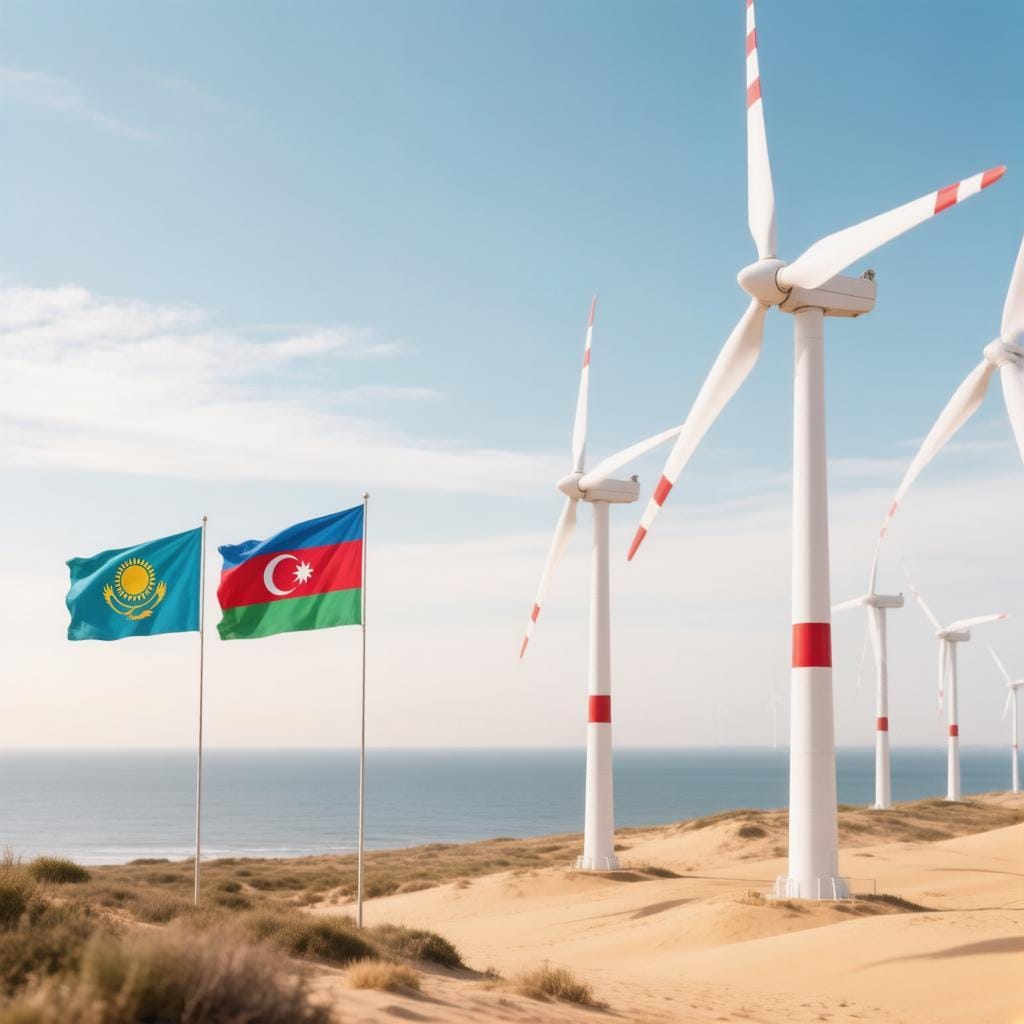
At the same time, Baku is negotiating with Astana on how to physically push growing volumes of cargo, including gas and oil, across the Caspian Sea.
The gist in brief
- In 2025, Azerbaijan exported 25.2 billion m³ of natural gas, of which 12.8 billion m³ went to Europe via the Southern Gas Corridor.
- Electricity generation from renewables in the first half of 2026 grew by almost 463 million kWh, with wind generation jumping from 21 million to 475.7 million kWh; by 2030, the country plans to commission about 6 GW of new renewable capacity.
- Kazakhstan and Azerbaijan are preparing a joint venture for dredging the Caspian Sea to expand the capacity of the Trans-Caspian International Transport Route — the Middle Corridor.
- The agreement provides for a single logistics operator, end-to-end tariffs, a single document for rail-water transportation, and the "one-stop shop" principle.
How green energy frees up gas
The mechanism described by Azerbaijan's Ministry of Energy is fairly simple: when part of the electricity is generated by wind and solar plants, thermal power plants no longer need to burn as much gas to produce the same volume as before. In the first half of 2026, thermal generation still accounted for about 79% of the country's total electricity output, but as renewables expand, this share will decline. One illustrative example is the Khizi-Absheron wind farm, which, according to government estimates, will produce about 1 billion kWh annually and save around 220 million m³ of gas. It is precisely these freed-up volumes that the country directs to exports without increasing production at the same rate, vestikavkaza writes.
Where Azerbaijani gas goes
The main supply route is the Southern Gas Corridor, through which gas flows via Turkey and then through the European gas transmission system to Italy, Greece, Bulgaria, Romania, Hungary, and Serbia. President Ilham Aliyev, speaking at the Southern Gas Corridor Advisory Council meeting back in April 2025, stated that the growth of renewable capacity by 2030 should allow more gas to be directed to exports without a proportional increase in production. For Europe, which continues to seek alternatives to Russian pipeline gas, a stable and growing flow from Azerbaijan is an important element of supply diversification.
The Caspian is too small for two countries at once
Growing gas exports are not the only reason Azerbaijan and Kazakhstan need a more passable Caspian. Both countries are preparing to create a joint venture for dredging the sea — an initiative aimed at maintaining the necessary depth in ports and ensuring stable shipping operations within the Trans-Caspian International Transport Route. Shallow waters and port siltation have long remained the bottleneck of the Middle Corridor: without constant dredging, the route's capacity is constrained not by railways or tariffs, but by the physical ability of vessels to enter the ports of Aktau, Kuryk, Baku, and Alyat.
What else is included in the agreement
In addition to dredging, the document, developed in pursuance of the instructions of the President of Kazakhstan following his visit to Azerbaijan in March 2024, covers a broader set of measures: priority servicing of liner vessels, introduction of end-to-end tariffs along the route, application of a single document for rail-water transportation, and the "one-stop shop" principle for logistics services. A separate area is the creation of a single logistics operator that will coordinate the full range of services along the transport chain, as well as the digitalization of cargo handling processes to reduce costs and increase operational transparency.
Why this matters for Kazakhstan
The Middle Corridor is one of the few land routes that allows Kazakhstan to ship goods to Europe bypassing Russian territory, and its capacity directly determines how much Kazakh raw material and products can pass along this route. Azerbaijan's logic of "green energy for gas exports" directly resonates with another project in which Kazakhstan itself participates — the "Green Energy Corridor" Caspian — Black Sea — Europe, which in July 2026 completed its feasibility study and moved to practical implementation. It is the same route across the Caspian, except instead of gas, Kazakh and Azerbaijani "green" electricity will flow along it in the future — the only realistic path for such exports to Europe, since overland lines through Russia are politically blocked. The Caspian dredging that Kazakhstan and Azerbaijan are discussing works for both of these tracks at once: both for growing cargo transit along the Middle Corridor and for the infrastructure along which an energy cable could eventually run. The connection to a more down-to-earth topic is also telling: Kazakhstan increased coal exports in the first five months of 2026 amid declining production — growth in export volumes along any commodity route sooner or later runs into the very transport and energy infrastructure that Kazakhstan and Azerbaijan are now jointly developing.
Author's conclusion
At first glance, Azerbaijan's green energy and Caspian dredging are stories from different sectors. But both are about the same thing: how the region's countries are increasing physical and energy capacity to ship more to external markets than the previous infrastructure allowed. For Kazakhstan, which together with Azerbaijan is building the Middle Corridor as an alternative to traditional transit routes, each such step by its neighbors — whether megawatts of renewables or meters of seabed deepening — directly affects the capacity of its own exports.
Comments ()