KazMunayGas creates consortium with Shell, Chevron, Sinopec and CNOOC for oil exploration in the Caspian region
Mature fields of KazMunayGas have already depleted almost 70% of their reserves.
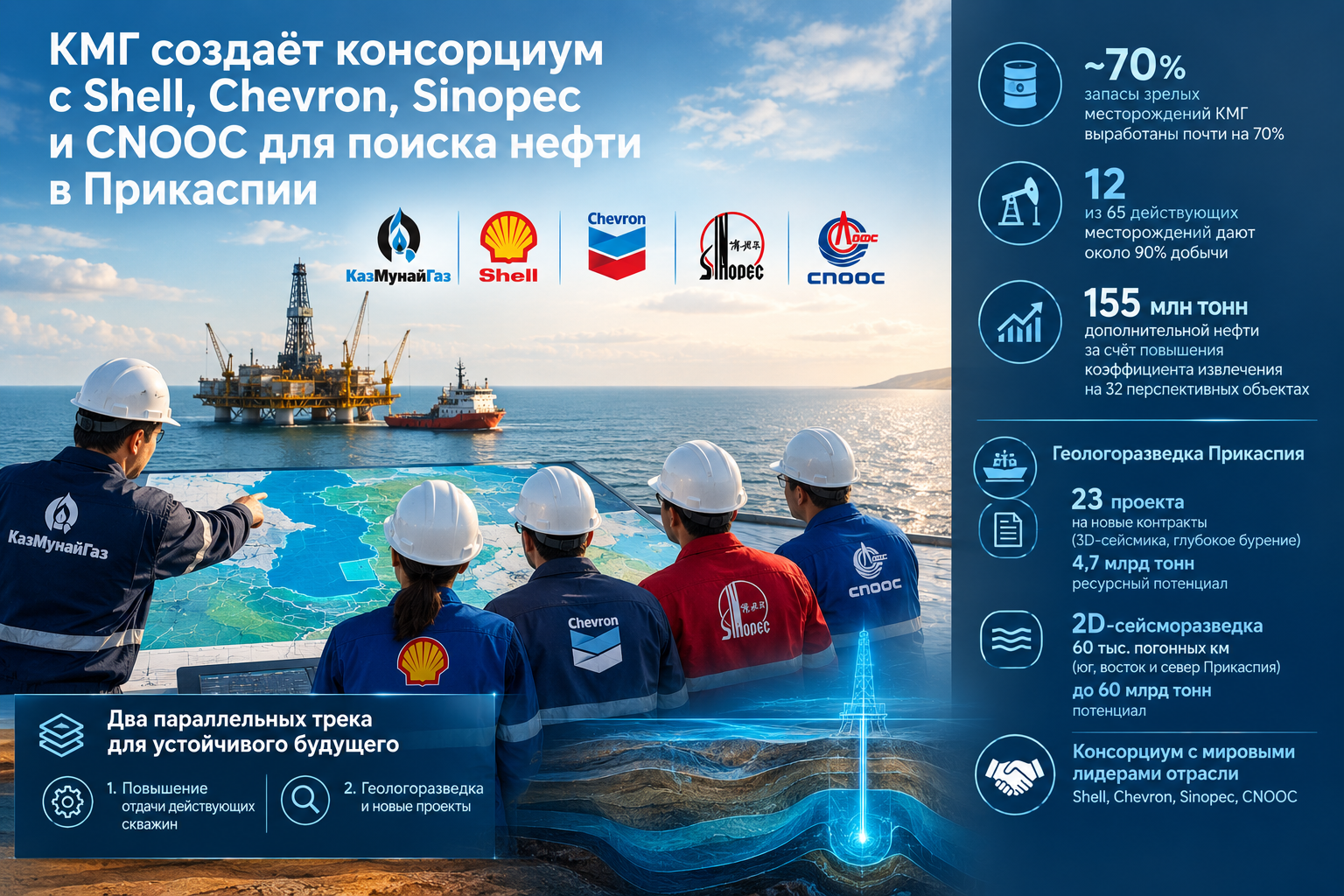
To avoid being left without a resource base for the coming decades, the national company is launching two parallel tracks at once — increasing the recovery from existing wells and geological exploration with the largest global players in the industry.
The gist in brief
- First Deputy Chairman of the Management Board of KazMunayGas Kurmangazy Iskaziyev said at the plenary session of KIOGE 2026: the mature fields of the company and of Kazakhstan as a whole have depleted their reserves by almost 70%; out of 65 operating KMG fields (excluding Kashagan, Tengiz and Karachaganak), about 90% of production comes from just 12.
- For these 12 fields, the company recorded that existing projects do not even reach the projected oil recovery factor targets — hence the new strategy, under which out of 143 objects 32 of the most promising were selected, where, through additional methods, they expect to raise the oil recovery factor above the projected level, adding 155 million tonnes of oil.
- In parallel, a geological exploration program for the Paleozoic deposits of the Caspian region is being prepared, consisting of two parts: 23 projects to obtain new subsoil use contracts (3D seismic, deep drilling) with a geological resource potential of 4.7 billion tonnes of conventional fuel, and a large-scale 2D seismic survey over 60 thousand linear km of the south, east and north of the Caspian region with a potential of up to 60 billion tonnes.
- To implement the seismic survey and subsequent deep drilling, KMG is forming a consortium with Shell, Chevron, Sinopec and CNOOC.
Why exactly 12 fields
The concentration of production in just 12 out of 65 operating fields is an indicator that explains the logic of KMG's entire new strategy. The company does not simply record the overall wear of its resource base, but names a specific technical problem: according to Iskaziyev, "under current conditions we do not even reach the projected recovery targets." This is a direct admission that existing development methods underutilize the potential of already explored reserves, and not merely the depletion of the reserves themselves as such. That is precisely why, out of 143 objects at these 12 fields, 32 of the most promising were selected for the application of enhanced oil recovery methods — targeted work on efficiency, rather than an attempt to increase production everywhere at once.
Digital twin and social context
One of the tools for this task will be a pilot project of a digital twin of the Vostochny Moldabek field — the technology is then planned to be rolled out at all 12 main operating fields. Iskaziyev separately drew attention to the social dimension of the issue: maintaining and increasing production is also important because this concerns the old districts and settlements of Western Kazakhstan, where the bulk of those employed in the oil industry is concentrated. In other words, technical solutions for increasing the recovery factor are not only a matter of the economics of subsoil use, but also of employment in specific localities that have long been tied to the operation of these fields.
International consortium for the Paleozoic
The second part of the strategy is geological exploration of new, not yet developed resources. Iskaziyev recalled that the Soviet-era Paleozoic fields of the Caspian region — Zhanazhol, Tengiz, Kashagan, Karachaganak, Urikhtau — are already held by subsoil users, meaning that a simple repetition of former discoveries should not be expected. The main emphasis of the new geological exploration is placed specifically on Paleozoic deposits, which are still less studied than the structures already being developed. For the seismic survey and subsequent deep drilling, KMG is forming a consortium with Shell, Chevron, Sinopec and CNOOC — that is, with companies representing several different jurisdictions and technological schools at once, rather than betting on a single foreign partner.
Link to oil refining plans
KMG's strategy logically complements what we analyzed at the very same KIOGE 2026 conference — the Ministry of Energy's plans to bring the country's total oil refining capacity to 39 million tonnes per year. An increase in refining capacity without a comparable increase, or at least stabilization, of raw material production volumes would quite quickly run into a shortage of feedstock for the new plants. KMG's current efforts — increasing recovery at existing fields plus geological exploration of fundamentally new resources — form the raw material side of the same equation that the expansion of Kazakhstan's refineries closes on the other side.
Author's conclusion
The direct admission about failing to reach projected recovery targets at the main fields is a rare frankness for a large national company, which, however, logically explains the scale of the measures being taken. The stated resource potentials — 4.7 billion tonnes for one part of the program and up to 60 billion tonnes for the other — are colossal, but this is specifically geological potential, not confirmed reserves: turning such estimates into actual production requires years of geological exploration, drilling and, probably, far from one hundred percent confirmation of the initial forecasts. Forming a consortium with Shell, Chevron, Sinopec and CNOOC is a practical step toward tackling this large-scale task not alone, but by combining the experience and resources of the largest global players in the industry.
Comments ()