Bangladesh Tops the Ranking of Countries by Land Irrigation — What About Kazakhstan?
While some countries rely almost entirely on artificial irrigation to feed themselves, others are steadily losing already developed irrigated land.
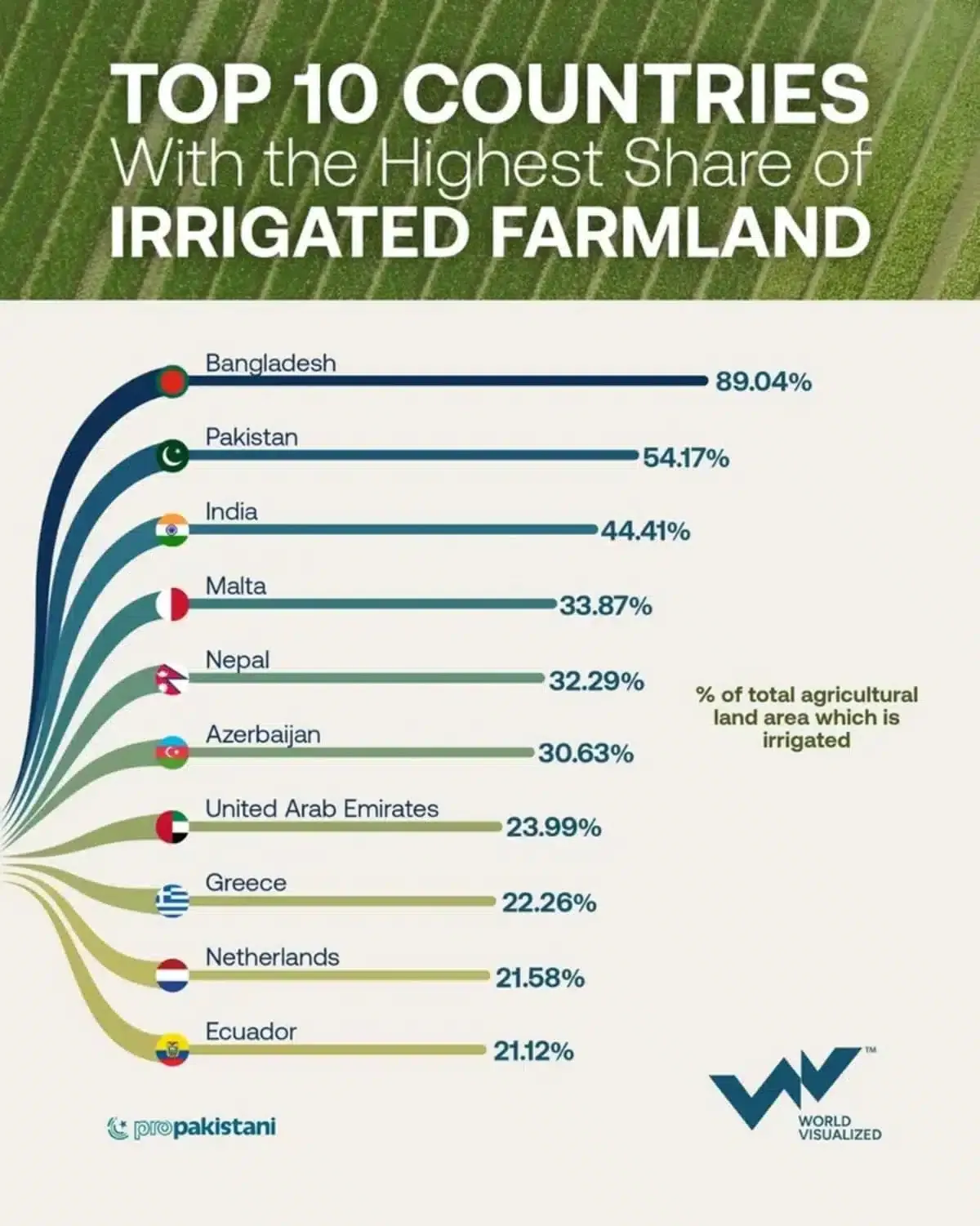
A fresh FAO ranking shows countries with a high share of irrigated land, writes NakedSciense. Kazakhstan is not in this ranking. Why? Let's try to figure it out.
The essence in brief
- According to FAO data, Bangladesh ranks first in the world by the share of agricultural land with artificial irrigation — 89.04% of all agricultural land in the country; Pakistan is second (54.17%), and India is third (44.41%).
- The top ten also includes Malta, Nepal, Azerbaijan, the UAE, Greece, the Netherlands, and Ecuador — the indicator reflects not the total volume of water consumed, but specifically the share of cropland receiving water artificially rather than only from precipitation.
- Kazakhstan is not on the list of leaders — and not because irrigation is undeveloped here, but because the country is systematically losing already developed irrigated areas: the share of such land in gross agricultural output fell from more than 30% in the early 1990s to 5–6% today.
- Of the 2.5 million hectares of irrigated land that existed in Kazakhstan at the beginning of 1991, about half has gone out of circulation by today.
Why irrigation matters at all
Artificial irrigation — the targeted supply of water to agricultural land instead of complete dependence on precipitation — is especially critical where rain falls seasonally, unstably, or in insufficient volume for intensive farming. That is precisely why South Asia ended up among the leaders in the ranking: Bangladesh, Pakistan, and India are simultaneously among the countries with the highest share of irrigated land, which reflects the critical role of artificial watering for regional crop production. At the same time, a high share of irrigation does not automatically mean a larger total water consumption — a small country can irrigate a significant part of its land while consuming noticeably less water than a large power with large-scale agriculture.
The Kazakh version of the same problem — only in reverse
The difference between the ranking leaders and Kazakhstan is fundamental: some countries are expanding irrigation to feed a growing population, whereas Kazakhstan is losing the Soviet irrigation infrastructure it has already created. The reason is not a single decision, but the sum of factors that we have already examined separately. On-farm canals serving individual farms inherited Soviet legal uncertainty and for years remained without a clear owner and a system for financing repairs — that is precisely why the Ministry of Water Resources proposes uniting farmers into irrigation condominiums modeled on Spanish "irrigator communities," where unproductive water losses in worn-out canals reach 50% of the water intake volume.
Four directions of one policy
At the same time, the state is working on the problem from several sides at once. For strengthening water-saving technologies and modernizing irrigation infrastructure in 2026–2028, 214.6 billion tenge is allocated — with an increase in the share of reimbursement of farmers' expenses from 50% to 80%. Recently the National Information System of Water Resources, put into commercial operation, should provide an accurate picture of the state of water bodies, without which any reforms remain largely speculative. And a separate initiative — cutting the tax on groundwater extraction for farmers by almost fivefold — is trying to relieve scarce surface sources at the expense of groundwater reserves that are practically unused today, of which only about 3.6% is utilized.
Author's conclusion
The FAO ranking by the share of irrigated land illustrates well that for Kazakhstan the question is not "how to build irrigation from scratch," but "how to stop its thirty-year decline and reverse the trend." The four directions of reform — a new ownership model for canals, subsidies for water-saving technologies, digital accounting of water resources, and cheaper groundwater — attack the problem from different sides simultaneously, which in itself is encouraging. But all four initiatives share a common feature: none has yet been completed, and some — such as irrigation condominiums — are supposed to start working only by 2027. The real answer to the question of whether Kazakhstan will manage to return to the indicators of the early 1990s will be not the fact that these reforms were launched, but the concrete statistics on irrigated areas in a few years.


Comments ()