China controls almost 60% of global electronics production
One region makes almost all the tech the rest of the world uses, from smartphones to circuit boards.
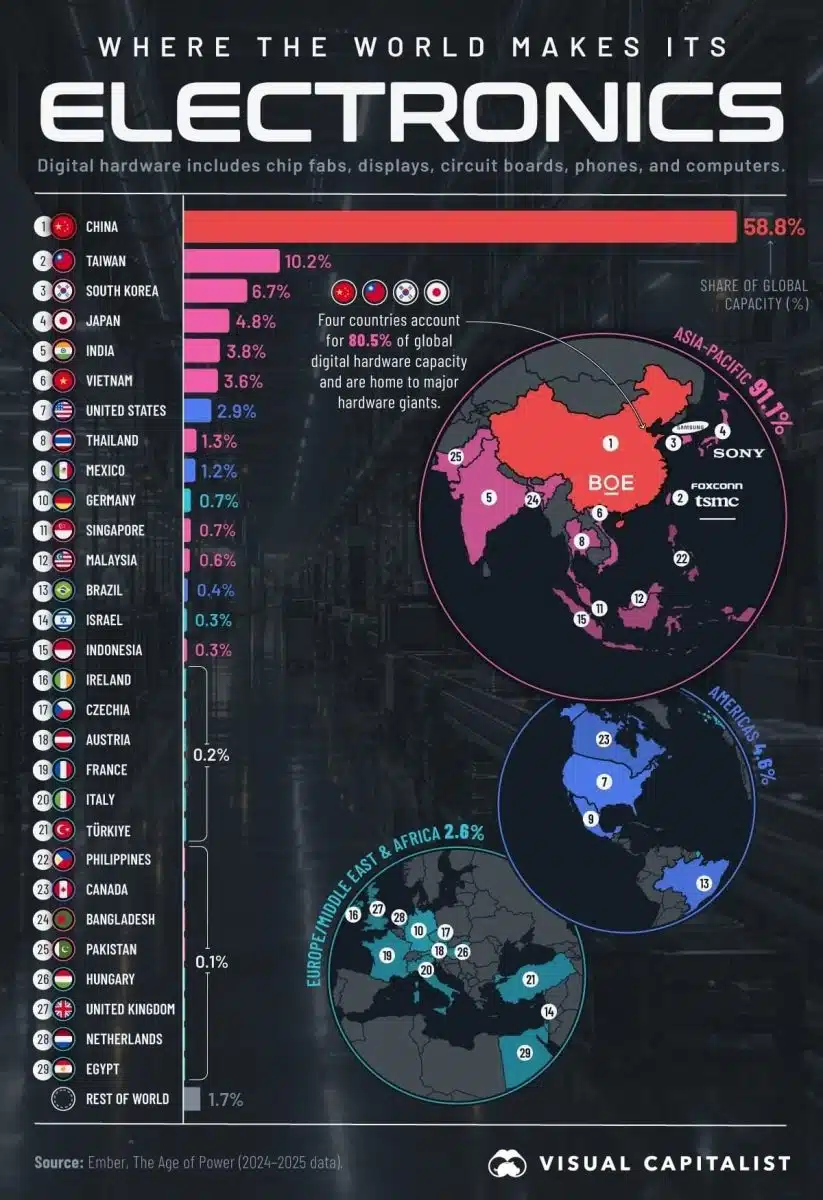
A new ranking shows just how concentrated this industry is around a handful of East Asian countries, writes Naked Science.
The gist in brief
- According to the organization Ember, based on statistics for 2024–2025, China accounts for 58.8% of global manufacturing capacity in the digital technology sector — almost six times more than second-place Taiwan (10.2%).
- Another 21.7% of global capacity comes from Taiwan, South Korea, and Japan — meaning the four leading East Asian countries together account for 80.5% of all global electronics production.
- Outside the top four, fifth place goes to India (3.8%), followed by Vietnam (3.6%) and the United States (2.9%); the largest European country in the ranking, Germany, controls only 0.7% of global capacity.
- China continues to strengthen its position under a new five-year plan for the development of semiconductors and artificial intelligence — by 2030, the country plans to bring the combined operating revenue of related industries to $4.5 trillion.
Why these four countries in particular
Each of the leading countries occupies its own specific place in a single production chain rather than duplicating the functions of its neighbors. Taiwan is one of the world's largest centers for semiconductor manufacturing and electronics assembly, South Korea specializes in the production of semiconductors and displays, and Japan has a long-established, mature electronics industry. Together, these economies form a dense regional chain — from the manufacture of semiconductors and electronic components to the assembly of finished devices — and the headquarters of the world's largest companies in the industry, such as TSMC, Samsung, and Sony, are located right here.
Production share is not the same as profit share
An important methodological caveat worth keeping in mind when reading rankings like this: the indicator reflects manufacturing capacity specifically, not who ultimately receives the added value from the devices produced. A significant portion of the electronics physically assembled in China is produced on order and under the brand of companies from other countries — meaning a high share of manufacturing capacity does not automatically equal the same share of profit from the sale of finished devices. The position of the United States in the ranking is also telling — the country ranks only seventh by volume, but it holds this position not through the scale of assembly production, but thanks to the output of the most advanced and high-margin products.
The link to Kazakhstan's critical minerals cluster
This entire production chain, concentrated in East Asia, begins not with chips and displays, but with raw materials — rare and critical metals, without which modern electronics are simply impossible. We have already written repeatedly about how Kazakhstan is building its own role as a supplier of such raw materials — from tungsten, which has entered the world's top three by extraction, to plans to move from simple export of rare earth raw materials to processing it within the country. It is precisely at the intersection of these two pictures — the global concentration of finished electronics production in Asia and Kazakhstan's growing extraction of critical minerals — that the logic of Kazakhstan joining the global technology alliance Pax Silica becomes clear: the country is betting not on competing with already established manufacturing giants like China or Taiwan, but on securing its position specifically in the raw materials link of this very same global supply chain.
Author's conclusion
The Ember ranking clearly shows just how concentrated modern electronics manufacturing is around a relatively small number of East Asian countries — a concentration that is unlikely to be changed to any noticeable degree in the foreseeable future, given the scale of the production ecosystems, infrastructure, and specialized competencies already accumulated in the region. For countries like Kazakhstan, this means that a realistic strategy for participating in the global electronics industry lies not in trying to compete for a share of assembly production, but in strengthening its position where competition is not yet so total — in the extraction and processing of raw materials, without which this production chain itself simply cannot function.
Comments ()