China is building the world's largest hydropower plant — three times more powerful than the Three Gorges
A construction project in southeastern Tibet is set to triple the capacity of the world's largest operating hydropower station.
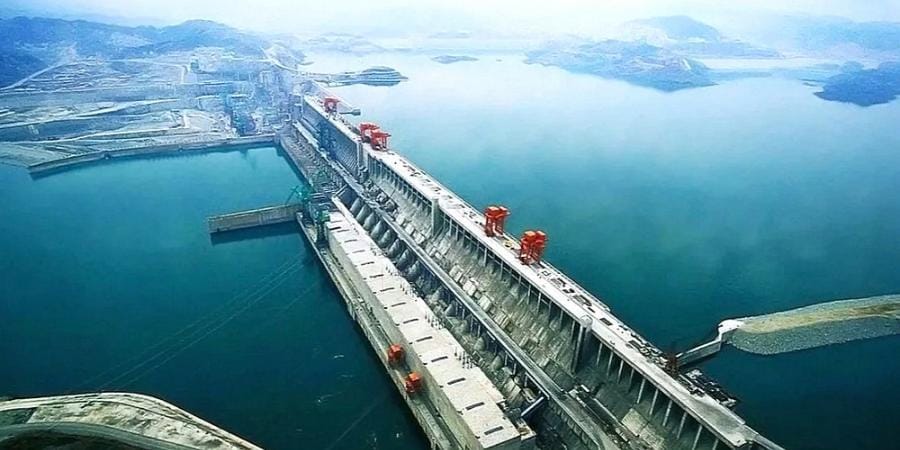
Behind the project's energy metrics lies a far more complex geopolitical context, writes Wprost.
The gist in brief
- China has begun construction of a hydroelectric power station on the Yarlung Tsangpo River in the Great Bend area in southeastern Tibet — along a stretch of about 50 km the river loses more than 2,000 meters of elevation, which provides unprecedented hydropower potential.
- The station's capacity is expected to be three times that of the already operating Three Gorges Dam on the Yangtze, and annual generation is estimated at about 300 billion kWh — enough to supply all of Tibet with a surplus that will be sent via power transmission lines to the industrial provinces of eastern China and the growing data centers for artificial intelligence.
- Construction is underway in Medog County — on the disputed border with India; through the system of dams, China will gain the ability to regulate water flows going to India and Bangladesh, holding back water in the dry season or releasing it rapidly during the monsoons.
- Due to the complexity of the terrain and engineering challenges, the entire cascade is planned to be built over about 10 years, with individual facilities being commissioned in stages in the 2030s and the start of commercial operation in 2033.
Energy not only for Tibet
The project addresses several tasks at once. Tibet is a strategically significant region for Beijing precisely because of its border with India, and reliable energy supply here has separate political value. But the surplus generated energy will also go via modern long-distance power transmission lines to the country's industrially developed eastern provinces, as well as to power the rapidly growing data processing centers for artificial intelligence — that is, the station fits into the same logic that we have already observed in relation to other Chinese energy projects, where the growing demand of AI infrastructure is becoming one of the key drivers of new generating capacity.
The issue of water resources for neighbors
The station's location adds an additional dimension to the project — control over the water resources of a transboundary river. The Yarlung Tsangpo, originating in Tibet, flows onward through the territory of India and Bangladesh, where it remains one of the main sources of fresh water for entire regions. The system of dams physically gives China the ability to regulate the flow — to hold back water in the dry season or release it intensively during the monsoons, which the Polish publication Wprost, cited by the original source, characterizes as a significant strategic vulnerability for India. No official position of the Indian or Bangladeshi sides on this specific project is provided in the material.
Real but tiny physics
The claim about the effect on Earth's rotation, featured in the headlines, is based on real calculations, but needs to be properly scaled. Back in 2005, NASA geophysicist Benjamin Fong Chao calculated: after the filling of the Three Gorges Dam reservoir — about 44 billion tons of water — the redistribution of mass slightly increased Earth's inertia, the length of the day increased by about 0.06 microseconds, and the rotation axis shifted by about 2 cm. The cumulative effect of thousands of dams around the world over recent decades is already estimated at a shift of the axis by about one meter. The effect is real and scientifically documented, but in practice completely imperceptible for everyday life — talk about it rather illustrates the scale of human intervention in the planet's geophysical processes than creates a practical threat.
The side of the same equation familiar to Kazakhstan
The dynamic that Wprost describes as a variable for India is not abstract for Kazakhstan — the country itself systematically finds itself in the position of being downstream in relation to its neighbors, including the same China. We have already written that since the beginning of 2026, Kazakhstan has conducted 38 regimes with neighboring states on transboundary water resources — 27 with Central Asian countries and 11 separately with China and China , from where other countries of transboundary rivers originate, including the Ili and Irtysh. That is, the same structural question — who and how regulates river flows through technical regulation — determines water security not only in India, but also above all for Kazakhstan, only in a negotiating rather than unilateral format.
A similar logic can be traced within Central Asia as well. We also wrote that the Amu Darya's flow in the river's course has fallen by 77%, and according to scientific research, the main cause is not climate change but irrigation water withdrawal in the middle course of the river — Kazakhstan is in a comparable position on the Syr Darya, where the water flow is determined not only by current natural indicators but also by the water policy of Kyrgyzstan and Uzbekistan upstream. The difference with the China-India case is fundamental: Kazakhstan tries to manage this vulnerability through intensive negotiating diplomacy and institutional mechanisms such as the recently created department of water diplomacy, whereas in the case of the Tibetan hydropower plant, the decision on control over the flow is made by Beijing unilaterally.
The energy context in China and Kazakhstan
The Tibetan project logically continues several trends that we have been following in the Kazakh and Chinese decade. We wrote that China has already surpassed coal in installed solar energy capacity , and the growing demand for AI data centers is becoming one of the significant drivers of the new energy landscape — it is precisely the same logic that can be traced in the Tibetan project, where surplus energy is purposefully used to power capacities. Transporting energy over long distances via modern power transmission lines is another detail that makes the project akin to the overall complex model of energy development, where large generating facilities in different regions supply industrial centers thousands of kilometers away.
Author's takeaway
The Tibetan hydropower plant is a project in which energy, geopolitical, and even geophysical aspects are intertwined more closely than in most megaprojects. With three times the capacity of the world's largest operating dam, it is capable of affecting the water supply of countries while also having, albeit microscopic, an effect on Earth's parameters — a rare combination for a single infrastructure object. The station is still at the beginning of a decade-long construction phase, but it is already obvious that its significance will go far beyond energy statistics.

Comments ()