China launches data center for 1 million AI accelerators powered by renewable energy
Envision Energy has launched a computing campus that redefines data center construction logic.
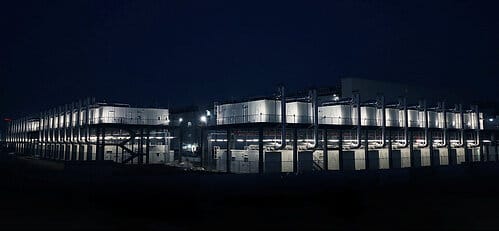
Electricity is not supplied to an already designed building; it is embedded in the project from the very beginning as an equal part of the architecture. Galaxy Campus in Inner Mongolia is designed for one million AI accelerators — and this entire volume must be powered directly from renewable sources.
The gist in brief
- Envision Energy has commissioned the computing campus Galaxy Campus in Ulanqab, Inner Mongolia — a facility covering 120,000 m², designed for 1 million AI accelerators and 1 million PFLOPS of computing power.
- In the long term, the campus capacity should exceed 2 GW — the level of a large industrial facility; it receives electricity directly from renewable sources through its own AI Power System.
- The company claims performance per square meter that is 10 times higher than that of conventional data centers.
- The project is part of the broader Envision Mission Gobi initiative, which envisions creating 5 GW of "green" computing capacity in desert and arid regions worldwide by 2030.
A data center designed around energy
Envision AIDC General Manager Ricky Zheng explained the project's logic:
"To power one million accelerators, a specially designed AI Power System is required, which combines renewable energy generation, specialized power transmission infrastructure, and large-scale energy storage to ensure stable and low-cost 'green' electricity."
According to Ricky Zheng, the next frontier in AI development is precisely infrastructure: as models grow, the limiting factors are increasingly not algorithms but electricity availability, grid performance, and energy efficiency. That is why Envision designs the campus's energy and computing components as a single system from the outset, rather than adding power supply to an already completed data center building.
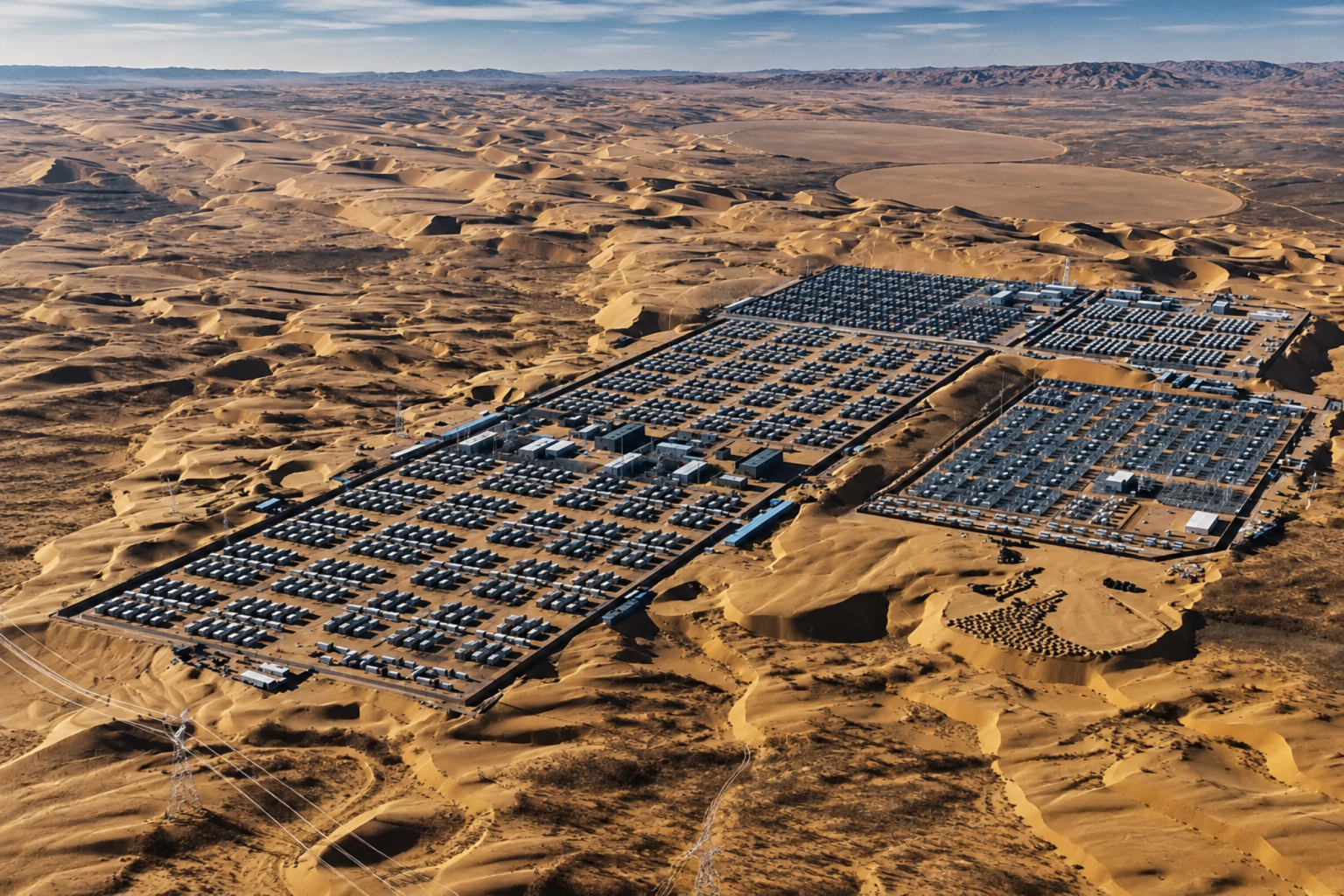
Why desert Inner Mongolia
Ulanqab has already become a major hub for China's digital infrastructure — regional grid capacities are designed to support large computing clusters requiring high-speed, low-latency networks. The location gives the project direct access to the region's wind and solar resources: instead of treating electricity as a separate external resource, the company directly integrates renewable energy generation and its management with computing infrastructure on a single site.
Part of a global strategy
Galaxy Campus is not a standalone experiment but part of the Envision Mission Gobi initiative, presented at the VivaTech exhibition in Paris in June 2026. It envisions creating 5 GW of "green" computing capacity in desert and arid regions worldwide by 2030 — meaning the company intends to replicate this very model, combining large-scale renewable generation with AI computing, beyond a single country.
Why this matters for Kazakhstan
The Envision model is a direct substantive alternative to how Kazakhstan is building its own "Data Center Valley" in Ekibastuz: the same principle of large-scale computing infrastructure, but based on the opposite energy source — coal-fired generation from the Ekibastuz GRES instead of renewables. Both approaches solve the same problem — providing sufficient and predictable power supply for the growing demand for AI computing — but the choice of energy base determines how attractive the project will be to international technology companies with their own climate commitments. A similar logic of combining solar generation with industrial facilities is already familiar from Chinese projects in Tibet and the Gobi Desert, which we have covered previously — Envision Mission Gobi continues this line, but specifically applied to computing infrastructure rather than conventional industrial production.
Author's conclusion
Galaxy Campus shows where the data center industry is heading as artificial intelligence's appetite for electricity grows: instead of connecting computing clusters to the existing grid and hoping for its stability, major players are beginning to build generation, storage, and computing as a single system from scratch. For Kazakhstan, which is also betting on becoming a regional AI hub, this is a benchmark for the future — the moment when a data center's energy model becomes no less significant a competitive factor than its computing power.

Comments ()